
.svg)
SIGN UP FOR JUICEBOX (IT’S FREE!)

Who are you looking for?
Thank you! Your submission has been received!
Oops! Something went wrong while submitting the form.

Employee referrals are consistently the top source for high-quality hires. Referred candidates onboard faster, perform better, and stay longer. A 2022 Zippia study found that referral hires have a 46% retention rate after one year, compared to 33% from career sites. Despite this, most referral programs are an afterthought: a dusty policy with a generic cash bonus that fails to inspire action.
The result is a massive missed opportunity. Your most powerful, cost-effective hiring channel is likely underperforming, leaking top-tier candidates you could have hired weeks ago. But there's a problem most tools ignore: a bigger bonus isn't the fix. The solution is a better-designed system. This is where a deep dive into successful employee referral program examples becomes critical for any scaling company.
This guide breaks down the mechanics behind 8 innovative referral models from companies like Google, Stripe, and Ramp. We’ll dissect the specific strategies, reward structures, and rollout tactics that make them work. You'll get actionable frameworks to move beyond generic templates and build a referral engine that actually drives results.
We will also explore how to amplify your efforts by integrating modern AI sourcing tools. For instance, platforms like PeopleGPT can help your team proactively source and validate potential referrals from your employees' extended networks, dramatically expanding your talent pool and accelerating the verification process. Forget passive programs; it's time to build an active talent pipeline with these employee referral program examples.
Google’s approach to referrals is legendary, not just for its significant financial rewards but for its unwavering commitment to quality. The model is simple on the surface: offer substantial cash bonuses, ranging from $2,000 to over $15,000, for successful hires. However, the true genius of this system is that the money only gets a candidate's resume to the top of the pile; it doesn’t lower the hiring bar.
Here’s the deal.
Referred candidates must still navigate Google’s famously rigorous interview process. This "high-incentive, high-bar" combination ensures the company gets the best of both worlds. The high incentives motivate employees to actively mine their networks for top-tier talent, while the high bar guarantees that only elite candidates who meet Google's standards make it through. This structure has consistently made referrals Google’s single most effective hiring channel, particularly for sought-after engineering roles. For more insights on scaling your tech hiring, check out our guide on the best sourcing tools for recruiters.
This model is one of the most powerful employee referral program examples because it perfectly balances quantity and quality.
Key Insight: The high bonus isn't just a payment; it's a signal. It tells employees that the company values their network and trusts their judgment, but it also reinforces the prestige and difficulty of joining the company, making them more selective about who they refer.
Dropbox’s referral program is a masterclass in prioritizing long-term success over short-term hiring velocity. While they offer competitive monetary bonuses, typically ranging from $1,000 to $5,000, the program’s core philosophy is built on the belief that current employees are the best predictors of cultural alignment. The financial incentive gets the conversation started, but the real filter is whether the referrer genuinely believes the candidate will thrive within Dropbox's specific values and work environment.
This "culture-first" approach delivered quantifiable results. Dropbox shared that hires from referrals had a 30% higher retention rate and performed better on team dynamics metrics. By empowering employees to act as cultural gatekeepers, the company builds teams that are not just skilled but also cohesive and deeply engaged. This strategy has proven so effective that referrals consistently account for over 40% of their engineering hires, demonstrating its power in building a sustainable and high-performing organization. This focus on long-term fit can also help avoid issues like malicious compliance down the line.
This model is one of the most insightful employee referral program examples for companies focused on sustainable growth and reducing churn. It codifies the idea that a great hire is about more than just skills on a resume.
Key Insight: The bonus is a reward for finding a match, not just a candidate. By framing the program around cultural stewardship, you shift the employee’s motivation from a transactional "who do I know that needs a job?" to a more strategic "who do I know that belongs here?" This subtle shift dramatically improves the quality and long-term success of referrals.
Airbnb transformed its referral strategy by looking beyond its direct employees and tapping into its broader ecosystem. Instead of a closed system, they built a community-driven model that invites contractors, partners, and other stakeholders to act as "talent ambassadors." This approach treats referral sourcing as a powerful form of community engagement, not just a transactional HR process.
The program uses tiered rewards, typically ranging from $500 to $2,000, and gamifies the experience with points, badges, and exclusive perks like early access to new features or conference passes. By doing so, Airbnb activates a massive, distributed network of advocates who understand the company culture and can identify talent that traditional sourcing might miss. This model was so effective it sourced over 30% of new hires through these ecosystem partners and helped fill over 200 positions annually through community channels alone.
This model is one of the most innovative employee referral program examples because it reframes "who" can refer, dramatically expanding the talent pool.
Key Insight: A community referral program is as much about brand building as it is about hiring. By inviting your ecosystem to participate, you reinforce their value to the company and give them a tangible stake in its success, strengthening loyalty and creating a powerful talent flywheel.
Stripe's referral program is a masterclass in aligning employee incentives with critical business metrics, specifically hiring velocity. While they offer competitive bonuses from $3,000 to $10,000, the program’s unique genius lies in its focus on speed. Stripe tracks and transparently reports on referral-to-hire cycle times, creating a system where efficiency is as valuable as the candidate's quality. This structure fundamentally redefines the referrer's role from a passive nominator to an active partner in an accelerated hiring process.
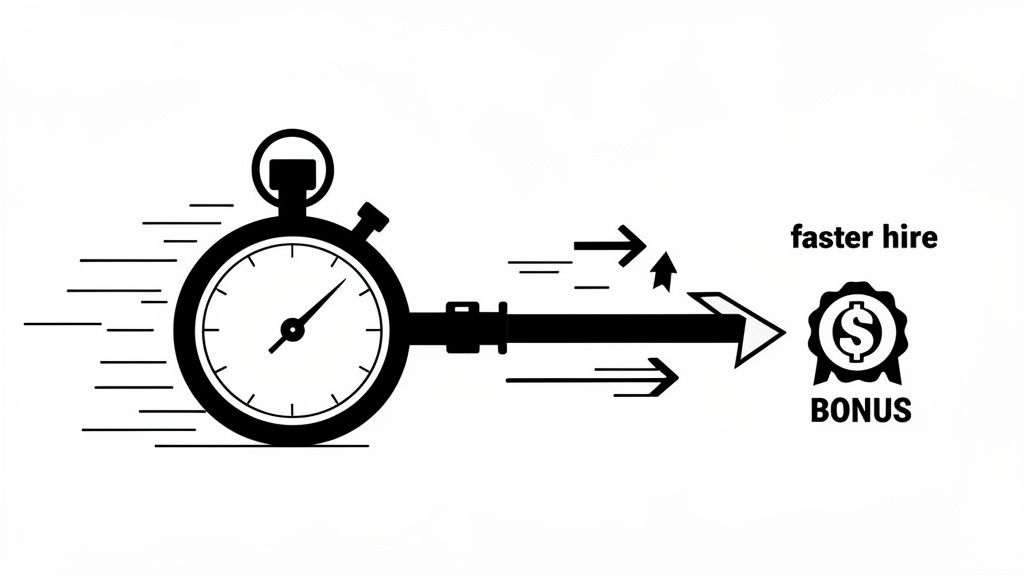
The model incentivizes employees to refer candidates who are not just qualified but are also highly motivated and ready to move through the process quickly. By making speed a key performance indicator, Stripe reportedly reduced its time-to-hire by 35% and now sources 55% of its engineering hires through this channel. It’s a powerful feedback loop: faster hires mean quicker bonus payouts and less time spent on sourcing, which ultimately lowers the overall cost per hire and fills critical roles faster.
This model is one of the most effective employee referral program examples for high-growth companies where speed is a competitive advantage.
Key Insight: Tying bonuses to speed metrics transforms the program from a passive sourcing channel into an active, high-velocity talent pipeline. It encourages employees to pre-qualify referrals for motivation and timing, not just skills, adding a layer of screening that a recruiter alone cannot provide.
LinkedIn transformed the traditional referral model by building it directly into its professional network, creating a system that operates at an unprecedented scale. Instead of relying solely on internal employees, their "Open Opportunities" feature empowers their entire user base to act as a distributed recruiting network. This dual approach combines standard internal referrals with a public-facing system where any LinkedIn member can refer their connections to open roles.
The bottom line?
The program's power lies in its seamless integration with the LinkedIn social graph. When a company posts a job using this feature, LinkedIn's algorithm identifies relevant first-degree connections of their employees and prompts them to make referrals. This turns a static job post into a dynamic, network-driven sourcing campaign. For LinkedIn itself, this model has accounted for over 30% of their hires, demonstrating its effectiveness in tapping into both active and passive talent pools through trusted network connections.
This approach is one of the most innovative employee referral program examples because it leverages technology to amplify the core principle of referrals: trust.
Key Insight: The true value of this model isn't just access to more people; it's access to the right people through warm introductions. A referral notification from a trusted connection carries far more weight than a cold InMail, significantly improving candidate response rates and creating a powerful competitive advantage.
HubSpot flipped the traditional referral model on its head. Instead of just offering a reward and asking for names, they invested in an "enablement-first" approach. This model operates on the principle that employees want to refer great people but often lack the confidence, knowledge, or tools to do so effectively. HubSpot solves this by equipping its team with a rich library of content and educational resources designed to turn them into highly effective talent scouts.
They provide referrers with everything from interview guides and job description templates to market intelligence on compensation benchmarks. After implementing this educational program, HubSpot saw referral quality improve by 40%. The program reduces friction and dramatically improves the signal-to-noise ratio by teaching employees precisely what a top-tier candidate profile looks like for any given role. This transforms the program from a passive suggestion box into an active, educated sourcing channel.
This approach is one of the most scalable employee referral program examples because it improves quality without exponentially increasing costs.
Key Insight: An enablement-first program shifts the focus from the transaction (the bonus) to the relationship (the referral). By investing in your employees' ability to identify and engage talent, you create a sustainable system that gets better over time as your team becomes more skilled at spotting a great fit.
Sequoia Capital flipped the traditional referral model on its head by creating a powerful, closed-loop ecosystem for its portfolio companies. Instead of employees referring candidates, Sequoia built a founder-to-founder network where over 500 CEOs and leaders actively source talent for each other. This transforms the referral program from an internal company initiative into a massive, interconnected talent marketplace, giving startups like Notion and Stripe a significant competitive advantage.
The model operates on mutual benefit and shared trust. A founder needing a specific role can broadcast a "talent bounty" to the entire network, and peers are incentivized to tap into their personal connections. This system has proven incredibly effective, with some portfolio companies sourcing over 40% of their key hires through this network. It dramatically shortens hiring timelines, often by a factor of 3x, by bypassing traditional sourcing channels and going straight to high-quality, peer-vetted candidates.
This approach is one of the most innovative employee referral program examples because it leverages the power of a curated, high-trust network rather than just a single company's employee base.
Key Insight: The true currency of this network isn't a cash bonus; it's social capital and reciprocity. Founders help each other because they know they will need help in return. This creates a powerful, self-sustaining talent engine built on the principle of "give and take," which is far more motivating for this cohort than a simple financial reward.
Ramp, the corporate spend management unicorn, built a lean referral machine designed for one thing: rapid, high-quality scaling. During its hyper-growth phase from Series B to C, the company created a program that blends modest cash bonuses ($500-$2,000) with more meaningful career development perks, like professional development budgets, equity grants, and clear opportunities for role progression. The core philosophy is to prioritize speed and efficiency over massive cash payouts.
This model is engineered for startups that need to scale from 50 to over 200 employees without a large, dedicated recruiting team. By keeping the process simple-often managed through a single Slack channel integrated with their ATS-Ramp sourced over 60% of its hires through referrals while adding 100+ employees in just 18 months. The system proves that for an energized, mission-driven team, the opportunity to bring in trusted colleagues and grow together can be a more powerful motivator than a five-figure check.
This approach is one of the most replicable employee referral program examples for any startup facing a steep growth curve.
Key Insight: For high-growth startups, speed is a competitive advantage. Ramp’s model focuses on a 30-day close target for referrals, which is possible only by removing friction. Simplify submissions, provide easy-to-share job description templates, and celebrate referral wins publicly and frequently in all-hands meetings to maintain momentum.
A great program combines clear incentives, minimal friction for referrers, and consistent internal communication to keep it top of mind for all employees.
Bonuses vary widely. Entry-level roles might be $500–$1,500, while hard-to-fill senior technical roles can command bonuses over $10,000.
Key benefits include higher quality candidates, lower cost-per-hire, faster hiring cycles, and improved new hire retention rates.
The journey through these employee referral program examples reveals a powerful truth: a world-class referral engine isn’t built by accident. It's a strategic asset, designed with the same intention as a product roadmap. From Google’s high-bar incentives to Dropbox’s focus on culture, each company has transformed referrals from a passive channel into a predictable, high-quality talent pipeline.
Most recruiting teams believe a bigger bonus is the key to more referrals. But the opposite is often true. The real secret isn't just incentivizing an action; it's removing friction and embedding referring into the company's DNA. This shift unlocks not just faster, cheaper hires, but a more engaged workforce that feels a deep sense of ownership in the company's growth.
Ready to build your talent engine? See how Juicebox works.
{{large_cta}}
Run your first search for free. Find and engage top talent across 800M+ profiles. Trusted by 5,000+ customers.



.png)