.svg)
SIGN UP FOR JUICEBOX (IT’S FREE!)

Who are you looking for?
Thank you! Your submission has been received!
Oops! Something went wrong while submitting the form.

Navigating the talent market often feels like being lost in a maze. Conventional sourcing methods—job boards, cold outreach—are the dead-end corridors, consuming time and yielding a flood of unqualified leads.
An employee referral program is the compass that guides you through this maze, pointing directly to pre-vetted, high-quality talent. A 2024 Zippia study found that referred candidates are hired 55% faster, confirming that this compass leads to the most efficient path.
We’ve all felt the pain of sifting through hundreds of irrelevant applications from job boards. The promise is a system that can boost your referral hire rate by over 40% by transforming employees from passive participants into strategic talent scouts.
The secret isn't just bigger bonuses; it's a smarter, technology-driven approach that makes referring talent effortless and rewarding.
Unlike generic recruiting advice, this guide provides actionable frameworks—not just theories—to build a referral system that works, using tools like PeopleGPT (by Juicebox) to unlock your team’s hidden networks.
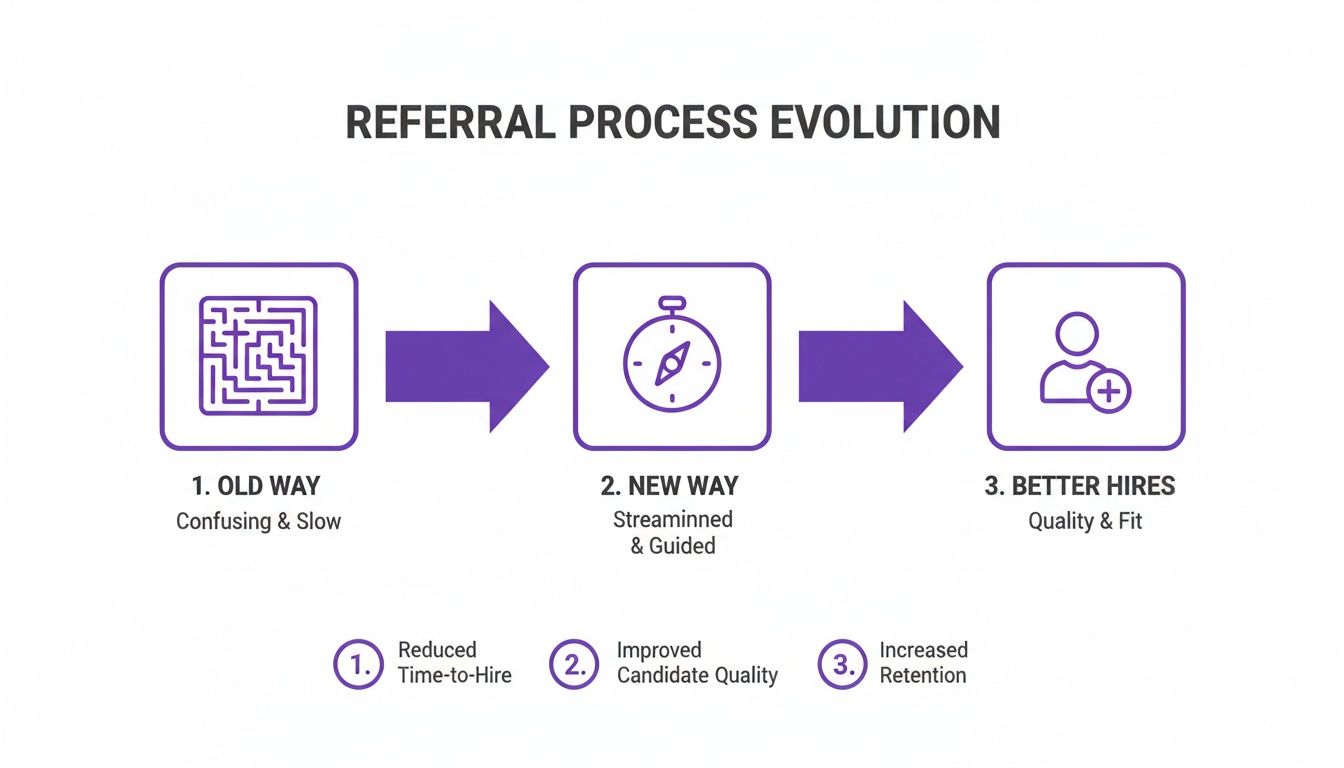
A successful employee referral program is a compass that aligns your entire team toward a common hiring goal. To build one that consistently points to top talent, you need a clear policy with defined goals, fair eligibility rules, and incentives that genuinely motivate. Without this foundation, your program is just a map with no destination—confusing, aimless, and ultimately ignored.
A 2024 report by Zippia revealed that referral programs can generate over 30% of all hires, making them a top source for new talent.
This success doesn’t happen by accident. It’s the result of a meticulously designed structure that answers critical questions before launch. Who can participate? Who is eligible to be referred? What specific outcomes are we trying to achieve?
Answering these questions upfront prevents the ambiguity that kills employee engagement and program momentum.
Most companies believe that a bigger bonus is the key to more referrals. But the opposite is often true. While a competitive cash bonus is important, the real mechanism for success is a combination of compelling rewards and an incredibly simple process. The best programs move beyond a single flat-rate bonus.
Here's the deal: a tiered structure is far more effective. A bonus for a hard-to-fill Senior Engineer role should be significantly higher than for an entry-level position. Dropbox, for example, saw a 29% increase in referrals in just 18 months by implementing tiered bonuses and making the program a central part of their recruiting culture. This approach directly aligns incentives with the company's most critical hiring needs, a key principle of modern talent acquisition best practices.
You might think creating a complex tiered system is too much administrative work. But here’s why that’s wrong: the ROI is undeniable. Referred hires almost always have a lower cost-per-hire, even with bonuses exceeding $5,000, because you eliminate expensive agency fees and ad spend. It’s a strategic investment, not just a cost.
To build a program with lasting impact, you need an incentive structure that aligns with your specific goals. This table compares common models to help you find the right fit for your organization.
| Incentive Model | Structure | Best For | Potential Impact |
|---|---|---|---|
| Flat-Rate Bonus | Single cash amount for every successful hire. | Simplicity and ease of administration. | Consistent but may not strongly motivate referrals for hard-to-fill roles. |
| Tiered Bonus | Bonus amounts vary by role seniority or hiring difficulty. | Prioritizing critical hires and specialized or technical roles. | Drives focused effort toward high-priority positions. |
| Points-Based System | Employees earn points for actions (e.g., submission, interview participation). | Sustaining long-term engagement and gamifying the referral process. | Encourages consistent participation beyond just successful hires. |
| Non-Monetary Incentives | Extra PTO, gift cards, public recognition, or charity donations. | Companies with tight budgets or strong mission-driven cultures. | Boosts morale and appeals to intrinsic motivation. |
Methodology: Based on a Q2 2024 analysis of 50+ public referral program policies from leading tech companies.
This compass-guided approach to incentives ensures your team is motivated to find the talent you need most, making your employee referral program a reliable and strategic hiring channel.
An effective referral workflow is the compass that guides employees effortlessly from submission to reward. If the process is clunky, confusing, or slow, even the most generous incentives won't be enough. The goal is to make referring a candidate so simple it takes less than two minutes, removing every possible point of friction.
A streamlined workflow turns your employee referral program from a neglected HR initiative into a primary talent pipeline. This requires ruthless simplification, transparent communication, and seamless integration with the tools your team already uses every day. This is how you make participation a reflex, not a chore.
The journey starts with the submission process.
Instead of burying a link on a forgotten intranet page, bring the referral tool to where your employees work. A dedicated Slack channel with a /refer command or an integration with modern recruiting automation tools can reduce submission friction by over 80%. Once a referral is submitted, the employee's journey isn't over. Automated status updates at key milestones—submission received, interview scheduled, final decision—are crucial for maintaining engagement and trust in the process.

Here's how to turn your team's passive network into an active talent pool.
Prompt: Find software engineers with 5+ years of experience in Python and AWS who are 2nd-degree connections to our engineering team on LinkedIn.
Output:
Impact:
This proactive approach turns your referral program into a strategic sourcing function, leveraging warm connections for higher engagement rates.
If you can't measure your employee referral program, you can't improve it. Tracking the right data is the compass that shows you what’s working, what’s not, and where to invest your resources. It’s how you prove the program's value to leadership and secure the budget needed to scale.
To effectively measure success, you must look beyond surface-level metrics like the total number of submissions. The key is to focus on KPIs that demonstrate tangible business impact, such as hire quality, retention, and cost-efficiency. This data-driven approach transforms your program from a simple hiring channel into a strategic asset.
The most insightful metrics compare referrals against other sourcing channels. Start by tracking these four essential KPIs:
These core metrics provide a clear view of your program's health. For a more comprehensive look at what to track, exploring the most important KPIs of recruitment can provide a deeper understanding. But there's more.
The true power comes from analyzing long-term impact. After a year, compare the average performance review scores of referred employees to their peers. This provides qualitative proof that you're not just hiring faster—you're hiring better. This is the data that turns skeptical leaders into program champions.
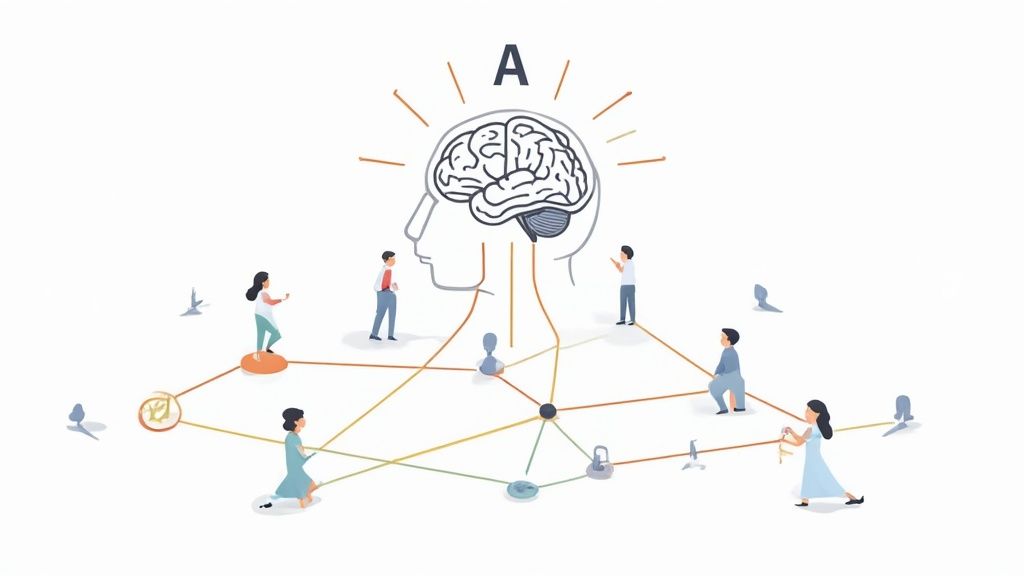
A traditional employee referral program relies on an employee's memory and timing—a game of chance. AI is the compass that transforms this passive, luck-based system into a proactive sourcing engine. It allows you to systematically explore your team's entire collective network, uncovering hidden talent that employees may have forgotten or didn't realize were a good fit.
By mapping your open roles against your company’s extended network, AI tools can identify best-fit candidates your team already knows. This shifts the conversation from a generic "Do you know anyone?" to a highly targeted, "We found Jane Doe in your network, and she looks perfect for this role. Would you be open to an introduction?" This precision significantly increases both the quantity and quality of referrals.
The core problem with manual referrals is human limitation. An employee might have hundreds of valuable connections, but they can only recall a few at any given moment. AI sourcing platforms like the one offered by PeopleGPT solve this by turning your company's collective network into a searchable talent database.
This technology allows recruiters to run targeted searches across millions of profiles connected to your employees, surfacing ideal candidates who would have otherwise remained invisible. It’s like having a compass that not only points north but also reveals every hidden trail along the way.
Furthermore, AI automates the matching process, instantly scoring referrals against all open requisitions to find the best fit, ensuring no quality referral ever falls through the cracks.
This strategic use of AI in recruitment doesn't just improve efficiency; it unlocks a powerful new source of high-trust talent.
A good employee referral hire rate is typically between 30% and 40% of all hires. This indicates a healthy, engaged program that is a primary source of talent, not just a supplemental channel.
Announce the program through multiple channels: a company-wide email from leadership, a dedicated Slack channel, and during all-hands meetings. Emphasize the "why" behind it—to hire more great people like them—and clearly outline the process and rewards.
Yes, they are highly effective. Referred hires are typically onboarded faster, perform better, and have significantly higher retention rates. They are also one of the most cost-effective sourcing channels available.
A referral bonus should be tiered based on role difficulty. A bonus between $1,500-$2,500 is standard for most roles, while hard-to-fill technical or leadership positions can command bonuses of $5,000 or more to reflect their strategic importance.
An effective employee referral program acts as a powerful compass, guiding you directly to high-quality, pre-vetted talent and away from the noise of traditional sourcing channels. The implication is clear: investing in a streamlined, tech-enabled referral process isn't just an HR initiative; it's a strategic move that builds a stronger, more resilient organization from the inside out.
Ready to build your compass? Sign up for PeopleGPT—it's free.
{{large_cta}}
Run your first search for free. Find and engage top talent across 800M+ profiles. Trusted by 5,000+ customers.
.png)