.svg)
SIGN UP FOR JUICEBOX (IT’S FREE!)

Who are you looking for?
Thank you! Your submission has been received!
Oops! Something went wrong while submitting the form.

Let's cut through the noise. The employee experience (EX) isn't about free snacks or ping-pong tables. It's the sum of every interaction an employee has with your company—from the moment they see your job ad to their very last day. In a talent market this competitive, getting the employee experience right has become a critical strategic advantage that separates the best from the rest.
Unlike generic HR advice, this guide focuses on the most critical and often overlooked phase: talent acquisition. We believe TA teams are the true architects of EX, laying a foundation that determines retention and engagement long before day one.
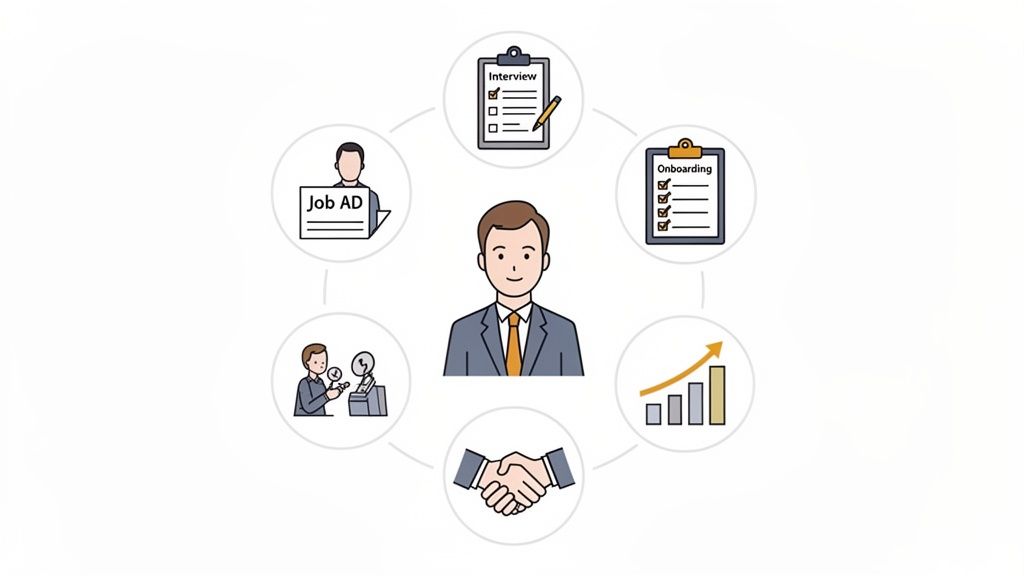
Think of your company's employee experience like a product you're offering to talent. Is it intuitive, supportive, and valuable? Or is it clunky, confusing, and frustrating? The answer directly impacts your ability to attract, hire, and keep the very people who drive your business forward. A great experience is one of the key pillars in your overall employee engagement strategy.
Most leaders believe a great EX is built on flashy perks and office amenities. The opposite is true. While benefits matter, the real foundation is psychological safety, clear career paths, and managers who know how to lead. These elements are systemic, not superficial.
You might think you can patch a poor experience with a higher salary or a better benefits package. But that approach fails because it treats the symptom, not the disease. A toxic manager or a chaotic workflow can't be fixed with a ping-pong table. As proof, a 2022 MIT Sloan study found that a toxic corporate culture is 10.4x more powerful than compensation in predicting a company’s attrition rate.
The data is clear: a negative experience is a massive financial drain.
Bottom line: When people feel disconnected or undervalued, their performance tanks and your best talent walks. The costs of backfilling roles, lost institutional knowledge, and a damaged employer brand are immense. A great employee experience is about systemic improvements, not superficial benefits.
To build a world-class employee experience, you have to move beyond HR theory and treat it like a core business strategy. This means mapping every touchpoint an employee has with your organization—from their first interaction with your recruitment emails to their last day—and intentionally designing each one to be positive and productive.
This guide gives talent acquisition teams actionable frameworks because the hiring process is the most crucial—and often most neglected—stage of the entire lifecycle.
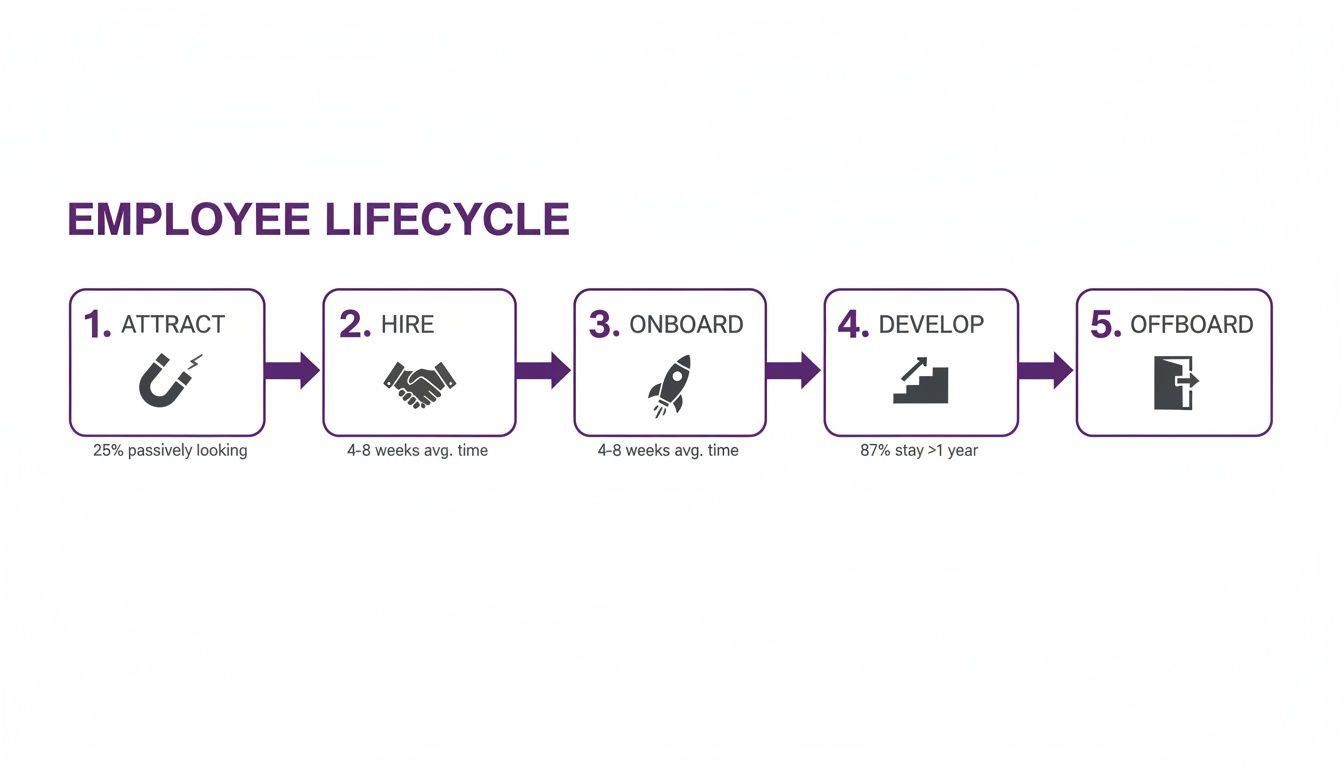
To get the employee experience right, you need a map. Stop thinking about the employee journey as a bunch of disconnected events. Instead, see it as a single, cohesive product your company offers its people.
This journey breaks down into five distinct stages. Each one is a chance to build trust and deepen engagement. A stumble in one can trip you up in all the rest.
This is where the employee experience truly begins. The Attract stage is about perception, shaped by your employer brand, job descriptions, and application process. A confusing careers page quietly tells candidates your company might be just as disorganized on the inside. A Glassdoor survey found that for over 70% of job seekers, their perception of the employee experience is a huge factor in their decision. This is your first shot at grabbing top talent.
The Hire stage is your culture in action. It’s defined by how you communicate, the respect you show candidates, and how organized your interviews are. Ghosting candidates or dragging them through a chaotic, ten-round interview gauntlet doesn't just lose you one person; it torpedoes your reputation. This is where the promises you made get confirmed or exposed as hype. A strong process can be one of your key recruiting metrics for success.
The first 90 days are everything. Onboarding is the critical bridge between candidate and team member. A bad experience—think IT glitches and fuzzy expectations—is a top reason for early turnover. Good onboarding is more than paperwork; it’s a structured program built to integrate, clarify, and empower. A well-designed plan for automated employee onboarding can lock in consistency and free up managers to focus on building human connection.
Once an employee is settled, the focus shifts to growth. The Develop stage is about feedback, learning, and career pathing. This is where people decide if they have a real future with you. Stagnation is the silent killer of retention. People expect to learn and see a clear path forward. Companies that nail this stage offer regular coaching and invest in training. They get that developing people is a direct investment in the company's future.
Even your best people will eventually move on. The Offboard stage is your last chance to leave a great impression. A thoughtful exit can turn a former employee into a lifelong advocate or a future boomerang hire. This means more than a check-the-box exit interview; it's about a smooth knowledge transfer and genuinely celebrating their contributions. How you treat people on their way out says everything about your company’s real values.
Most companies get this wrong. They think the employee experience begins on day one.
The truth is, it starts way earlier.
Your talent acquisition team is the true architect. They lay the foundation for the entire journey long before onboarding. Every touchpoint—from the first cold outreach to the final offer call—sets the tone. It’s the first real preview a candidate gets of your company’s culture, values, and how you respect people. Looking for a better way to find talent? Check out these Indeed alternatives to expand your search.
You might think a bumpy hiring process is easily forgotten. But the data tells a different story. Those early impressions have a long shelf life, often leading to lower engagement and higher turnover within the first year.
Why? The hiring process tells candidates everything about:
A great hiring process is the bedrock of a world-class employee experience.
Making this shift means moving away from a transactional, "butts-in-seats" mindset. This is where understanding the difference between a recruiter and talent acquisition professional becomes critical. TA is about playing the long game.
But there’s a problem most tools ignore. Traditional sourcing methods are built to find skills, not alignment. They often miss the cultural and behavioral fit that predicts long-term success, forcing recruiters into a high-volume game that leaves zero time for crafting a memorable candidate experience.
This is where a smarter approach changes everything. For instance, Juicebox customers using PeopleGPT to find candidates who align with company values have seen a 25% reduction in 90-day attrition within six months. By pinpointing the right people from the start using our PeopleGPT platform, their TA teams spend less time on manual sourcing and more time on high-touch, personalized communication.
If you’re serious about improving the employee experience, you need to measure what’s working. This means getting past vanity metrics and digging into the numbers that predict long-term success. Many talent teams track KPIs like Time-to-Hire, but they only tell you what happened, not why.
Here’s the issue: they track process efficiency but completely miss the human element. They can't measure how the candidate actually felt. This is a massive blind spot.
The trick is to shift your focus to a metric that captures this feeling: Candidate Journey Satisfaction. This single indicator is the most powerful predictor of a new hire’s engagement and 90-day retention. A candidate who feels valued, informed, and respected walks in the door with a deep sense of trust and excitement.
To systematically improve the employee experience, you need a simple, repeatable process like the Measure-Analyze-Act feedback loop.
This isn’t a one-and-done project. It’s a continuous cycle of improvement. This is how you streamline the recruitment process effectively.
You don't need a dedicated data science team to do this. Modern tools can surface these insights for you. For instance, one of the biggest sources of candidate frustration is unrealistic timelines. This Juicebox Talent Insights dashboard shows how you can use market data to set clear, realistic hiring timelines right from the start.
By analyzing data on how long it takes to hire for similar roles, you can proactively tell candidates, "We expect this process to take around 4-6 weeks." This builds trust through transparency. You can dive deeper into these principles by exploring what is people analytics and how to apply them.
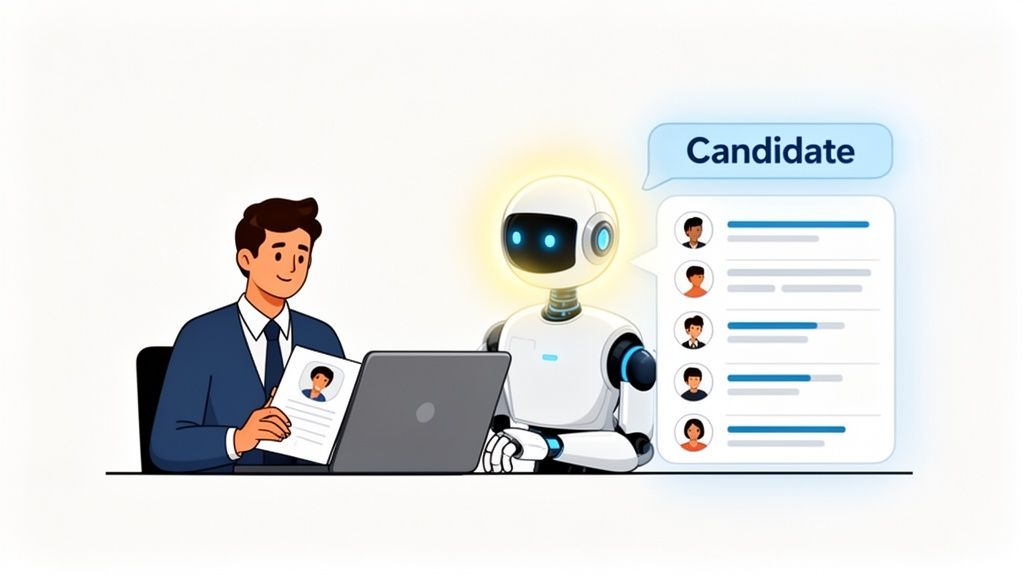
It sounds backward, but the right tech can make your hiring process more human. This isn't about replacing recruiters with robots. It’s about augmenting them—automating the high-volume work so your team can reclaim time for building relationships and crafting a stellar employee experience.
Most recruiters are buried in tedious tasks: writing Boolean strings, sifting through profiles, and chasing contact info. This grind leaves little time for the high-touch activities that create a memorable candidate journey.
But what if you could change that?
This is where AI flips the script. By taking over the rote parts of sourcing, it frees up recruiters to be the strategists and candidate advocates they were meant to be. This is a core focus of the top 10 AI recruiting tools for 2026.
Let's make this concrete. A recruiter needs to find a Senior Backend Engineer with experience in distributed systems and a fintech background.
Instead of burning hours on manual sourcing with something like X-ray search, they can use a single prompt in PeopleGPT:
"Find me senior backend engineers in San Francisco or New York who have worked at Series B-D fintech companies like Ramp or Brex. They need deep experience with Go, Kubernetes, and distributed systems architecture."
In seconds, PeopleGPT searches over 30 platforms and delivers a shortlist of aligned candidates. Using AI-powered recruiting and sourcing tools makes the process efficient for the recruiter and personalized for the candidate.
That reclaimed time is where the magic happens. Recruiters can finally focus on:
This transforms the employee experience from a numbers game into a relationship-building exercise. A deeper look into AI in recruitment shows how this principle extends across the entire function.
Where should a small company start with improving employee experience?
Zero in on hiring and onboarding first. A clear, respectful interview process and a structured 90-day plan for new hires have the highest immediate impact.
How can I prove the ROI of investing in employee experience?
Track hard numbers: employee turnover rate, time-to-fill, and new hire satisfaction scores. A measurable drop in turnover provides a direct cost saving.
Is employee experience only an HR responsibility?
No. While HR often leads, the talent acquisition team owns the critical first impression, and managers shape the day-to-day reality. It's a team sport.
What's the biggest mistake companies make with employee experience?
Confusing perks with culture. Free lunch is a perk. Psychological safety, clear career paths, and great management—that's culture. Perks are the icing, not the cake.
Ultimately, a world-class employee experience is one of the most durable competitive advantages you can build. It's the difference between constantly plugging holes in a leaky bucket and building a brand that the best performers actively seek out.
This strategic investment unlocks a virtuous cycle where great people attract more great people, creating a resilient and innovative company from the inside out.
Signup for Juicebox (it's free!)
{{large_cta}}
Run your first search for free. Find and engage top talent across 800M+ profiles. Trusted by 5,000+ customers.