.svg)
SIGN UP FOR JUICEBOX (IT’S FREE!)

Who are you looking for?
Thank you! Your submission has been received!
Oops! Something went wrong while submitting the form.

A proactive diversity recruiting strategy isn't a corporate social responsibility checkbox. It’s the engine for building teams that are more resilient, more innovative, and ultimately, more profitable.
The end goal: Widen your talent pool to attract and hire incredible candidates from all walks of life, ensuring your process is free from the biases that stunt growth.
In this guide, we'll help you build a diversity recruiting strategy that's effective (unlike outdated playbooks) by integrating modern sourcing tools and data-driven recruitment.
TL;DR: Building a Modern Diversity Recruiting Strategy
If your company's growth feels stuck or innovation has flatlined, the problem might be hiding in plain sight: your hiring process.
When you keep fishing in the same pond—relying on the same few sourcing channels like these Indeed alternatives and familiar networks—you create a talent echo chamber. You end up hiring people who think, act, and look just like your current team. It feels safe, but it's a recipe for stagnation.
Here's the bottom line. This kind of homogeneity is a hidden risk, a lot like an investment portfolio packed with a single stock. When the market shifts, you’re left dangerously exposed.
A modern diversity recruiting strategy flips this entire script. It's not about hitting quotas; it’s about treating your talent pipeline like a diversified investment portfolio. By sourcing from a wide range of talent pools, you hedge against risk and maximize your returns.
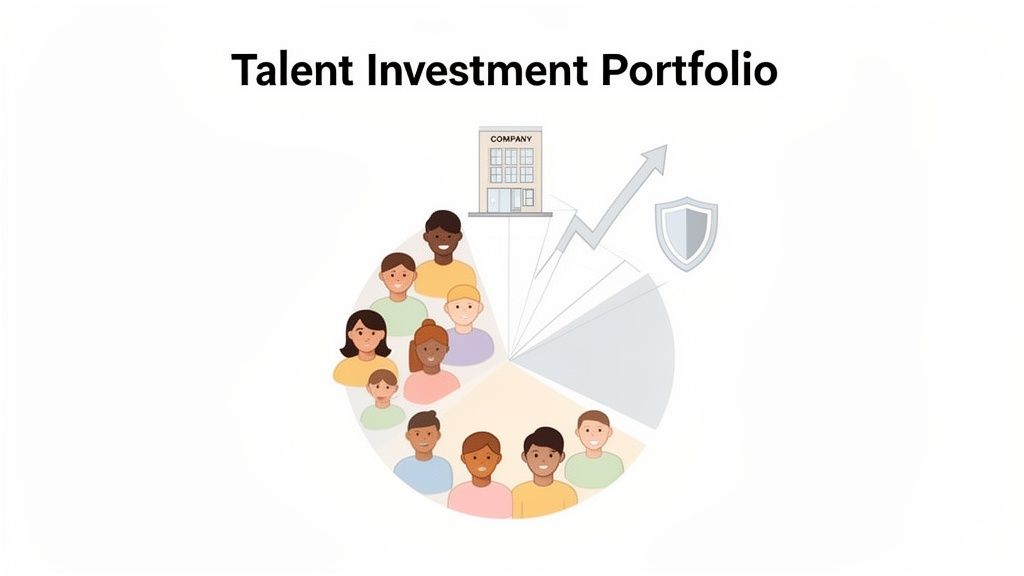
Most companies believe the biggest hurdle is a "pipeline problem." The opposite is true. The issue isn't a lack of talent; it's a lack of imagination in your search. Exceptional candidates from underrepresented backgrounds are everywhere, but they often aren't hanging out on the same platforms your recruiters have bookmarked. To find them, you need a new map and better tools. This means moving beyond legacy platforms and embracing a more dynamic, data-driven approach to recruitment and perhaps even looking for a skilled freelance recruiter to help.
For far too long, diversity initiatives were siloed in HR, treated as a compliance task completely separate from core business goals. This is a massive strategic mistake. An effective diversity recruiting strategy is a powerful engine for growth.
Think about it this way:
You might think building this kind of strategy requires a huge budget and a dedicated team. But that's a common misconception. The real shift is in your mindset—moving from passive recruiting to proactive talent discovery. This is where modern AI recruiting tools like Juicebox become a game-changer. They can scan millions of profiles across dozens of platforms, pinpointing top candidates based on skills and experience, not just keywords and connections.
This isn't just about feeling good; it's about measurable business outcomes. The data connecting diversity to performance is overwhelming.
Look at the proof: McKinsey & Company found that companies in the top quartile for ethnic diversity were 36% more likely to financially outperform their less diverse peers. They achieved this by systematically investing in inclusive hiring practices that delivered tangible returns. This systematic approach is the core of a modern diversity recruiting strategy and helps you build the high-performing team you need to win.
Sourcing all the diverse talent in the world won't move the needle if your hiring process is fundamentally biased. A truly effective diversity recruiting strategy isn't just about finding people; it's about building a system that gives every single one of them a fair shot.
If the foundation is cracked, the house will fall. Designing an inclusive framework means you're intentionally engineering fairness into every stage, from the first sentence of a job description to the final offer call. It's about looking inward first and creating a clear, objective path where skills and potential are all that matter.
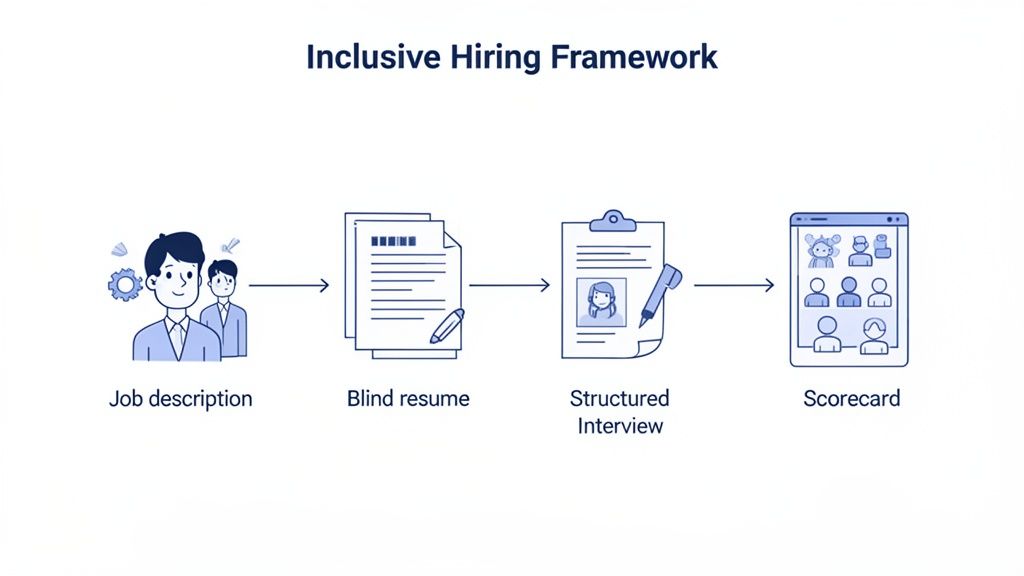
Think of your job description as the front door to your company. Is it welcoming, or is it covered in warning signs that tell great candidates to stay away? Too often, JDs are cluttered with jargon, biased language, and unrealistic demands that slam that door shut.
Here's the real kicker: that long laundry list of "nice-to-haves." Research has shown that women often won't apply for a job unless they meet 100% of the criteria, while men will throw their hat in the ring if they meet just 60%.
By ruthlessly cutting your requirements down to the absolute "must-haves," you instantly widen your talent pool. Your goal is to describe the problem the new hire will solve, not to create an impossible checklist of qualifications.
Unconscious bias is the silent killer of diversity in hiring. It sneaks into resume reviews, interviews, and team debriefs without anyone even noticing. The only way to combat it is to make your process intentionally and systematically objective.
A great place to start is adopting a skills-based hiring mindset. This approach forces you to evaluate candidates on what they can actually do, rather than relying on weak proxies for talent like where they went to school or what big-name company they worked for previously. (We dive deeper into this in our guide on what is skills-based hiring). It also helps to streamline your recruitment process to ensure consistency.
Here are a few high-impact changes you can make right away:
"Gut feel" is where bias loves to hide. The single most powerful tool for dragging it out into the open is a standardized evaluation rubric, or scorecard.
Before you interview a single person, the hiring panel needs to sit down and agree on the 3–5 core competencies that are truly critical for the role. These aren't just technical skills like "knows Python." They're broader capabilities like "problem-solving," "stakeholder communication," or "project management."
Next, for each competency, you define what "poor," "good," and "excellent" actually look like in an interview.
Example Scorecard Competency: Problem-Solving
After every interview, each panel member scores the candidate on these competencies independently. This quantitative data becomes the foundation for your debrief meeting, turning a subjective "I liked them" discussion into a data-driven decision.
It’s a simple mechanism, but it ensures the most qualified candidate—not just the most charismatic one—is the one who gets the offer. You can find out more about building interview rubrics in our detailed guide.
If your entire sourcing strategy lives and dies on LinkedIn, you're fishing in an overcrowded pond. A real diversity recruiting strategy means breaking out of that echo chamber. There are many other sites like LinkedIn to consider.
Your next great hire might be pushing code on GitHub, showing off a killer portfolio on Behance, or nerding out about industry trends in a niche Slack community. To find them, you have to go where they are. This isn't just about cross-posting jobs; it's about proactively engaging with people in the digital spaces they already call home.
But there's a problem most tools ignore: this manual approach doesn't scale. How can a small startup team possibly cover all this ground?
Expanding your sourcing channels is the first tactical move. Stop waiting for diverse candidates to stumble upon your job ad. Instead, actively seek them out in the communities where they’re already building, creating, and connecting.
Here are a few high-impact places to start looking:
Finding these untapped talent pools requires new tactics, especially when it comes to sourcing tech talent who aren't job hunting.
This is where AI-powered sourcing becomes a massive force multiplier for your diversity recruiting strategy. Modern tools like PeopleGPT are built to scan millions of profiles across dozens of sources at once, doing in seconds what would take a human sourcer weeks of tedious work.
Forget wrestling with complex Boolean strings that often bake in biases. Now, you can just use plain English.
Juicebox PeopleGPT Workflow Example:
A recruiter could simply ask: “Find me female software engineers in the Midwest with experience in fintech startups who have contributed to open-source projects.”
In a few moments, the AI scours sources like GitHub, LinkedIn, academic sites, and more. This completely bypasses the limitations and built-in network biases of any single platform. By automating that top-of-funnel discovery, you free up your recruiters to do what they do best: build relationships with amazing people. This is a core focus of the top 10 AI recruiting tools for 2026.
You’ve done the hard work and sourced a rich, diverse pool of candidates. But all that effort can be undone in a single 45-minute interview if unconscious bias slips into the evaluation.
This is the moment of truth for any real diversity recruiting strategy. The goal is to move away from subjective, "gut feel" hiring—which is often just a fancy term for affinity bias—and toward a structured, objective process where the best candidate wins, period.
The single biggest vulnerability in any interview process is inconsistency. When interviewers are allowed to "wing it" and ask different questions to different candidates, you're not just getting messy data. You're actively inviting bias to the table.
The solution is radical standardization. This systematic approach turns an interview from a casual chat into a reliable data-collection exercise. It minimizes the impact of cognitive shortcuts like the halo effect, where a great answer to one question unfairly colors the perception of everything else. It is a key part of avoiding malicious compliance in hiring.
Who asks the questions matters just as much as what questions are asked. A homogenous interview panel is a massive blind spot.
A diverse interview panel is a powerful antidote.
When you bring people from different departments, seniority levels, genders, and ethnic backgrounds into the room, you get a much wider range of perspectives. Research from Tufts University found that diverse groups are better at re-examining facts, staying objective, and ultimately making better decisions. A diverse panel doesn't just signal inclusivity; it actively produces a better hiring outcome.
You might think your hiring managers are objective pros, but without training, they’re just as susceptible to unconscious bias as anyone else. Acknowledging our potential for bias is the first step toward overcoming it.
You don't need a huge L&D budget. A simple, 60-minute workshop can have a real impact.
Lightweight Bias Training Framework:
This small investment gives your team the language and awareness to challenge their own assumptions and hold each other accountable. It’s a critical piece of operationalizing your diversity recruiting strategy.
A world-class diversity recruiting strategy isn’t built on good intentions. It’s built on good data.
Without clear metrics, your efforts are just aspirational noise. To build real momentum, you have to move beyond simple vanity metrics and start tracking the numbers that reveal the true health of your entire hiring process.
What gets measured gets managed. You can’t fix a leak you can’t see. The real insights come from analyzing the entire funnel.
To really get a handle on how effective your strategy is, you need to track pass-through rates at every single stage. This is just the percentage of candidates from a specific demographic who advance from one step to the next.
Let's look at the core metrics you should be tracking:
By breaking down the data this way, you can spot the drop-off points immediately. This data turns vague problems into specific, solvable challenges. These are the kinds of recruitment KPIs that actually drive success.
You might be thinking that tracking all this data sounds like a job for a full-time analyst. But manual data pulls from spreadsheets are slow, full of errors, and just not sustainable.
This is where modern talent platforms with built-in analytics are a game-changer. For example, Microsoft’s 2023 Global Diversity Report shows that since 2019, representation for Black and African American employees grew by 120.3%, and for Hispanic and Latinx employees by 79.2%. This progress only happens when you have a solid data infrastructure in place.
When you automate your reporting, you stop being reactive and start being proactive. This consistent, data-driven feedback loop is what separates performative DEI from a functional, high-impact diversity recruiting strategy. It’s how you build—and keep—momentum for the long haul.
What are the most important diversity metrics to track?
Focus on pass-through rates by demographic at each hiring stage, offer acceptance rates, and the effectiveness of your sourcing channels.
How often should we report on diversity recruiting metrics?
A quarterly report to leadership is a great rhythm. It keeps the initiative top-of-mind and clearly shows progress and ROI over time.
How do you set realistic diversity hiring goals?
Use a mix of external benchmarks and your own internal funnel data. Set small, incremental goals to improve representation at your biggest drop-off points.
Building an effective diversity recruiting strategy isn't about meeting quotas or checking boxes. It’s about a fundamental upgrade to your company’s talent engine. When you engineer bias out of your process and expand your search to where the best talent actually lives, you create a sustainable system for attracting and retaining high-performing, innovative teams. This unlocks a wider pool of skills and perspectives, giving you a powerful competitive advantage that homogenous competitors simply cannot match.
{{large_cta}}
Run your first search for free. Find and engage top talent across 800M+ profiles. Trusted by 5,000+ customers.