.svg)
SIGN UP FOR JUICEBOX (IT’S FREE!)

Who are you looking for?
Thank you! Your submission has been received!
Oops! Something went wrong while submitting the form.


Deel has rapidly become a dominant force in global hiring, but its expansion into an 'everything app' isn't the right fit for every company. As teams scale, they often need more specialized support, transparent pricing, or deeper integrations that a one-size-fits-all model can't provide. For many HR and recruiting teams, finding strong Deel alternatives is less about replacing a bad tool and more about finding the best tool for a specific growth stage. The ideal platform for a startup hiring its first five international contractors looks very different from the solution required by an enterprise managing payroll across 50 countries. This guide breaks down the top options for 2026.
This guide moves beyond generic feature lists to provide a clear framework for choosing the right Employer of Record (EOR), global payroll, and contractor management solution. We'll dive into the top 12 platforms, breaking down the specific use cases where each one truly excels. For each alternative, you will find a detailed analysis with screenshots, a pricing snapshot, pros and cons, and a quick-compare table to help you make a decision. Understanding the nuances of each platform, including how they handle critical steps like the pre-employment screening process, is essential for compliance and efficiency. To simplify your search, we also offer insights into why choosing a Deel alternative can be a strategic move, especially when it comes to recruiting metrics and talent acquisition.
By the end, you'll have a shortlist and a clear path to making your next global hire with confidence, whether you need a provider with its own legal entities, a budget-friendly option for contractors, or a system with robust HRIS integrations.
TL;DR: The Top 12 Deel Alternatives
Remote positions itself as a premier global-first HR platform, specializing in Employer of Record (EOR) services, contractor management, and global payroll. Its core strength lies in its infrastructure. Unlike many competitors that rely on third-party entities, Remote has established its own legal entities in over 90 countries. This owned-entity model provides a significant advantage for businesses prioritizing compliance and stability, as it removes the complexity and potential risks associated with intermediaries. This makes it one of the most reliable Deel alternatives for companies scaling their international teams.
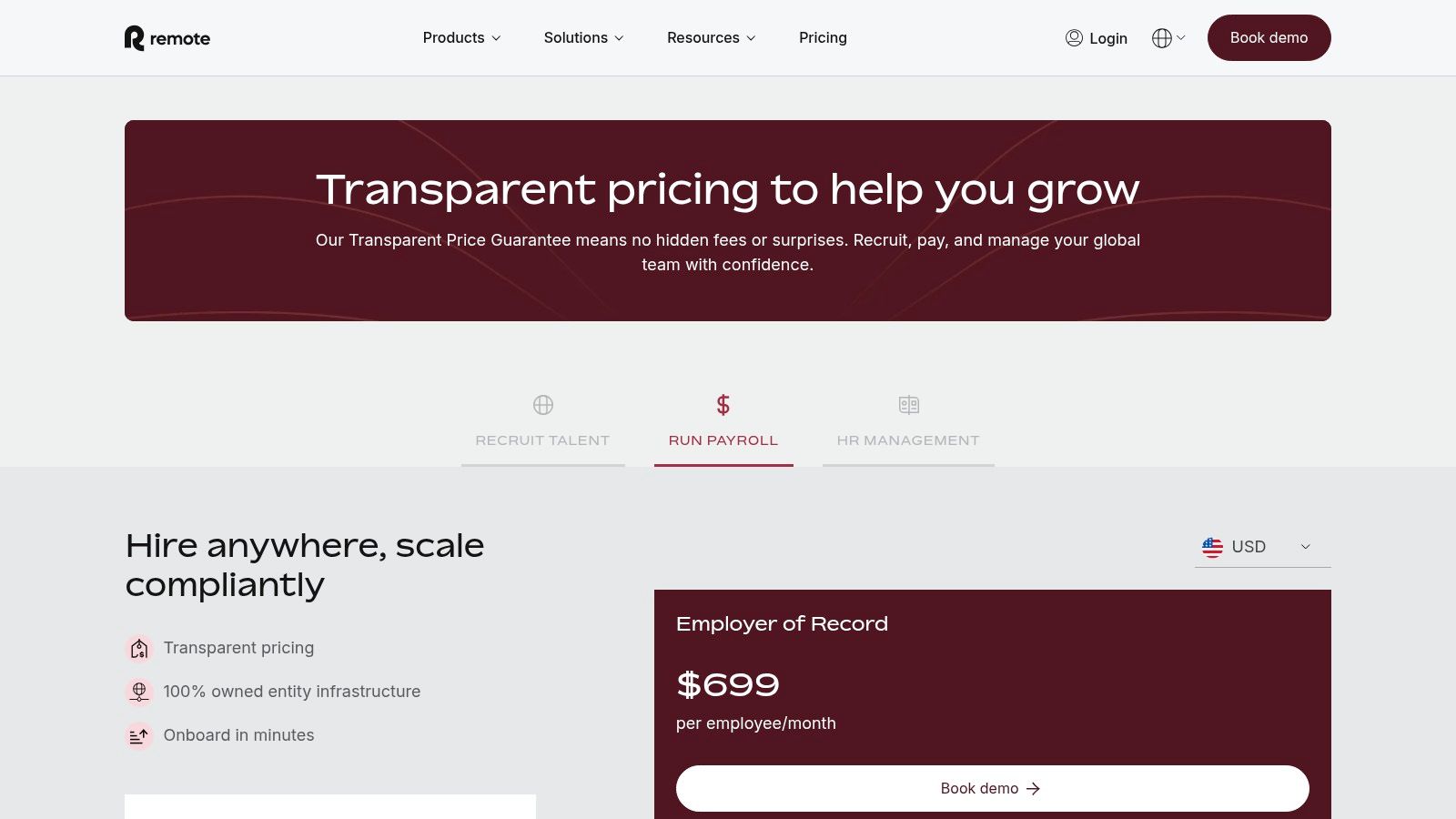
The platform is particularly well-suited for startups and SMBs that value a straightforward, self-serve experience and predictable costs. Its transparent pricing model is a key differentiator. Contractor management is free for core features, while EOR services are priced at a flat rate per employee, per month, often with a discount for annual billing. The platform's ease of use helps streamline the recruitment process on the backend.
Pros:
Cons:
You can view their current pricing and offerings directly on their website: https://remote.com/pricing
Rippling takes a fundamentally different approach, positioning itself as a unified workforce platform that combines HR, IT, and Finance. Its EOR, contractor management, and global payroll capabilities are modules within this larger ecosystem. This makes Rippling a powerful Deel alternative for businesses that want to consolidate their entire employee lifecycle management, from onboarding and payroll to app provisioning and device management, into a single source of truth. The platform's core strength is its deep integration and automation, allowing HR actions to trigger IT and finance workflows automatically.
What does that mean for you?
It means that when you hire a software engineer in Portugal, Rippling can handle their payroll, benefits, and local taxes while also automatically shipping them a laptop and granting access to your company's GitHub and Slack accounts—all from one place.
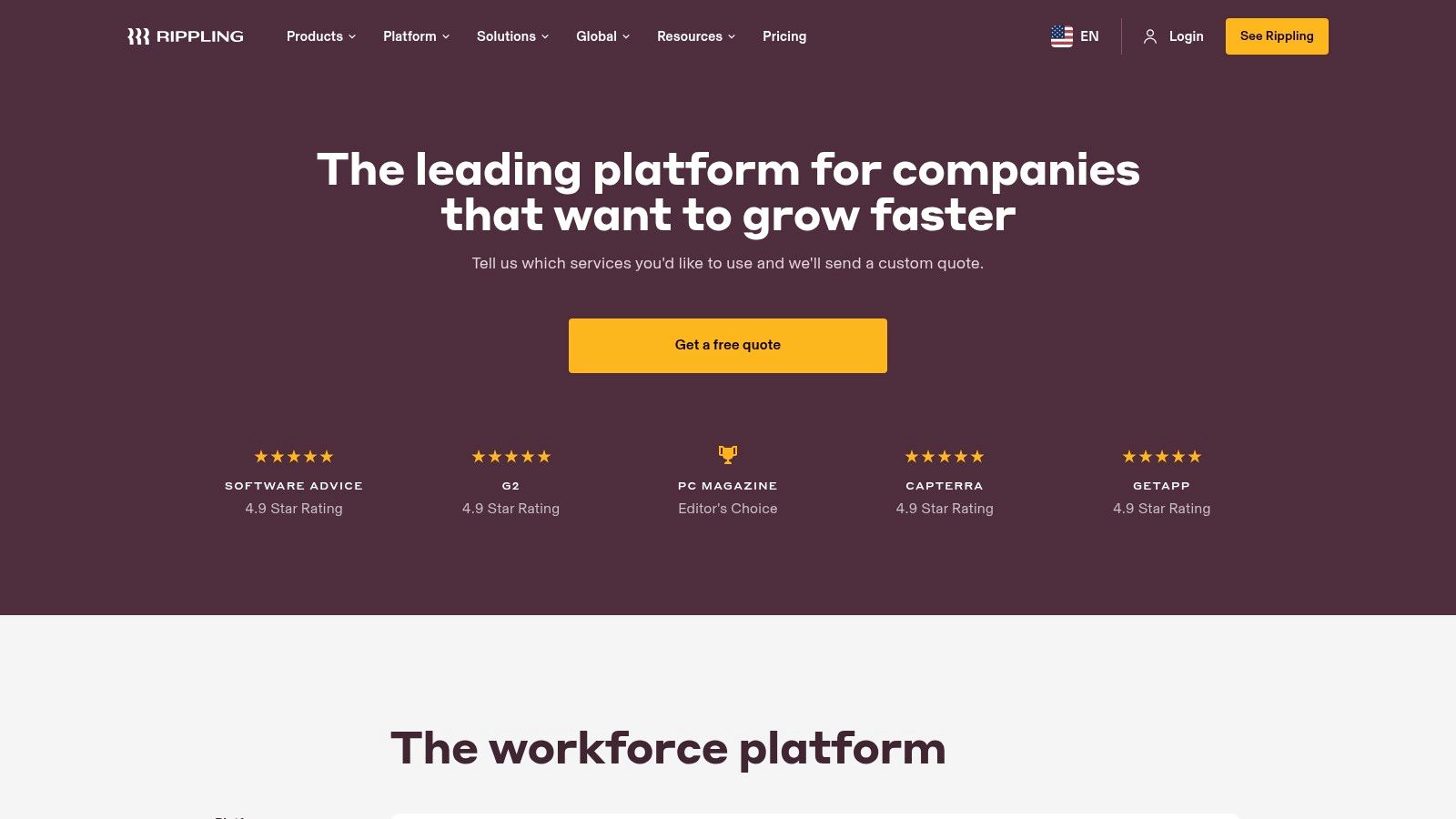
This modular design is ideal for companies that need more than just global HR and want to scale their operations holistically. You can start with the core HRIS and add on services like EOR or global payroll as you expand. However, pricing is not a fixed flat rate; it's quote-based and depends entirely on the specific modules and countries you select, which can lead to higher overall costs as you add more functionality.
Pros:
Cons:
You can view their current offerings and request a custom quote on their website: https://www.rippling.com/pricing
Oyster positions itself as a global employment platform designed to simplify cross-border hiring with a strong emphasis on speed and user experience. It offers a comprehensive suite of services including Employer of Record (EOR), contractor management, and global payroll, making it an excellent choice for distributed teams.
The platform's appeal lies in its transparent pricing and its mission-driven approach to enabling remote work, which resonates with companies building a global-first culture. This makes Oyster one of the most popular Deel alternatives for businesses prioritizing straightforward costs and rapid onboarding for their international talent.
But there's a problem most tools ignore: the complexity of benefits. Oyster tackles this head-on with localized benefits packages.
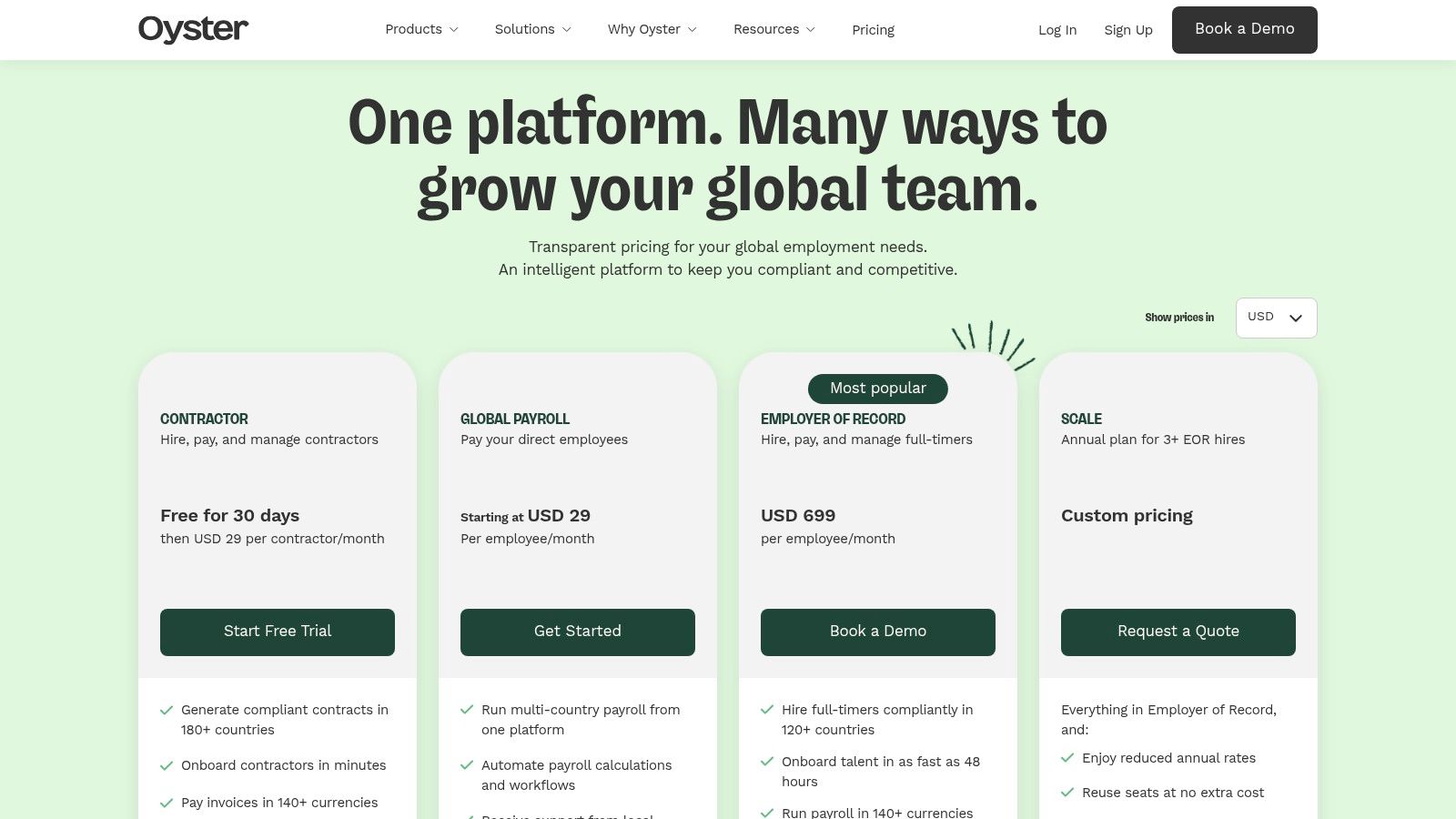
Oyster is particularly well-suited for companies that value public, predictable pricing models. They offer clear, tiered pricing for both contractors and EOR employees, including an annual "seat" option that can provide cost savings for businesses committed to long-term global hiring. While their entity ownership model varies by country, combining both owned entities and partner networks, their focus remains on providing a seamless experience for both employers and team members across their covered regions. Their approach simplifies managing things like the popular 9/80 work schedule across different time zones.
Pros:
Cons:
You can view their current pricing and offerings directly on their website: https://www.oysterhr.com/pricing
Papaya Global positions itself as a unified global workforce management platform, heavily geared towards enterprise clients with complex needs. It offers a comprehensive suite of services including Employer of Record (EOR), contractor management, and managed global payroll.
Its key differentiator is its payments-first infrastructure, designed to handle mass global payouts, foreign exchange (FX), and provide employees with flexible payment options like digital wallets. This focus makes it a powerful Deel alternative for large organizations that prioritize payment velocity and financial analytics.
The platform is best suited for established, multinational companies that require a robust system to manage a diverse and geographically dispersed workforce. Papaya’s strength lies in unifying disparate payroll data into a single source of truth, complete with BI dashboards and deep analytics. This allows finance and HR teams to gain strategic insights into workforce spending.
While powerful, its enterprise positioning means pricing is quote-based, which may be less suitable for SMBs seeking transparent, off-the-shelf solutions.
Pros:
Cons:
You can request a custom quote and view their service offerings on their website: https://www.papayaglobal.com/pricing/
As a pioneer in the Employer of Record industry, Globalization Partners (G-P) is a well-established global growth platform tailored for enterprise-level clients. It focuses on simplifying international expansion with robust compliance and HR support across a vast global footprint. G-P’s core strength lies in its comprehensive, technology-first approach, combining EOR services with an AI-powered compliance assistant, G-P Gia, to navigate the complexities of international labor laws. This makes it a formidable Deel alternative for large organizations prioritizing risk management and deep compliance expertise.

The platform is designed for multinational corporations that require a high-touch, full-service solution. Unlike some platforms with transparent, flat-rate pricing, G-P typically operates on a custom pricing model, reflecting its enterprise focus. This approach allows for tailored service packages that can include extensive legal support, integrations with major systems like ADP, and dedicated account management, which are critical for companies managing large-scale, distributed teams.
Pros:
Cons:
You can learn more and request a quote on their official website: https://www.g-p.com
Velocity Global is a long-standing leader in the global workforce solutions space, recognized for its extensive geographic reach and deep advisory services. The platform is designed for enterprises that require robust support for Employer of Record (EOR), global payroll, and complex workforce needs like immigration and equity management. Its emphasis on providing a comprehensive, high-touch service model with in-country advisors and 24/7 support makes it a strong Deel alternative for large organizations navigating intricate international employment laws. Velocity Global focuses on providing a single, clear invoice to simplify global financial management.
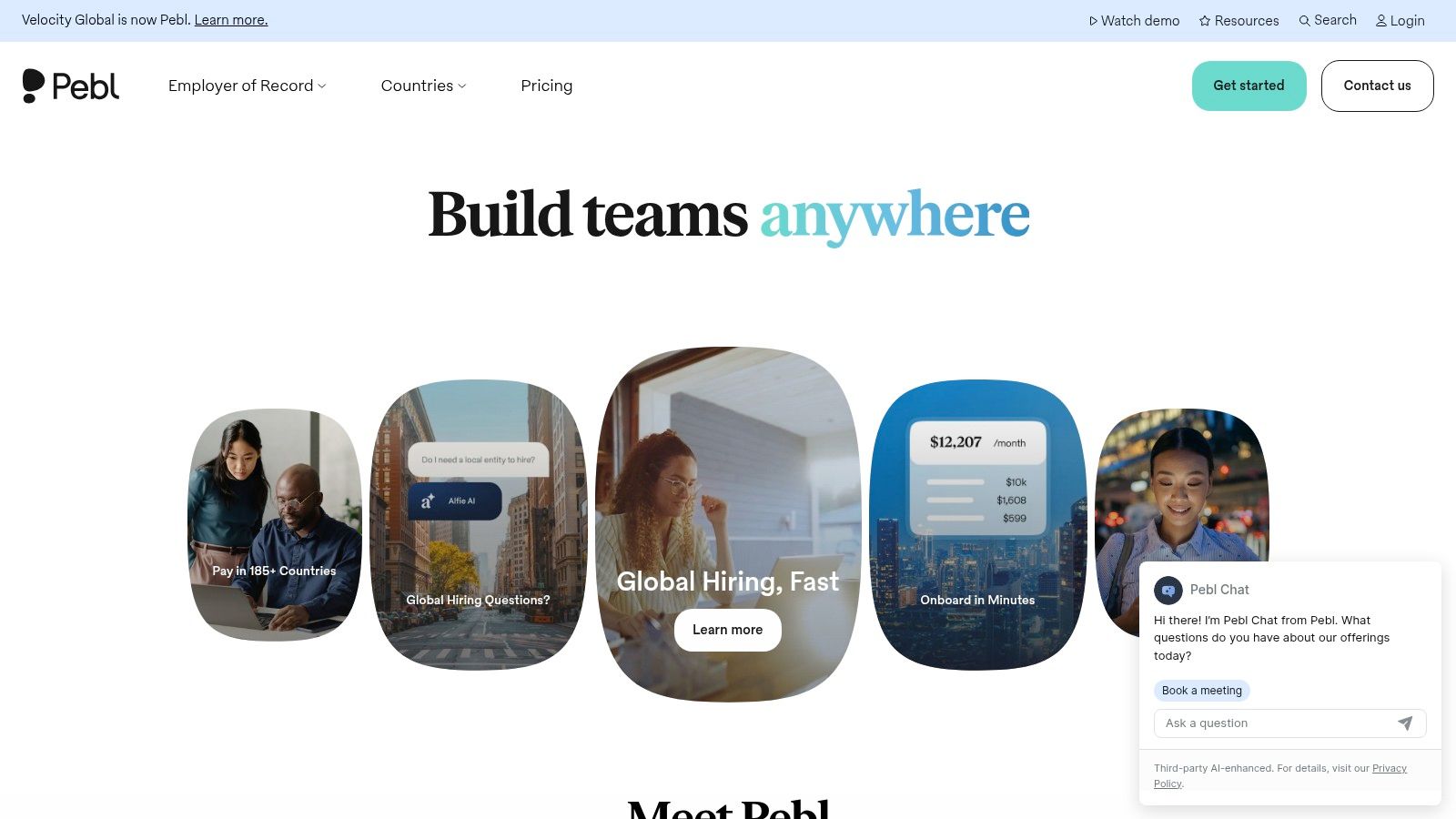
The platform is best suited for large-scale businesses and enterprises that prioritize compliance, expert guidance, and premium support over a purely self-service model. While public pricing is not readily available, their quote-based approach is tailored to the specific needs of each client, covering everything from benefits administration to complex legal and HR advisory. This makes it a go-to for companies where risk mitigation and expert partnership are paramount. This high-touch service is particularly valuable for companies looking for more than just software, but a true partner in global expansion, including support for sourcing talent with the best sourcing tools for recruiters.
Pros:
Cons:
You can request a custom quote and explore their enterprise solutions on their website: https://hellopebl.com
Multiplier positions itself as a global employment platform for companies hiring and managing talent across international markets. Its broader “Global Exchange for Work” offering combines Employer of Record (EOR), contractor management, global payroll, and compliance capabilities with an owned-entity infrastructure. This gives businesses a way to manage international employment through a single platform while maintaining greater control over compliance and workforce operations.
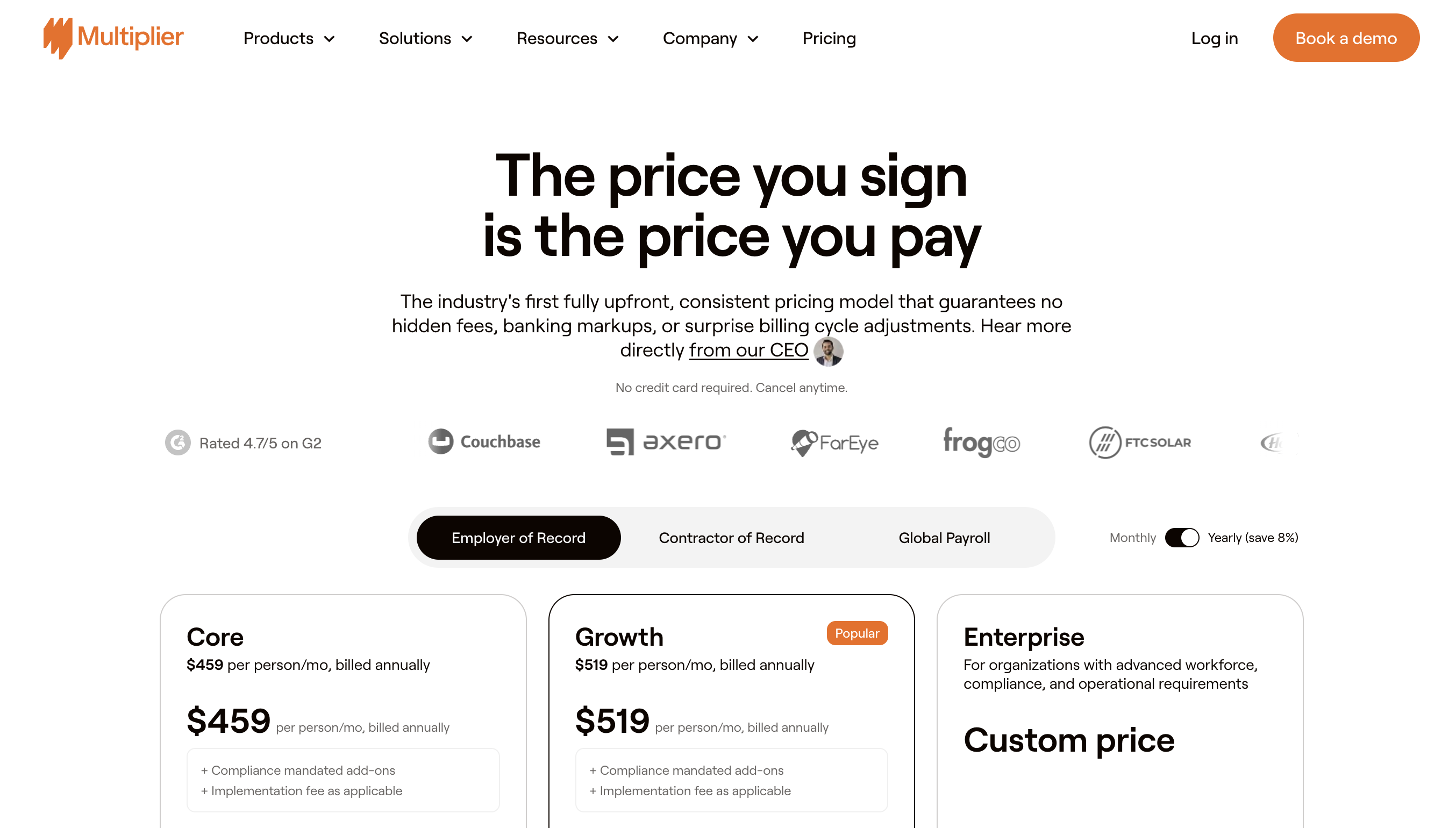
The platform is particularly well-suited for growing companies that want to quickly onboard employees and contractors in new countries without establishing their own local entities. Its services cover everything from compliant local contracts and benefits administration to multi-country payroll and global payments. Multiplier also publishes pricing for its core services, making it a compelling Deel alternative for companies looking to balance global employment infrastructure, compliance, and cost predictability.
Pros:
Cons:
You can view their current pricing and offerings directly on their website: https://www.usemultiplier.com/pricing
Atlas HXM establishes itself as a direct-model Employer of Record (EOR), emphasizing its owned-entity infrastructure across more than 160 countries. This direct approach is its core value proposition, appealing to enterprises and scaling companies that prioritize deep compliance and operational transparency. By managing its own legal entities, Atlas minimizes reliance on third-party providers, which can reduce complexity and potential points of failure in global HR operations. This makes it a compelling Deel alternative for businesses that require a high degree of control and consistency in their international hiring strategy.
The bottom line?
When you hire through Atlas, your employee has a direct employment contract with an Atlas-owned entity in their country, not a third-party partner.
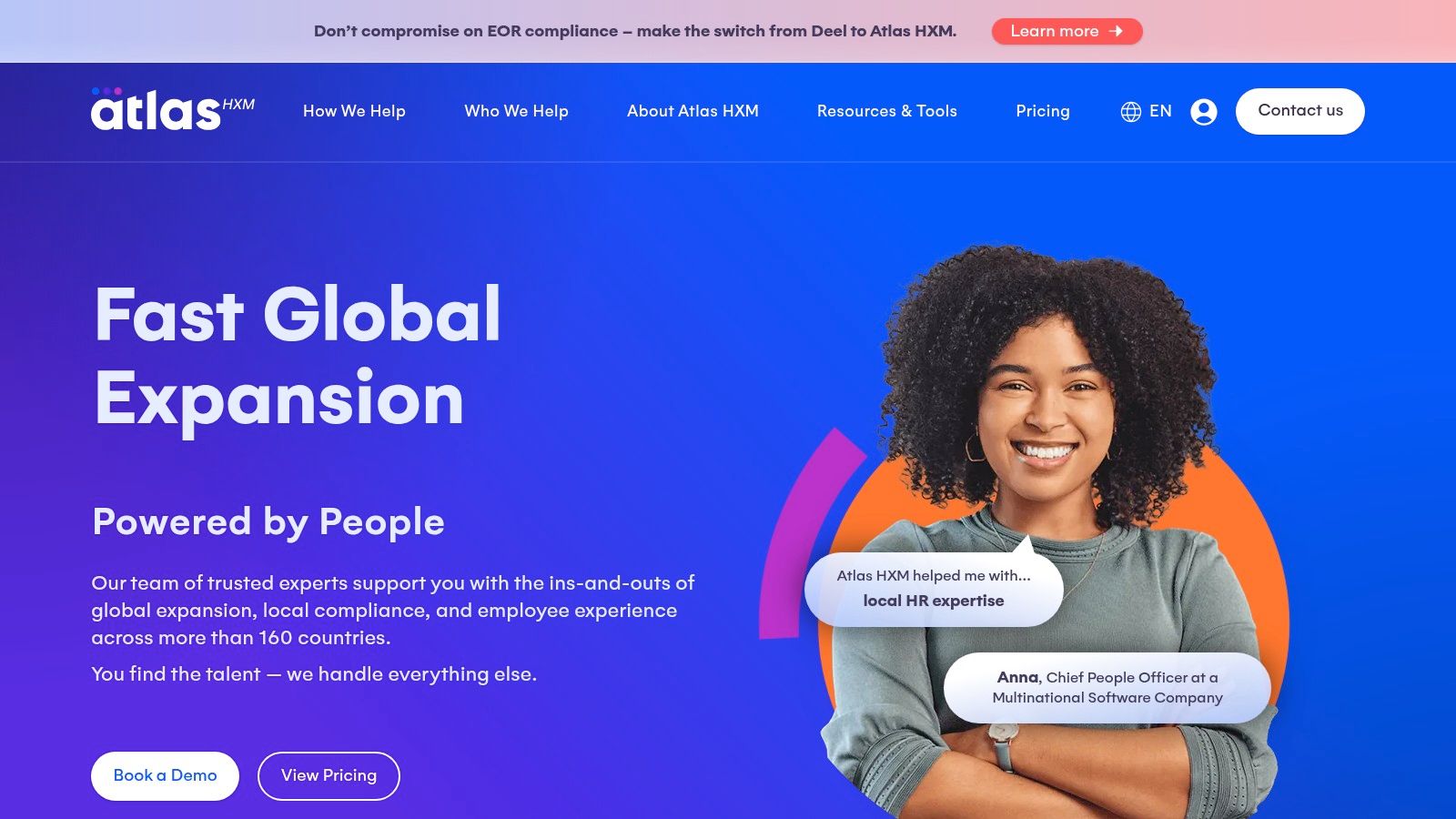
The platform is designed for organizations that are past the initial startup phase and are focused on building a sustainable, compliant global workforce. Its pricing model is all-inclusive, aiming to provide predictability for budget planning, though its starting costs are comparable to other premium solutions. While much of the platform is self-serve, its go-to-market strategy is more sales-led, particularly for complex needs or multi-country deployments, reflecting its focus on enterprise-grade solutions and services.
Pros:
Cons:
You can explore their solutions and request a demo on their official website: https://www.atlashxm.com
Remofirst enters the market as a highly budget-conscious EOR platform, appealing directly to startups and SMBs prioritizing cost-efficiency in their global expansion. Its primary draw is an aggressive and transparent pricing model, offering one of the lowest published starting rates for EOR services. This approach allows businesses to hire full-time employees and manage contractors across more than 185 countries without the substantial overhead typical of more established players, making it a compelling Deel alternative for cost-sensitive companies.
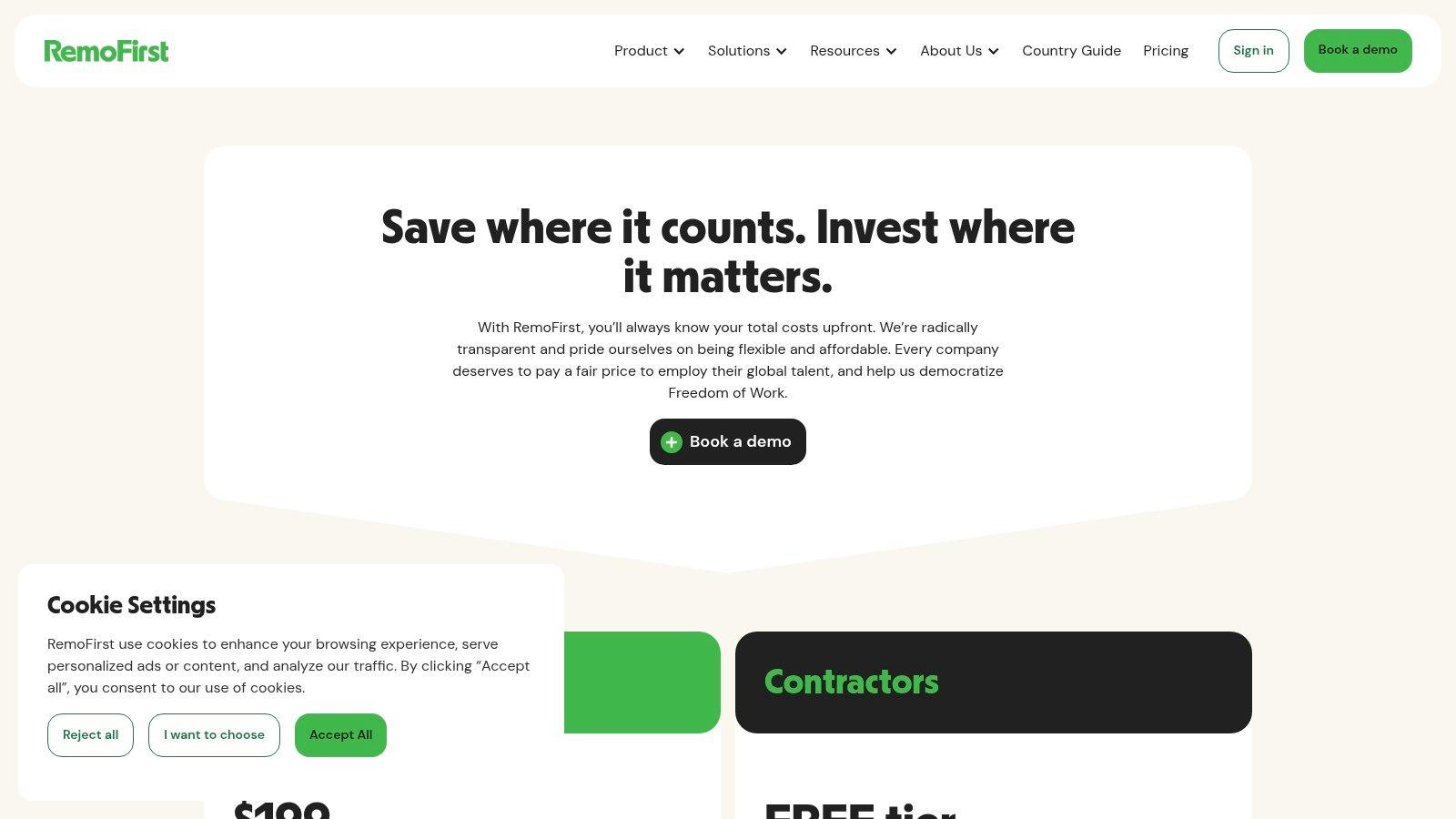
The platform is designed for speed and simplicity, boasting fast employee onboarding and responsive customer support through dedicated account managers. While Remofirst relies on a partner network rather than its own legal entities in many regions, this model enables its broad geographical coverage and competitive pricing. For organizations comfortable with a partner-based compliance structure, Remofirst delivers significant value and operational agility. Their model can be particularly attractive to a freelance recruiter building out a distributed team for a client.
Pros:
Cons:
You can explore their plans and use their cost calculators on their pricing page: https://www.remofirst.com/price
Plane (formerly Pilot) carves out its space as a global payroll and EOR provider by focusing on operational simplicity and direct financial transactions. It supports businesses looking to manage both full-time employees and international contractors through a unified platform. A key differentiator is its payment philosophy; Plane prioritizes direct bank payouts over e-wallets, simplifying the payment process for global teams and ensuring funds are received without extra steps or third-party accounts. This straightforward approach makes it a compelling Deel alternative for companies that value efficiency and transparency in their payroll operations.
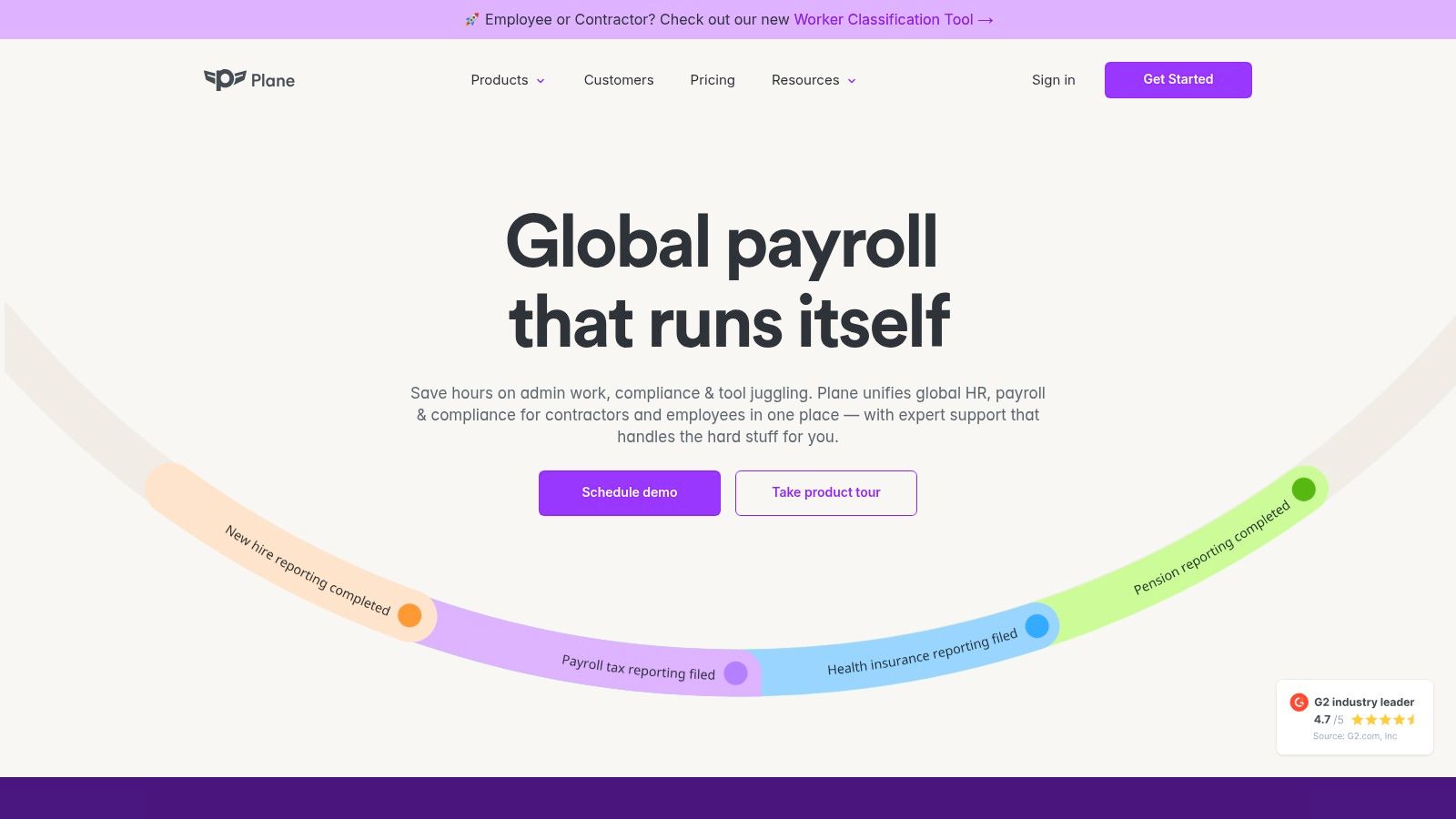
The platform is particularly well-suited for businesses that also have a significant US presence, as it includes US W-2 payroll and HRIS functionalities alongside its international offerings. This dual capability allows companies to manage domestic and global workforces without needing separate systems. Its clear pricing and extensive help center documentation further appeal to teams that prefer self-service and predictable costs when scaling their hiring.
Pros:
Cons:
You can explore their services and pricing structure directly on their website: https://plane.com
Boundless positions itself as a streamlined global employment platform with a strong European focus, emphasizing transparent pricing and compliance. It's designed for companies that need a straightforward Employer of Record (EOR) solution, particularly when expanding into the UK and EU. The platform's core value proposition is its simplicity; it offers a single, clear fee for its EOR services, which consolidates all employer costs into one invoice. This makes it an effective Deel alternative for finance and HR teams who prioritize predictable budgeting and clear documentation over a vast, feature-heavy ecosystem.
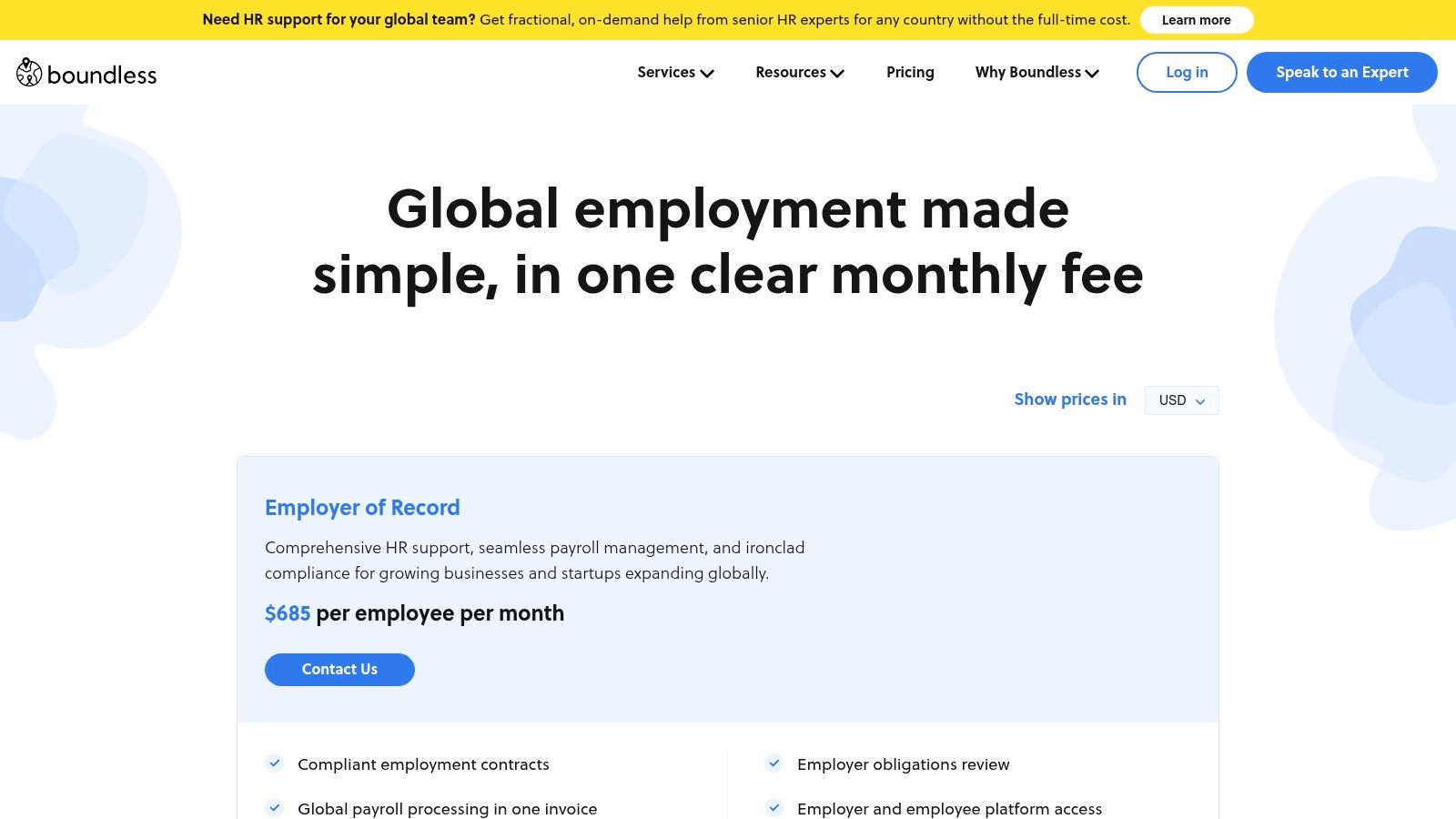
The platform is well-suited for businesses that value a direct, supportive relationship with their EOR provider. Boundless prides itself on providing clear compliance documentation and direct access to local employment experts via live chat and email. This hands-on approach appeals to companies that want more than just a software interface and prefer having a clear line of communication to navigate the complexities of international employment laws, especially within Europe.
Pros:
Cons:
You can view their current pricing and offerings directly on their website: https://boundlesshq.com/pricing/
Skuad enters the market as a value-focused global HR platform, offering competitive pricing for Employer of Record (EOR) services and contractor management. It carves out a niche by providing broad country coverage (160+ countries) and attractive volume discounts, making it a compelling choice for businesses planning to scale their international workforce quickly. By blending a multi-currency payroll engine with localized contract agreements, Skuad presents a practical and affordable solution for managing a distributed team, positioning it as one of the more accessible Deel alternatives for cost-conscious companies.
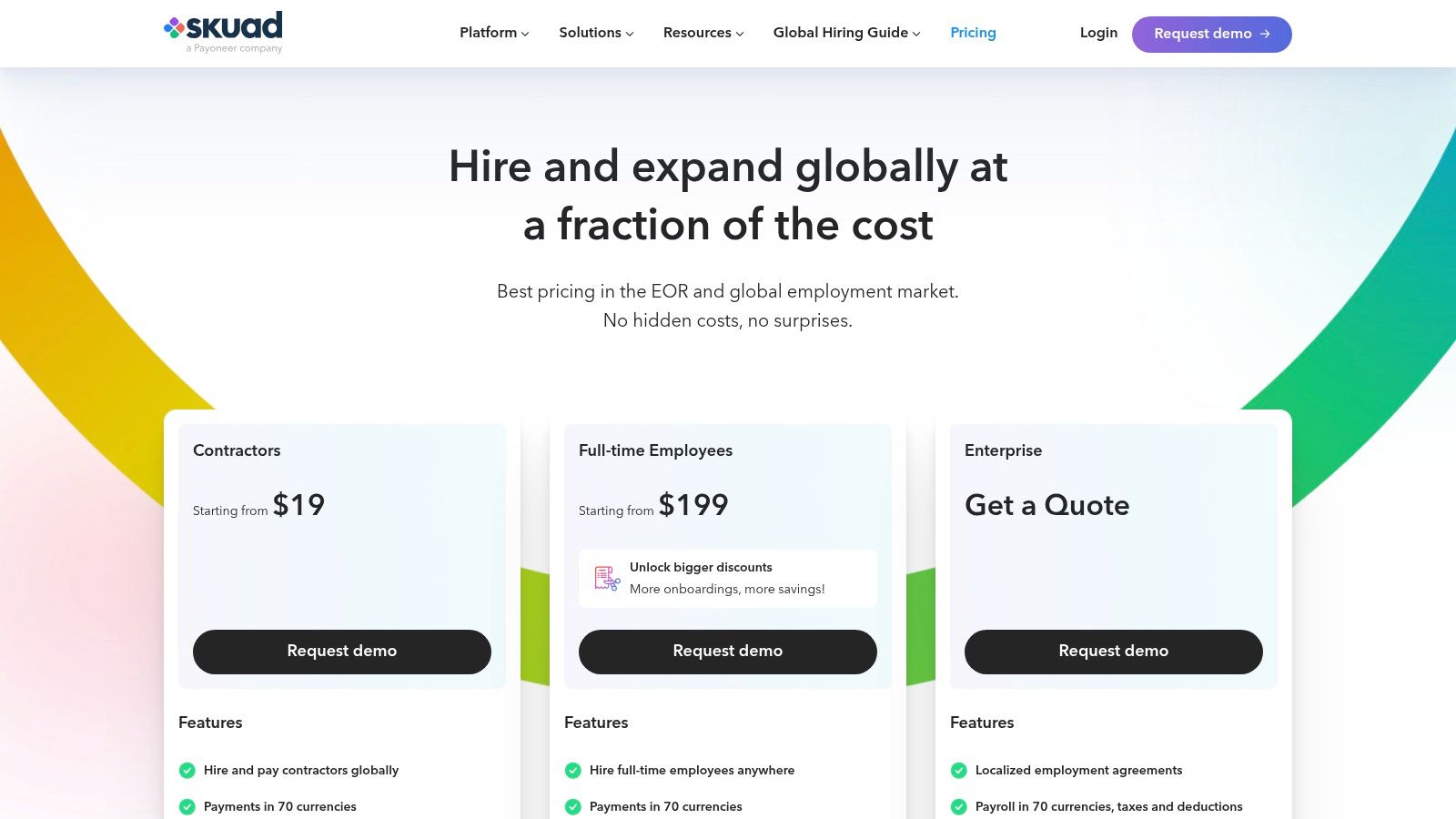
The platform is particularly well-suited for startups and growing businesses that need a comprehensive global employment solution without a premium price tag. Its transparent fee structure and multi-channel support aim to simplify the complexities of international hiring. While it relies on a partner network in many locations rather than fully owned entities, its strength lies in its balance of cost, coverage, and essential features like visa support and equipment logistics.
Pros:
Cons:
You can view their current pricing and offerings directly on their website: https://www.skuad.io/pricing
Navigating the crowded market of Deel alternatives can feel overwhelming. We've dissected twelve of the strongest contenders, from all-in-one powerhouses like Rippling to direct-ownership EORs like Atlas HXM and nimble, startup-focused platforms like Plane. The core takeaway isn't that one platform is definitively "best," but that the "right" choice is intensely personal to your company's stage, budget, and global ambition.
You might think that once you've selected a platform, the hard part is over. Why that fails: a world-class global HR stack is useless without world-class talent to run through it. For example, Google found that by using a global hiring model, they were able to reduce their average time-to-hire by 25% within just one year, a testament to the power of expanding the talent pool. This is the real goal.
As you move from evaluation to decision, anchor your choice in these four critical areas. Don't just look at feature lists; model them against your specific growth plans.
Choosing the right global hiring platform can also support broader talent retention strategies. For example, explore global lessons on retaining talent in technology, including insights on pay transparency and flexibility. A platform that enables these modern work arrangements is a powerful retention tool.
What is the best Deel alternative for a small business?
For small businesses, Remofirst and Multiplier are excellent choices due to their transparent, low-cost pricing models that make global hiring affordable.
Which Deel alternative has the best compliance?
Remote and Atlas HXM are top choices for compliance because they operate with their own legal entities, offering greater control and reducing third-party risk.
Can these platforms help with visa and immigration?
Yes, many platforms like Oyster, Remofirst, and Skuad offer visa and immigration support as part of their services, helping you relocate top talent globally.
Ultimately, selecting from the many excellent Deel alternatives is about building an operational backbone that lets your talent acquisition team do what they do best: find and attract incredible people. The core benefit isn't just simplified payroll; it's the removal of geographical barriers to talent. This unlocks your ability to hire the best person for the job—period—transforming your total addressable talent market from a local pond into a global ocean.
{{large_cta}}
Run your first search for free. Find and engage top talent across 800M+ profiles. Trusted by 5,000+ customers.

.png)
.png)
.png)