.svg)
SIGN UP FOR JUICEBOX (IT’S FREE!)

Who are you looking for?
Thank you! Your submission has been received!
Oops! Something went wrong while submitting the form.

Think of a database for recruitment not as a dusty, digital filing cabinet, but as an active, intelligent engine for discovering talent. It’s a tool that does more than just store resumes; it helps you find, verify, and connect with both active and passive candidates from all corners of the internet.
A great one is your unfair advantage in a competitive market.
Here's how to build a database for recruitment that helps you hire better, faster:
For too long, recruitment databases have been treated like passive repositories where candidate profiles go to collect digital dust. Recruiters spend hours wrestling with complex Boolean searches just to find someone relevant. It's like using an old library card catalog to search the entire internet.
But there’s a problem most tools ignore: the best talent isn't just sitting in your inbox waiting. They’re passive candidates who aren’t actively looking, and you have to go find them. This is where the old model crumbles.
Here’s the deal. An AI-powered database for recruitment is different. Instead of a simple catalog, it's a team of expert researchers. You tell it what you need in plain English, and it won't just find who you asked for—it will even suggest incredible candidates you didn't know you needed. It’s a complete shift from reactive resume management to proactive, strategic talent sourcing.
We built Juicebox on this principle: turn passive data into active discovery, giving any team, regardless of size, the ability to compete for top talent.
The infrastructure powering this change is huge. The global HR and recruitment services market, which relies on this technology, hit a massive $893.9 billion in 2024. This number alone shows just how critical a powerful database for recruitment is for any modern business.
Instead of just storing applicants, modern systems are built to cultivate relationships with a wide and diverse talent pool. For a deeper dive, check out our guide on effective candidate relationship management.
Modern platforms like Juicebox let you search across millions of profiles using simple, conversational language. Ready to streamline your hiring? Explore these powerful AI recruiting tools.
This screenshot shows exactly how it works. A recruiter can find highly specific talent just by describing their ideal candidate, completely ditching the need for manual Boolean searches and saving hours of tedious work.
Let's bust a common myth: your Applicant Tracking System (ATS) is not a real sourcing database. Most believe it is, but the opposite is true. Why? Because it creates a massive blind spot in your hiring strategy.
You see, your ATS is a reactive tool. It was built to do one thing really well—manage people who have already applied to your jobs. It’s an administrative system for organizing an existing pipeline, not a discovery engine for building one from scratch. While our guide on what an ATS is explains its functions, it was never designed for proactive sourcing.
A true sourcing database plays a totally different game. Its main job is to open up the entire passive talent market for you—the millions of top-tier professionals who aren't scrolling through job boards but would be the perfect fit for your team. This is the shift from old-school, reactive recruiting to a modern, proactive talent engine. To see how this compares to other platforms, check out our analysis of Indeed alternatives.
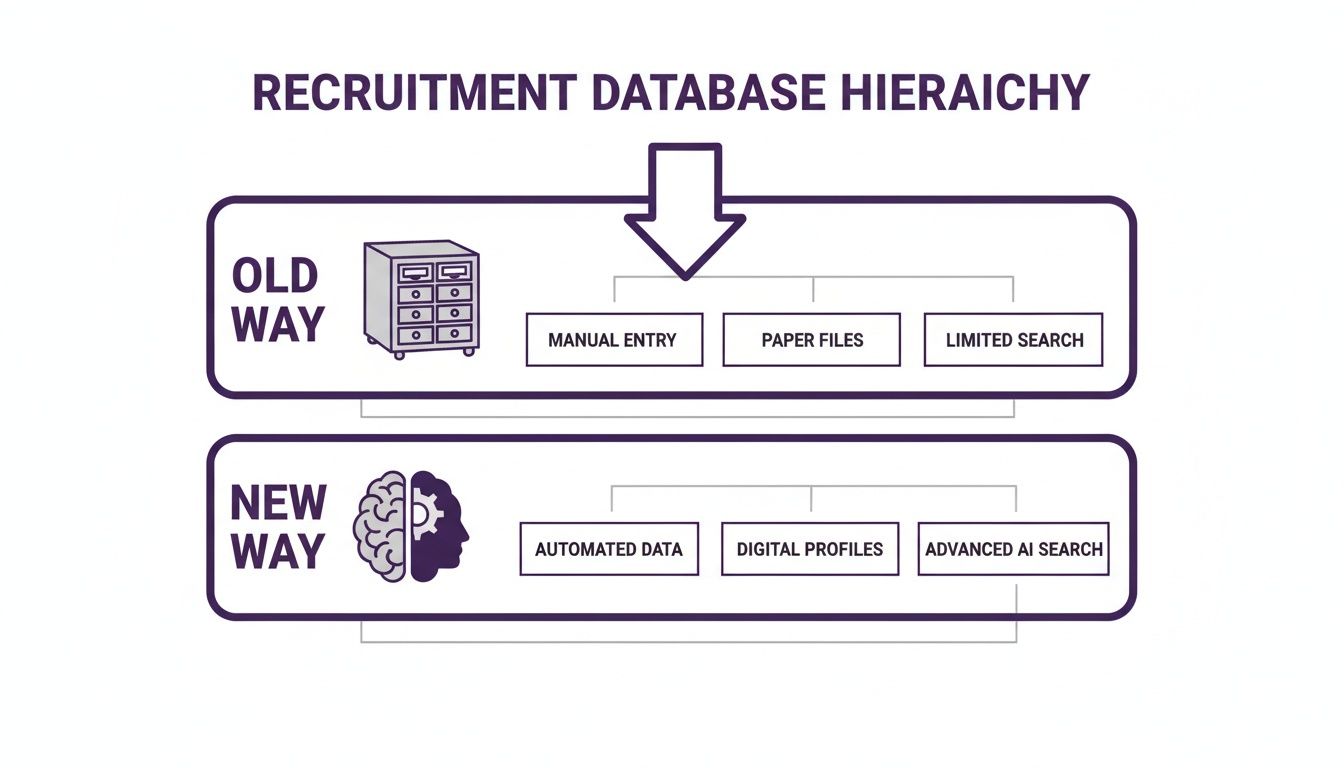
The image above perfectly illustrates this evolution. We've moved from the "Old Way," a static card catalog of applicants, to the "New Way," an intelligent and dynamic brain that actively discovers talent. It’s the difference between simple data storage and a true engagement platform.
Think of it this way: your ATS is the filing cabinet where you keep folders on everyone who walked into your office looking for a job. A sourcing database, on the other hand, is the powerful telescope you use to scan the professional universe for stars you never knew existed.
To make this even clearer, let's break down how these different systems function:
| System Type | Core Function | Primary Data Source | Limitation for Sourcing |
|---|---|---|---|
| ATS | Manages inbound job applicants and the end-to-end hiring workflow | Candidates who have actively applied to your jobs | Reactive: Only includes active applicants, missing the entire passive talent market |
| CRM | Manages relationships and nurtures leads (often past candidates) | “Silver medalists,” past applicants, and referrals | Limited scope: Closed ecosystem relying on previously collected data, not net-new talent |
| Sourcing Database | Proactively discovers and engages the external talent market | Aggregated public profiles from dozens of sources (LinkedIn, GitHub, portfolios, etc.) | Purpose-built: Optimized for discovery and engagement, not for managing the internal hiring workflow |
The biggest problem with relying only on an ATS or CRM is that they force you to choose between your internal applicant data and the vast external talent pool. This creates disconnected silos of information.
The goal isn't to replace your ATS but to supercharge it. For example, modern recruiting tools like PeopleGPT integrate directly with dozens of top ATS and CRM systems. According to a 2024 analysis by Zippia, 75% of recruiters use some form of recruiting software. But without a sourcing layer on top, they're only seeing a fraction of the available talent. This integration turns an administrative tool into a strategic hiring machine.
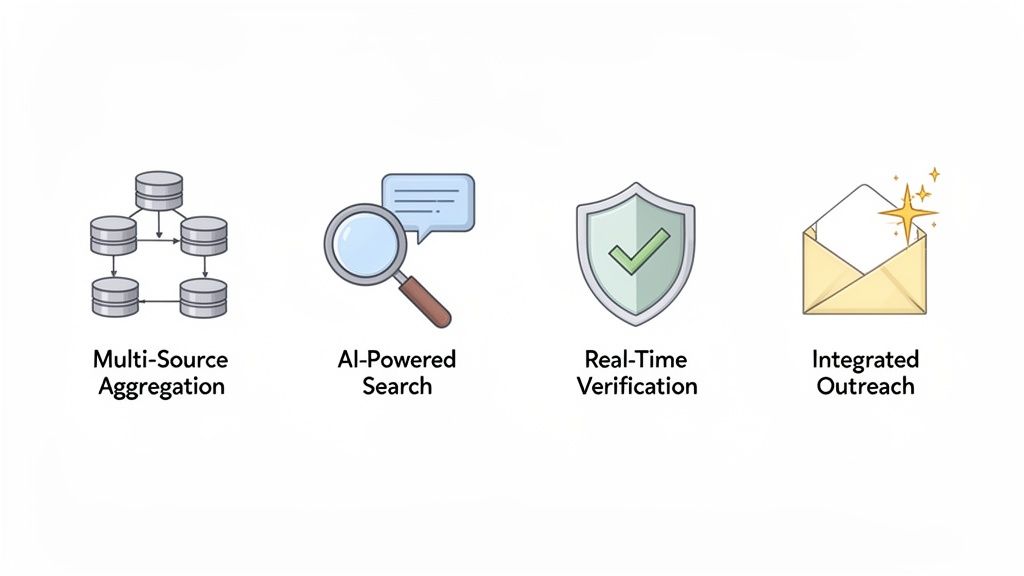
What really separates a game-changing database for recruitment from a glorified spreadsheet? It's an intelligent engine built for speed and precision. A high-performance database is defined by a few non-negotiable components that work together to find, verify, and engage top talent before your competitors even know they exist. A poorly structured 9-80 work schedule can hinder productivity; likewise, a poor database hinders recruitment.
The foundation is multi-source aggregation. Legacy systems often trap you in a single ecosystem, severely limiting your view. A modern system pulls and unifies data from dozens of public sources—like GitHub, academic sites, and personal portfolios—to create a complete, 360-degree picture of a candidate.
This is critical. Why? Because in 2023, 82% of jobseekers used social networks to find opportunities, showing how fragmented the talent landscape is. A powerful database pulls from all these sources automatically.
Next up is AI-powered search. Recruiters shouldn't have to be Boolean wizards. Modern platforms use natural language, letting you simply describe your ideal candidate—"senior backend engineer with fintech experience at a YC-backed startup"—and get a ranked list of perfect matches in seconds.
But finding profiles is only half the battle. You need accurate, up-to-date information. This is where real-time data verification comes into play.
The best systems don't just find profiles; they constantly refresh them. They automatically validate email addresses, update job titles, and confirm current employment, ensuring your outreach lands in the right inbox.
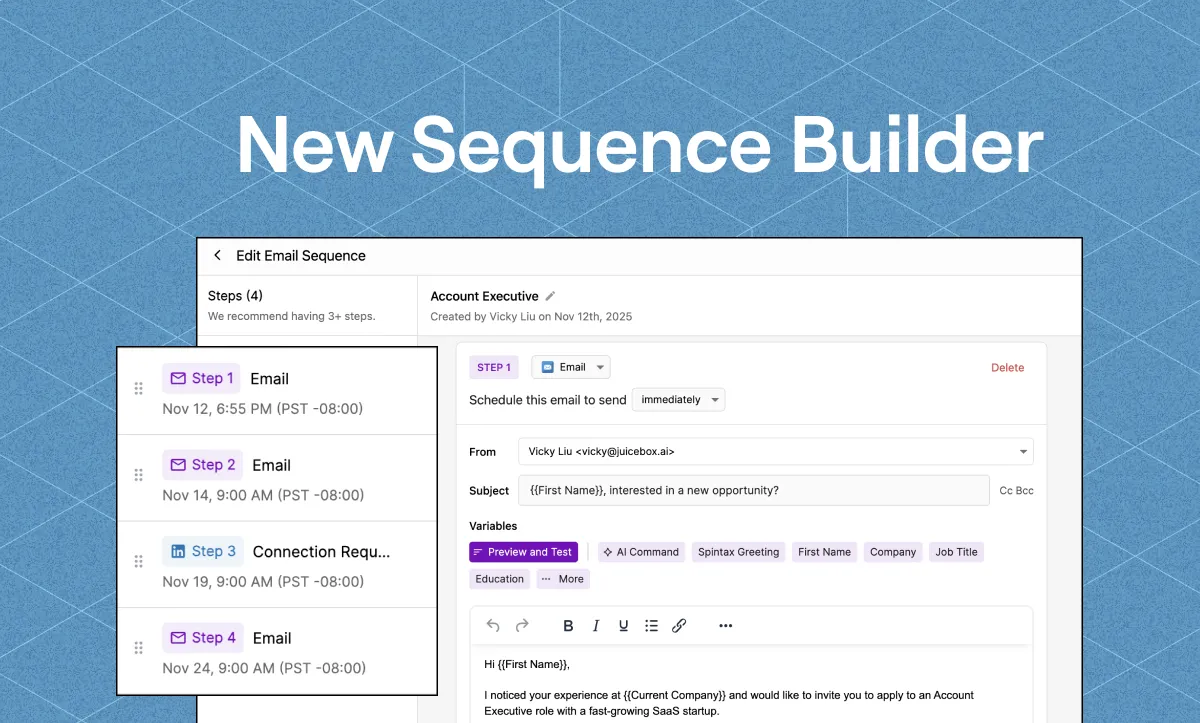
Finally, all these pieces need to connect seamlessly to integrated outreach tools. Companies like Ramp and Perplexity use this integrated approach to close critical roles 5x faster. By using an AI-powered database for recruitment, they score thousands of profiles per search and instantly surface the best fits. You can see how Juicebox helps create richer talent profiles through this exact process. Understanding SeekOut pricing can also provide context on market rates for similar tools.
This screenshot shows how a simple prompt can instantly generate a list of qualified candidates, complete with verified contact info and one-click outreach options. This seamless workflow collapses the sourcing-to-outreach process from hours to seconds.
Choosing the right database for recruitment can feel like navigating a minefield. Get it wrong, and you're locked into a clunky, expensive system that slows down hiring. But get it right, and it becomes the engine driving your entire talent strategy.
You might think you need a massive budget and a long implementation cycle to get a powerful tool. But that's exactly where the old enterprise model fails. You think you're buying a complete solution, but what you often get is a year-long implementation, mandatory training, and a price tag that needs board approval. This old model values complexity over speed and efficiency.
What's the bottom line? The average cost per hire is around $4,700, but that can easily balloon when sourcing is inefficient. With nearly 90% of hiring managers struggling to find qualified talent, it's no surprise that 44% of firms now use AI to improve matching and slash hiring times.
Modern tools flip this script entirely. They’re built on transparent pricing and an intuitive experience. Focus your evaluation on these three core pillars:
Once you’ve found a tool that nails these criteria, getting started should be painless. Forget those month-long onboarding programs. For a deeper dive into your options, check out our recruiting software comparison guide.
The entire process should look something like this:
This streamlined approach means you spend less time wrestling with software and more time building relationships.
This is where theory hits the road. A modern, AI-powered database for recruitment doesn't just nudge your workflow forward—it completely rebuilds it, turning a slow, manual chore into a strategic edge.
Remember spending hours wrestling with complex Boolean strings? That entire step is now a relic. Today’s sourcing workflow is conversational, intuitive, and fast.
Instead of fighting with syntax, a recruiter can just type what they're thinking.
Example Prompt:
“Find me backend engineers in San Francisco who previously worked at a YC-backed fintech startup and have experience with Rust.”
This natural language approach is a total game-changer. It frees up recruiters to focus on the what—the nuanced qualities that make a candidate great—instead of getting bogged down in the how of clunky search logic. You can see more on how this works in our deep dive on AI-powered sourcing.
The system instantly gets to work, scanning millions of profiles from over 30 public sources, scoring each one for relevance, and serving up a ranked list of the best matches.
Here’s what that actually looks like inside a platform like PeopleGPT.
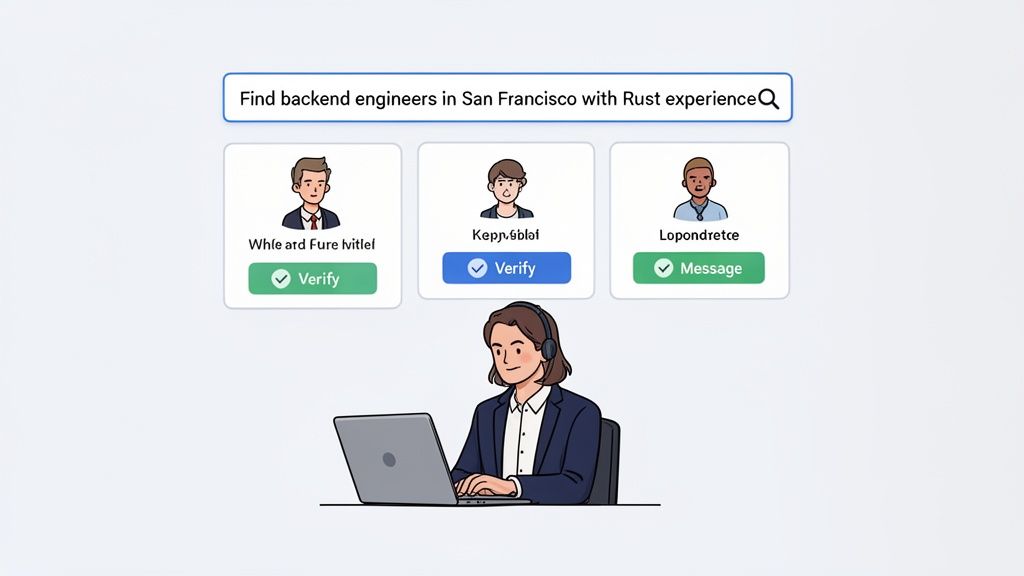
What you're seeing is the immediate payoff: an AI-curated shortlist of ideal candidates, complete with verified contact info. From there, a recruiter can launch a personalized outreach sequence in a single click. A process that used to take hours is now done in seconds. This is the new baseline for an effective database for recruitment.
And this isn't just for massive enterprises. Juicebox, a four-person team, scaled to over 2,000 paying customers without a single traditional salesperson, all by using their own platform to find talent. It’s proof that with the right tools, even the leanest teams can compete for top-tier talent.
An ATS manages active applicants who apply to your jobs. A recruitment database is for proactively discovering and engaging passive talent across the web.
AI understands natural language, so you can ditch complex Boolean searches. It also scans dozens of sources at once, saving hours of manual work.
Yes, reputable platforms are built to be fully compliant with data privacy laws like GDPR and CCPA, ensuring your sourcing is both ethical and legal.
Absolutely. It levels the playing field, giving small teams the same sourcing power as large enterprises so they can compete for top talent from day one.
A powerful database for recruitment isn't just another tool—it's the central nervous system of a modern talent acquisition team. The core benefit is transforming recruiting from a reactive, administrative task into a proactive, strategic function that directly drives business growth. What this unlocks is the ability for any company, regardless of size, to compete for and win top-tier talent by finding the best people faster.
{{large_cta}}
Run your first search for free. Find and engage top talent across 800M+ profiles. Trusted by 5,000+ customers.
.png)
.png)