.svg)
SIGN UP FOR JUICEBOX (IT’S FREE!)

Who are you looking for?
Thank you! Your submission has been received!
Oops! Something went wrong while submitting the form.

Data-driven recruitment isn't about letting robots make your hiring decisions. It’s the simple practice of using data and analytics to make smarter, faster, and fairer choices. Instead of relying solely on gut feelings, you use real insights to find, attract, and hire the right people.
It’s a shift from subjective guesswork to objective strategy, and it’s the core benefit that separates winning teams from the rest. At Juicebox, we've seen firsthand how this shift transforms recruiting from a cost center into a strategic advantage.
Think of it like a championship sports team. They don't just draft players based on what an old-school scout saw in one game. They dive deep into advanced analytics to predict performance, find undervalued talent, and build a roster engineered to win.
That’s exactly what data-driven recruitment does for your company. It applies that same analytical discipline to building your most important asset: your team.
For too long, hiring has been bogged down by slow processes, sky-high costs, and hidden biases. We've just accepted things like long time-to-fill rates and hit-or-miss quality of hire as the cost of doing business. But there’s a problem most tools ignore: they show you lagging indicators, not the real-time insights you need to land top talent before your competitors even know they exist.
TL;DR: The Short Version
This guide will show you how to move from theory to practice, turning your talent acquisition function from a cost center into a strategic driver of business growth. Let's get started.
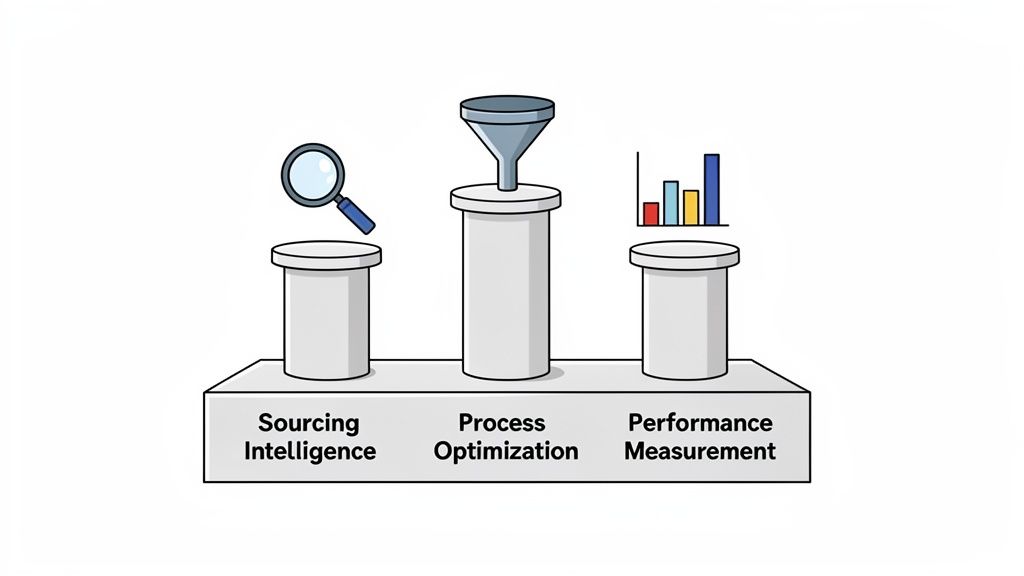
Making the switch to a data-driven recruitment model can feel like a massive project, but it’s simpler than it looks. The whole system really just rests on three core pillars. Get these right, and you’ll turn hiring from a reactive chore into a proactive, strategic weapon.
Think of it like building a house. You wouldn’t start without a foundation, walls, and a roof, right? These three pillars give your hiring engine the structure it needs to be stable and predictable when it comes to attracting top talent.
Look, here's how it breaks down.
The first pillar is Sourcing Intelligence. This is all about going beyond basic keyword searches and using data to find entire talent pools your competition doesn't even know exist. This is a critical component of any effective streamline recruitment process.
Second is Process Optimization. Here, you dig into your hiring funnel to find and fix the bottlenecks that drag out your time-to-fill and make great candidates drop out.
And finally, there's Performance Measurement. This is where you track the actual quality of your hires, not just recruiter activity, creating a feedback loop that helps you get better with every hire.
Great sourcing isn't just about finding resumes; it's about understanding the entire talent market. Sourcing Intelligence means using data to get answers to critical questions before you even send that first outreach message. A great way to start is with powerful Xray search techniques.
Where do the best engineers for our niche actually hang out online? What are the real salary expectations in that specific market? Which companies are sitting on untapped, high-potential talent?
Answering these questions with data stops you from wasting weeks searching in all the wrong places. For instance, instead of just defaulting to LinkedIn, data might show you there's a thriving community of qualified candidates on GitHub or a niche industry forum. According to Deloitte's 2024 Global Human Capital Trends report, over 70% of companies are now using AI to sharpen these early-stage recruiting functions.
Once you've found great candidates, the next challenge is moving them through your pipeline without losing them. Process Optimization is about analyzing every stage of your funnel to identify and plug the leaks. A huge drop-off rate between the phone screen and the technical interview, for example, is a massive red flag.
Look for bottlenecks like:
Data makes these problems impossible to sweep under the rug. A talent insights dashboard, like the one below, can immediately shine a light on where candidates are getting stuck.
This kind of visualization instantly tells you where your process is breaking down, letting you focus your energy on the fixes that will have the biggest impact.
The final pillar is what closes the loop. Performance Measurement is all about connecting your hiring efforts to actual business outcomes. You might think your team is crushing it because they're hitting their outreach numbers, but are those new hires actually performing well six months down the line?
This is where you graduate from vanity metrics and start focusing on what really matters.
By tracking the right metrics, you create a powerful feedback system. If new hires from a certain university consistently become top performers, you know to double down on that source. Conversely, if candidates sourced from a specific job board have high turnover rates, you can cut that spending and reallocate your budget.
This pillar is what links recruiting directly to business goals. A LinkedIn Talent Solutions survey found that over 60% of talent professionals consider "quality of hire" the single most important recruitment metric. But without a system to measure it, you're just guessing.
To build a solid framework for this, check out our deep dive into the most important KPIs of recruitment. This is how you prove the strategic value of your talent acquisition team.
To get real results from data-driven recruitment, you have to look past the vanity metrics. Things like social media shares on a job post feel good, but they don't tell you if you're actually making good hires. Drowning in dozens of data points is just as bad—it leads straight to analysis paralysis.
The trick is to focus on a few key performance indicators (KPIs) that tell the whole story of your hiring performance.
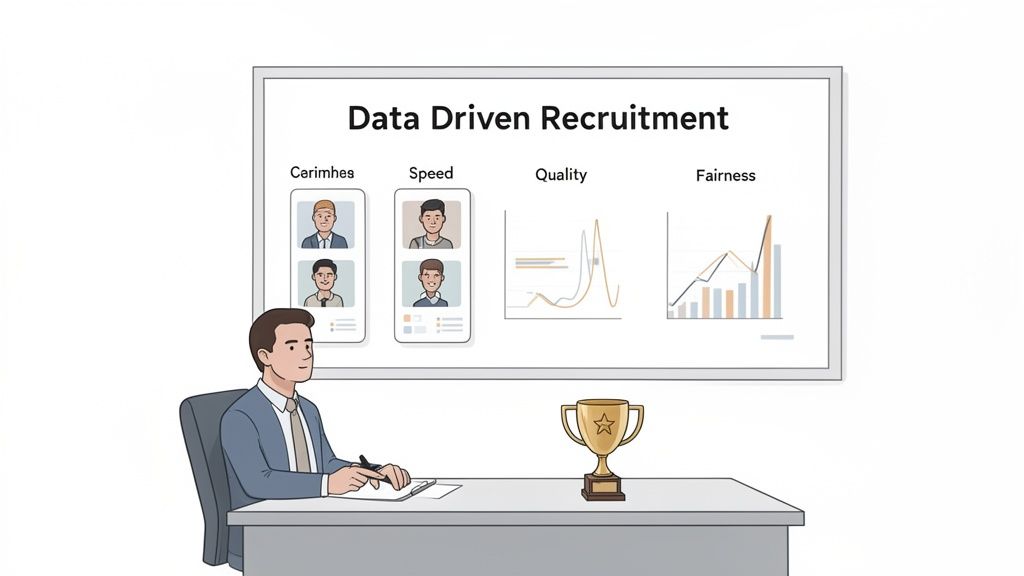
Think of it like the dashboard of a car. You need to know how fast you're going (Speed), if you're headed in the right direction (Quality), and how much fuel you're burning to get there (Efficiency).
Tracking all this might sound like you need a dedicated data analyst, but most believe you need a data science degree to get started. The opposite is true. Modern platforms like Juicebox are built to automate this reporting, turning messy data into simple, clear charts. The point isn't to create more work for yourself; it's to get powerful insights without wrestling with spreadsheets.
In a competitive talent market, speed is everything. The very best candidates are often off the market in just 10 days. A slow process doesn’t just frustrate candidates; it can cost you your top choice before you even make an offer.
These aren't about rushing; they're about spotting the hidden bottlenecks. Are interview scheduling delays grinding things to a halt? Is feedback from hiring managers too slow? These metrics bring those problems to the surface.
Proof in Action: The team at Ramp, a leader in finance automation, completely changed their sourcing game. By looking beyond a single platform and using a multi-source strategy with AI recruiting tools, they found 80% of their hires outside of LinkedIn in just 3 months. This move dramatically sped up their Time to Fill for mission-critical roles.
This is the most important—and easily the hardest—metric to get right. A fast hire who doesn’t perform is a massive drain on the company. Quality of Hire is the true measure of the value a new employee brings.
But there’s a big problem with how most tools handle this. They often rely on simple, post-hire surveys, which are subjective and don't paint the full picture. A much better approach is to combine a few different data points for an objective view:
By looking at these three inputs together, you get a much clearer, more reliable picture of who your best hires really are—and, crucially, where you found them. For a deeper dive, check out our detailed guide to essential recruiting metrics.
Efficiency metrics make sure your hiring engine is not just effective but also sustainable. They help you get the most out of your budget and your recruiters' time. The main KPI here is Cost per Hire, which is simply your total recruiting expenses divided by the number of hires you made.
This includes everything—job board fees, technology costs, recruiter salaries, you name it. Tracking it helps you justify your budget and make smarter decisions about where to put your money.
The industry is already moving in this direction. By 2025, 64% of talent acquisition leaders plan to increase their tech budgets, and 67% of HR leaders are putting more money into analytics. This isn't just a trend; it's a response to a global recruitment market projected to hit $1.06 trillion by 2030.
| Metric | What It Measures | Why It’s Critical |
|---|---|---|
| Time to Fill | The total number of days from opening a job requisition to a candidate accepting the offer. | Measures overall hiring velocity and exposes bottlenecks across the entire hiring process. |
| Time to Hire | The total number of days from a candidate entering the pipeline to accepting the offer. | Shows how quickly you can move qualified candidates through your hiring funnel. |
| Quality of Hire | The value a new employee adds, measured through performance, productivity, and retention. | The ultimate indicator of hiring success and long-term business impact. |
| Cost per Hire | Total recruiting costs (technology, ads, recruiter salaries) divided by number of hires. | Ensures hiring efforts are financially sustainable and ROI-positive. |
| Source of Hire | The channel where your strongest candidates originate (e.g., referrals, job boards, sourcing). | Helps you double down on channels that consistently deliver high-quality talent. |
Focusing on these core metrics gives you a complete, actionable view of your hiring performance without getting lost in the noise.
Knowing which metrics to track is one thing. Turning those insights into a coherent strategy is where the real work begins. Shifting to data driven recruitment isn't a project you knock out in a weekend; it's a fundamental change in how your team thinks and operates. This four-phase playbook gives you a clear path from theory to action, helping you build a hiring engine that constantly learns and gets better.
It gets better.
You can apply that same disciplined approach to your talent acquisition, just like building a high-performance race car. We're going to apply that same disciplined approach.
You can't improve what you don't measure. The very first step is a no-holds-barred audit of your current hiring process to get a baseline. This means digging into your existing data—no matter how messy it might feel—to understand your starting point for those essential metrics we've covered.
Key questions to answer:
This audit isn't about judgment. It's about creating a clear "before" picture. These initial benchmarks become the yardstick you'll measure all future progress against, making it easy to prove the ROI of your new strategy down the road. This also informs your approach to hiring a freelance recruiter.
With a baseline set, it's time to equip your team with the right tools. A common misconception is that you need a complicated and expensive suite of separate software for sourcing, outreach, and analytics. The opposite is true. The modern approach is to consolidate with a single, powerful platform that tears down data silos and kills manual work.
This is where you'll pick and implement your core tech stack, making sure it plays nicely with your existing ATS or CRM. Getting team buy-in here is absolutely critical. The goal isn't to add another administrative headache but to introduce tech that makes everyone's job easier and more impactful. To get even smarter about this, you can learn more about how to use predictive analytics for HR.
The visualization really drives home the point that you need a balanced focus on all three areas to win at hiring long-term.
This is where your strategy truly comes to life. With the right tools locked in, you can start automating the most time-sucking parts of the recruiting workflow. This frees up your team for the high-value, strategic work they were hired to do. Instead of spending hours manually sourcing, you can deploy AI agents to find qualified candidates 24/7.
Here’s what that looks like in the real world:
Find, verify, and email 10 qualified software engineers from Series A fintech startups in 60 seconds using a single prompt. An AI-native platform like PeopleGPT can run this entire play autonomously—searching across dozens of sources, validating contact info, and launching a personalized outreach campaign—while you focus on talking to interested candidates.
This kind of automation collapses weeks of work into minutes, giving your team an insane speed advantage.
A data driven recruitment strategy is never really "done." The final phase is all about creating a continuous feedback loop to constantly refine your approach. Your tools should give you real-time dashboards that show how your KPIs are trending against the benchmarks you set back in Phase 1.
Schedule regular, data-focused check-ins with your team to review what’s working and what isn't. Is a new outreach template getting a higher reply rate? Are candidates from a specific source consistently crushing the technical screen? Use these nuggets of insight to make small, steady adjustments. This iterative process is what turns good hiring teams into truly exceptional ones.
Beyond just making things faster, the real heart of data-driven recruitment is its power to build a fairer hiring process. When you lean on objective data, you have one of the strongest tools available to dismantle the unconscious biases that quietly steer sourcing and screening decisions.
It’s about leveling the playing field. Instead of just going with a gut feeling about "culture fit"—which, let's be honest, often just means hiring people who remind us of ourselves—data forces everyone to focus on what actually matters: a candidate's skills, experience, and potential to do the job well.
So much of traditional hiring relies on proxies for talent that are just riddled with bias. Think about it: where someone went to college, who they used to work for, even their name. A data-driven approach is all about systematically swapping these subjective shortcuts for objective proof.
Here are a few practical ways you can start doing this today:
But this brings up a huge, and valid, concern.
You might be thinking, "Won't AI and automation just bake in the biases already hiding in our old hiring data?" It’s a fair question. A poorly designed system can absolutely amplify unfair patterns. Why that fails is simple: garbage in, garbage out.
Here’s the reality: a well-built AI, one that's intentionally trained on diverse datasets and calibrated to prioritize skills over superficial signals, creates a far more equitable process than a flawed, human-only system ever could. The goal isn't to remove human judgment entirely, but to give it objective guardrails.
If you want to go deeper into the complexities of using data ethically, including compliance and AI, this guide on navigating AI ethics, EPPA compliance, and risk management in Human Resources is a great resource.
At the end of the day, data creates accountability. It shines a light on biases, making them visible and impossible to ignore. A Glassdoor survey even found that 70% of organizations saw an improvement in landing top talent after they focused on a positive candidate experience—something that’s directly tied to fairness and transparency.
When you can clearly see the demographic breakdown of your talent pipeline at every step, you can start asking the tough questions and making targeted changes. This constant feedback loop is what drives real progress toward building a team that actually reflects the diverse world we live in. Data isn't just about efficiency; it's about integrity.
Most recruiters think building a powerful, data-driven hiring engine means juggling a dozen expensive, disconnected tools. You’ve got one for sourcing, another for verifying contacts, a separate CRM, and maybe an outreach sequencer on top of that.
This isn't just a misconception—it's the single biggest source of wasted budget and crippling data silos in modern recruiting.
The smart approach isn't about adding more tools; it's about strategic consolidation. The goal is to bring the core parts of your workflow together into one intelligent system that just works.
Your tech stack only needs to do three things exceptionally well: find talent, manage relationships, and track your progress. This boils down to three essential components that should act as a single unit.
Traditionally, these systems rarely talk to each other. You're left manually copy-pasting data, losing valuable context with every click. This is where AI-native platforms completely change the game.
You might think consolidating your stack means sacrificing best-in-class features for a clunky all-in-one. That’s old news. A truly unified platform like Juicebox integrates sourcing, verified outreach, and analytics natively. Why that fails to meet modern demands is clear: data friction and multiple subscriptions. This consolidation is a direct path to serious cost savings.
Let's get real about the hidden costs of a fragmented tech stack. Enterprise tools come with high prices, like LinkedIn Recruiter pricing, but hide their true cost behind sales calls. Once you tack on separate tools for email verification and outreach, your annual spend can easily spiral.
By bringing these functions under one roof, you kill off redundant costs and data chaos. For example, instead of paying for a sourcing tool and an email finder, an integrated platform handles both in a single, smooth workflow. To really nail this, look for platforms that can tap into specialized pools like AI, Machine Learning, and Data Science talent registers to find exactly who you need.
This unified approach isn’t just about saving money; it’s about making your entire process more efficient. It’s the difference between patching together a clunky system and driving a finely tuned machine built for speed. A modern stack gives you a massive advantage in the race for top talent. Find out more about the best sourcing tools for recruiters.
Start with a simple audit. You can't improve what you don't measure. Get a baseline for metrics like time-to-fill and cost-per-hire to find opportunities.
Absolutely. Modern platforms automate data collection, giving small teams powerful insights to compete for top talent without needing a massive budget.
Data helps pinpoint the specific skills and career paths of your top performers. You can then source and screen for those proven qualities in new candidates.
It doesn't have to be. In fact, consolidating with a single, powerful platform like Juicebox can be far more cost-effective than juggling multiple legacy tools.
The core benefit of data-driven recruitment is not about drowning in spreadsheets; it's about building an engine that lets you assemble incredible teams with speed and precision. It means moving past gut feelings and into a world where every single hiring decision is backed by solid proof.
This unlocks a massive competitive advantage. You are no longer just filling roles; you are engineering a high-performance organization from the ground up.
This approach gives you the power to find and connect with top-tier talent before your competitors even know they're looking. Suddenly, talent acquisition shifts from a reactive cost center to a core driver of business growth. A 2024 Deloitte report found that over 70% of companies are already using AI to sharpen their recruiting process. This isn't some far-off trend—it's the new standard for winning talent right now. You can see this shift happening in how the best sourcing tools for recruiters are evolving.
This isn’t just a better way to hire. It’s the only way to build a team that will out-innovate and outperform everyone else.
{{large_cta}}
Run your first search for free. Find and engage top talent across 800M+ profiles. Trusted by 5,000+ customers.
.png)