.svg)
SIGN UP FOR JUICEBOX (IT’S FREE!)

Who are you looking for?
Thank you! Your submission has been received!
Oops! Something went wrong while submitting the form.

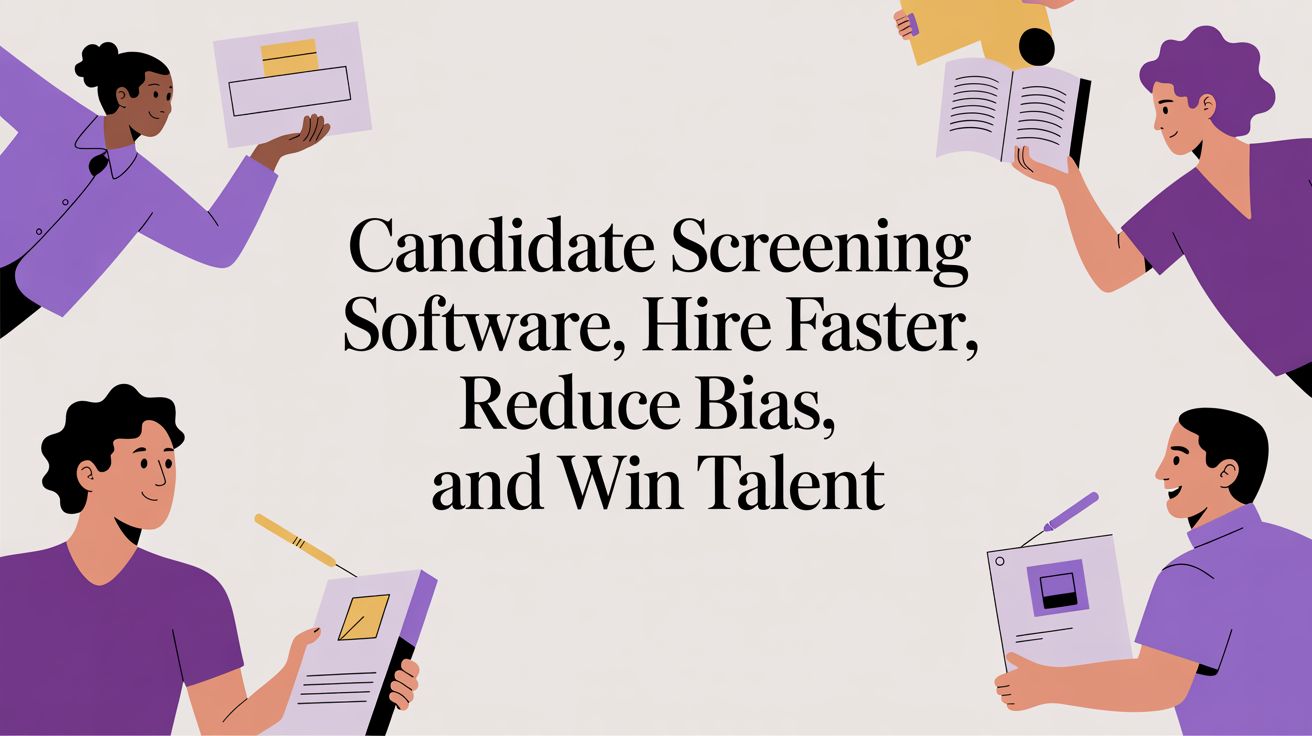
Recruiting can feel like looking for that mythical needle in a haystack. But let's be honest, finding candidates isn't the real problem. The soul-crushing part is the endless, manual sorting that comes after you've collected the hay.
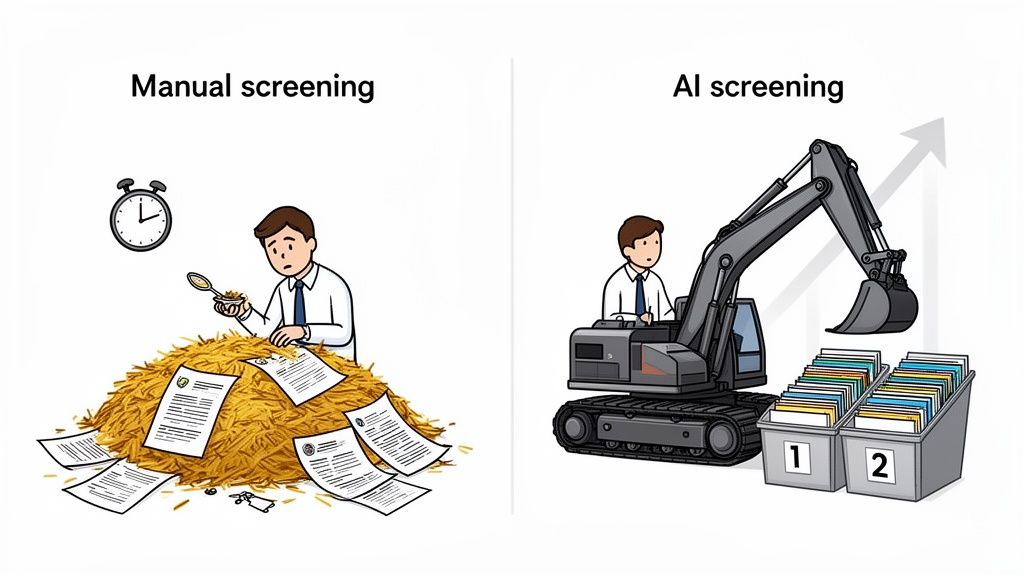
Doing it the old way is like panning for gold with a teaspoon. Modern candidate screening software, on the other hand, is like bringing in an industrial-grade excavator. It doesn’t just speed up the process; it fundamentally changes the game by using AI to pinpoint top talent your old methods would have missed. This guide will show you how.
TL;DR: Why This Guide Matters
The traditional hiring process is fundamentally broken. It's a massive operational bottleneck masquerading as administrative work. Recruiters spend hour after draining hour manually sifting through digital stacks of resumes, trying to match keywords to a job description. This isn't just slow; it's a strategic liability.
What's the bottom line?
Every minute spent reading an unqualified resume is a minute you're not spending with a high-potential candidate—someone who is almost certainly being courted by your competitors. The hidden costs are staggering and go way beyond just wasted time.
Most believe the biggest cost of slow hiring is recruiter salary. The opposite is true. The real damage ripples through the entire organization, hitting everything from team morale to the bottom line.
Here’s where it really hurts:
You might think, "My Applicant Tracking System (ATS) handles this." Why that fails? Legacy ATS platforms were built to be digital filing cabinets—databases for storing resumes, not intelligent systems for understanding them.
They lean on rigid, exact-match keyword filters that often screen out amazing talent. A filter for "Senior Software Engineer" could miss a rockstar whose resume says "Lead Developer." You're overlooking your best applicants because of outdated tech. The highly competitive world of Formula 1, for example, shows just how limited this is; the Red Bull Racing recruitment process demands a level of nuance that simple keyword matching could never provide. This is especially true if you're exploring alternatives to Indeed.
But there’s a problem most tools ignore... even modern ones. They still treat screening as a separate, isolated step.
True candidate screening software integrates this intelligence into a unified workflow. It doesn't just filter resumes. It analyzes skills, experiences, and career trajectories to bring qualified, interested candidates to the surface—people your old process would have buried. This isn't just about saving time; it's about fundamentally upgrading how you build your team.
Let's cut to the chase.
Modern candidate screening software acts as an incredibly smart digital librarian for your entire talent pool. It’s an assistant that reads, understands, and categorizes every profile instantly, surfacing the best-fit candidates before you even search the stacks.
This is a huge leap from where recruiting tech started. For years, Applicant Tracking Systems (ATS) were little more than digital filing cabinets. Their "screening" relied on crude keyword filters that missed brilliant candidates and buried more talent than they ever found.
Modern platforms don't just match words; they understand concepts, powered by sophisticated tech.
Here’s a quick look under the hood:
Instead of forcing recruiters to build complicated Boolean search strings—a skill that’s quickly becoming obsolete—the AI does the heavy lifting. This makes tools like X-ray search for recruiters less of a necessity.
Scoring a resume is just the beginning. The real magic is building a complete, verified picture of each person. A resume is just one data point, and it's often outdated.
Look, here's the deal.
The best platforms act as a central intelligence hub, enriching profiles with public data from dozens of sources—professional networks, code repositories, personal websites. The system then verifies information like email addresses and cross-references skills to create a single, unified profile you can trust.
This multi-source approach is no longer a "nice-to-have." The global recruiting software market hit $5.3 billion in 2024, driven by the need for AI that goes beyond a single channel (GlobeNewswire). With 80% of hires now coming from outside traditional networks, multi-source AI is the key to unlocking a massive competitive advantage.
Not all candidate screening software is created equal. The truly elite platforms are defined by a specific set of features that turn hiring from a reactive chore into a strategic advantage. It's not about having more features; it's about having the right ones working together.
The biggest leap forward is the shift from rigid keyword matching to intelligent, AI-powered scoring. Instead of just checking for "Python," these systems understand context, seniority, and related skills. For example, our guide to automated resume screening shows how this tech prevents great candidates from slipping through the cracks.
Key features include:
Proof: Companies like Ramp and Perplexity use Juicebox's AI to score thousands of profiles for a single search, identifying top candidates in under 60 seconds—a task that would take days to do by hand.
Here’s a common myth: a bigger candidate database is always better. Reality check: without smart screening, a huge database is just a bigger haystack.
The best candidate screening software excels at creating a single, unified view of every candidate. It acts as a central intelligence hub, pulling in and verifying data from dozens of different sources. This turns a flat resume into a dynamic, multi-dimensional profile. You're no longer guessing if an email is valid; the system has already done the heavy lifting.
The final pillar is connecting screening directly to action. An elite platform doesn't just identify top talent; it helps you engage them immediately.
The flowchart below shows how screening technology has evolved, moving from basic legacy systems to modern platforms that enrich profiles and automate entire workflows.
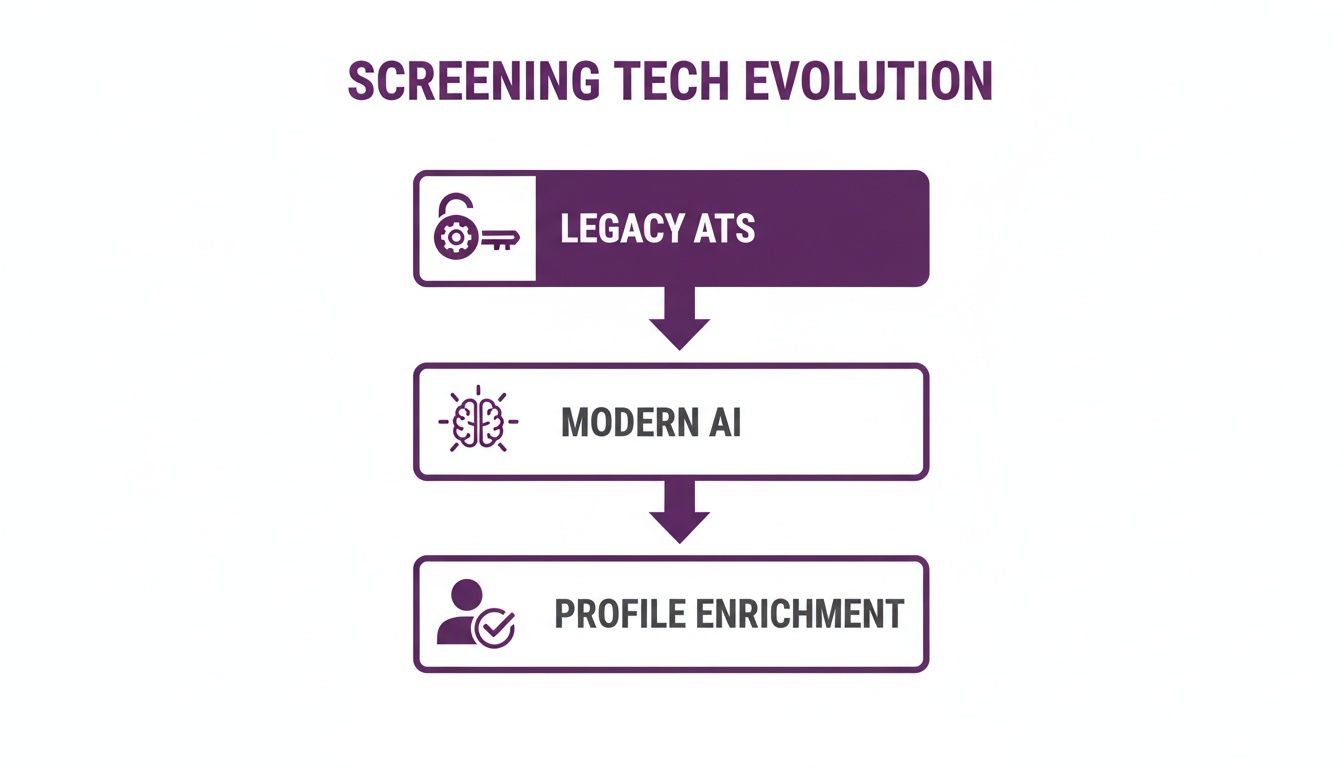
This progression makes it clear: the goal isn't just finding candidates, but creating a smooth, integrated process.
Core automation features include:
Switching to automated candidate screening software isn't just an upgrade—it's an operational overhaul. The impact ripples far beyond "saving time." We're talking about a measurable, strategic advantage.
Think of it like this: you can navigate with a paper map, or you can use real-time GPS. One gets you there eventually, but the other gives you the speed and intelligence to beat the traffic.
First, you'll see a massive drop in your time-to-hire. By automating the top of the funnel, teams can shrink a process that once took weeks down to days. But here’s the catch most tools miss: speed without quality is just a faster way to make bad hires.
Proof: Companies like Ramp and Perplexity use Juicebox’s AI to screen thousands of profiles per search, surfacing qualified people in under 60 seconds. This allows them to consistently fill mission-critical roles 5x faster than their competitors, turning talent acquisition into a growth engine.
While other companies are drowning in resumes, you’re already talking to the best candidates, dramatically increasing your odds of closing them.
Modern candidate screening software is built with fairness at its core. These systems are trained on diverse datasets and designed to focus only on objective criteria—skills, experience, and accomplishments. They actively ignore demographic data that can trigger unconscious bias.
This data-driven approach delivers two key wins:
The candidate skills assessment market, a key component, was valued at $2.3 billion in 2022 and is projected to hit $7.4 billion by 2032 (Allied Market Research).
Finally, the impact shows up on the balance sheet. When you automate hundreds of hours of manual work, you drastically lower your cost-per-hire. Your recruiters are freed from administrative grind and can focus on high-impact activities like building relationships and closing offers. This efficiency allows teams to scale hiring without scaling headcount, turning the talent function into a strategic asset. If you are a freelance recruiter, this kind of leverage is invaluable.
Picking the right candidate screening software is like bringing on a strategic partner. The right platform feels like an extension of your team; the wrong one adds friction.
First things first: integration. Your new software must connect seamlessly with your ATS, like Greenhouse or Lever. Without it, you're signing up for manual data entry that kills productivity.
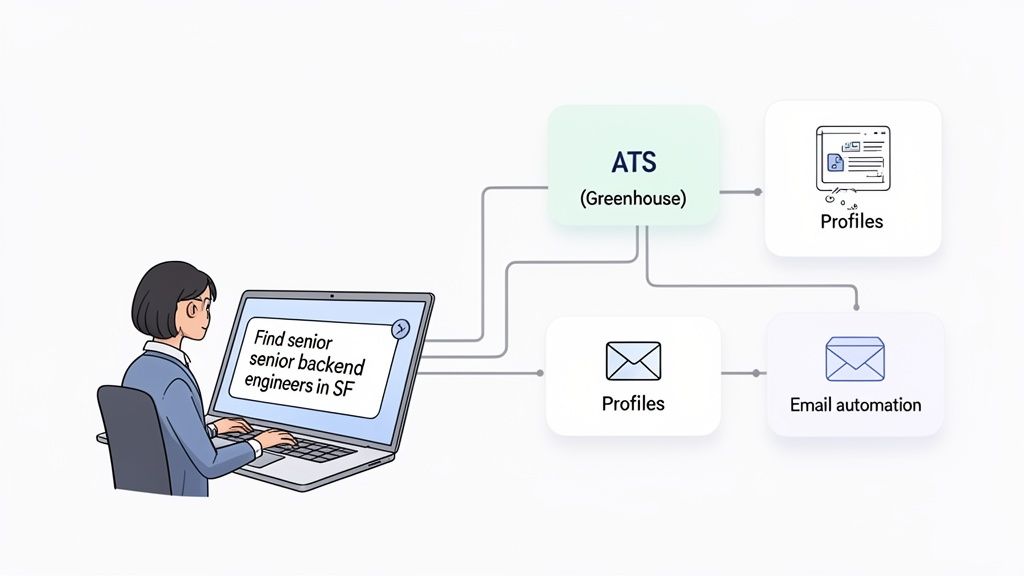
Next, dig into data quality and scale. A top-tier tool is built on a massive, verified, and refreshed talent database. Ask vendors about the size of their talent pool—platforms with hundreds of millions of profiles give you a serious leg up. But don't stop there. Ask how they enrich and verify that data.
Keep an eye out for these signs of a high-quality platform:
The global talent acquisition software market is exploding, valued at $10.8 billion in 2024 and projected to hit $24 billion by 2034 (Fact.MR). A huge reason is the speed of cloud-based systems, which offer 25% faster setup times. This is why PLG platforms are leaving legacy tools in the dust.
To really get a feel for a platform's value, picture it in action. The modern workflow for candidate screening software should be intuitive and lightning-fast.
Think about this scenario:
Proof: Juicebox scaled to 2,000 customers with no sales team by providing a tool that sets up in 60 seconds. This demonstrates the power of a PLG model that delivers immediate value, allowing teams to start sourcing on day one.
This proves powerful software doesn't need to be complicated. The best AI recruiting tools are the ones you can start using—and getting value from—almost instantly.
The screening tool market has split in two: sourcing-first platforms that score inbound and outbound candidates against a job, and assessment-first platforms that put candidates through a structured task or interview before a recruiter ever opens their resume. The right pick depends on where your bottleneck sits, at the top of the funnel or in the middle.
Below are five platforms worth a serious look this year.
Juicebox is a sourcing and screening platform built around natural-language search across 800M+ profiles from 30+ data sources. Recruiters describe the role in plain English ("Series B fintech engineer who's shipped a payments product, based in NYC"), and Juicebox returns a ranked, scored shortlist in about 60 seconds. Used by Ramp, Perplexity, Cognition, and 5,000+ other teams.
Key features:
Best for: In-house and agency recruiters who spend most of their time sourcing passive candidates and want to compress the search-to-shortlist-to-outreach loop.
Pricing: Per-seat plans with a free trial.
Mokka combines AI sourcing with structured pre-interviews. Its sourcing agent pulls from 850M+ profiles and 250+ job boards, then routes both inbound applicants and sourced candidates into a text, voice, or video interview scored against a competency model. The screening side is its main differentiator: Mokka evaluates answer content and structure rather than tone or appearance, which sidesteps a lot of the bias and AI-resume-optimization problems that traditional keyword screening can't handle.
Key features:
Best for: Talent teams running high-volume reqs who need to filter both inbound and sourced candidates before a recruiter screen.
Pricing: $199 to $699 per seat per month depending on tier.
Truffle is candidate screening software that combines resume screening, one-way video interviews, and talent assessments in one platform. You design your own screening workflow for each role, and AI scores and ranks every candidate against your criteria, surfacing match scores, summaries, and 30-second Candidate Shorts. AI surfaces the evidence, but recruiters make the decision.
Key features:
Best for: in-house recruiting teams and agencies hiring for high-volume roles that need to separate real, qualified candidates from AI-polished resumes without outsourcing the decision to AI.
Pricing: $149/month, or $99/month billed annually. 7-day free trial, no credit card required.
HireVue is the incumbent in video interviewing. Candidates record asynchronous responses to structured questions; HireVue's models score them and surface a ranked list. Heavily used by enterprises with thousands of applicants per req in financial services, retail, and hospitality.
Key features:
Best for: Enterprise hiring teams running large-volume hourly or graduate programs.
Pricing: Custom enterprise pricing; typically starts in the low five figures annually.
Vervoe leads with skill assessments rather than interviews. Candidates complete realistic, role-specific tasks (writing a customer email, debugging code, building a campaign brief) and Vervoe's models grade the output. The pitch is that you're hiring on demonstrated work, not credentials.
Key features:
Best for: Teams hiring for roles where output quality is hard to read off a resume, including writers, designers, ops, and junior engineers.
Pricing: Starts at $300 per month; usage-based enterprise pricing.
TestGorilla is the lower-cost workhorse for skills testing. Recruiters assemble multi-test assessments (cognitive, personality, role-specific, language) and send them to candidates before a screen. The catalog is broad, with 400+ tests, and the per-candidate cost is low enough that smaller teams can use it on every applicant.
Key features:
Best for: SMB and mid-market teams who want pre-screen assessments without an enterprise contract.
Pricing: Free tier; paid plans from $75 per month.
If your hardest problem is finding qualified candidates in the first place, lead with a sourcing-first platform: Juicebox if you live in passive outbound, Mokka if you want sourcing and screening in one workflow.
If your hardest problem is filtering a flood of inbound applicants, lead with an assessment-first platform: HireVue for enterprise volume, Vervoe for output-based roles, TestGorilla for breadth on a budget.
Most teams end up with two tools: one for the top of the funnel, one for the middle. The integration story between them is where you'll spend more time than you expect, so check ATS compatibility before you sign anything.
How does AI screening software reduce hiring bias?
AI tools focus on objective data like skills and experience while ignoring demographics. This ensures consistent, data-driven evaluation for every single candidate.
Can screening software integrate with my current ATS?
Yes, the best platforms connect seamlessly with tools like Greenhouse and Lever. This eliminates manual data entry and creates a unified workflow across your entire tech stack.
Is this software affordable for startups?
Absolutely. Modern tools often use product-led growth models that let you start for free and scale as you grow, unlike expensive legacy tools like those with SeekOut pricing.
Using the right candidate screening software isn't just about efficiency—it's a strategic weapon to build an incredible team before your competition can react.
By automating the soul-crushing manual work, you free your recruiters to focus on what they do best: building relationships with top-tier talent.
What this unlocks is the ability to consistently out-hire your rivals. You secure the people you need to build, innovate, and lead. This isn't just about filling roles; it’s about winning your market by building a better team, faster than anyone else.
{{large_cta}}
Run your first search for free. Find and engage top talent across 800M+ profiles. Trusted by 5,000+ customers.

.png)
.png)
.png)