
.svg)
SIGN UP FOR JUICEBOX (IT’S FREE!)

Who are you looking for?
Thank you! Your submission has been received!
Oops! Something went wrong while submitting the form.


Candidate relationship management is all about playing the long game. Instead of waiting for a role to open and scrambling to find someone, you're building genuine, lasting relationships with potential hires before you even have a job for them. It’s a fundamental shift from a reactive, transactional process to a proactive, strategic one.
Most recruiting software was built for a past era, focusing on managing applicants after they apply. But modern recruiting is about proactive sourcing. We built PeopleGPT to be an AI-native platform that unifies sourcing, engagement, and relationship management, giving teams the tools to build talent pipelines before they're needed.
You’re essentially creating a warm pipeline of qualified people who already know and respect your company. Ready to see how it works?
Let's be honest, traditional recruiting can feel like putting out fires. A position opens up, and the mad dash begins: post the job, sift through hundreds of applications, and hope the perfect candidate just happens to see it.
The result? It’s an inefficient process that leaves far too much to chance.
Think of it like this: reactive recruiting is like fishing with a single line and hoping for a bite. Candidate relationship management, on the other hand, is like cultivating a fully stocked fish farm. You aren't just waiting for talent to come to you; you're actively building a community and nurturing connections.
The game has changed. Today's top talent is mostly passive—they aren't desperately scrolling through job boards. A reactive strategy misses this massive pool of people entirely. By building relationships over time with a tool like one of these best sourcing tools for recruiters, you stay on their radar.
The core idea is simple but powerful: stop treating candidates like disposable applicants and start treating them like valued members of a professional network.
The market is catching on. The global Candidate Relationship Management (CRM) software market hit $1.4 billion in 2024, and it's projected to keep growing. This isn't just a fleeting trend; it’s a clear signal that the industry is moving away from outdated, spray-and-pray sourcing methods.
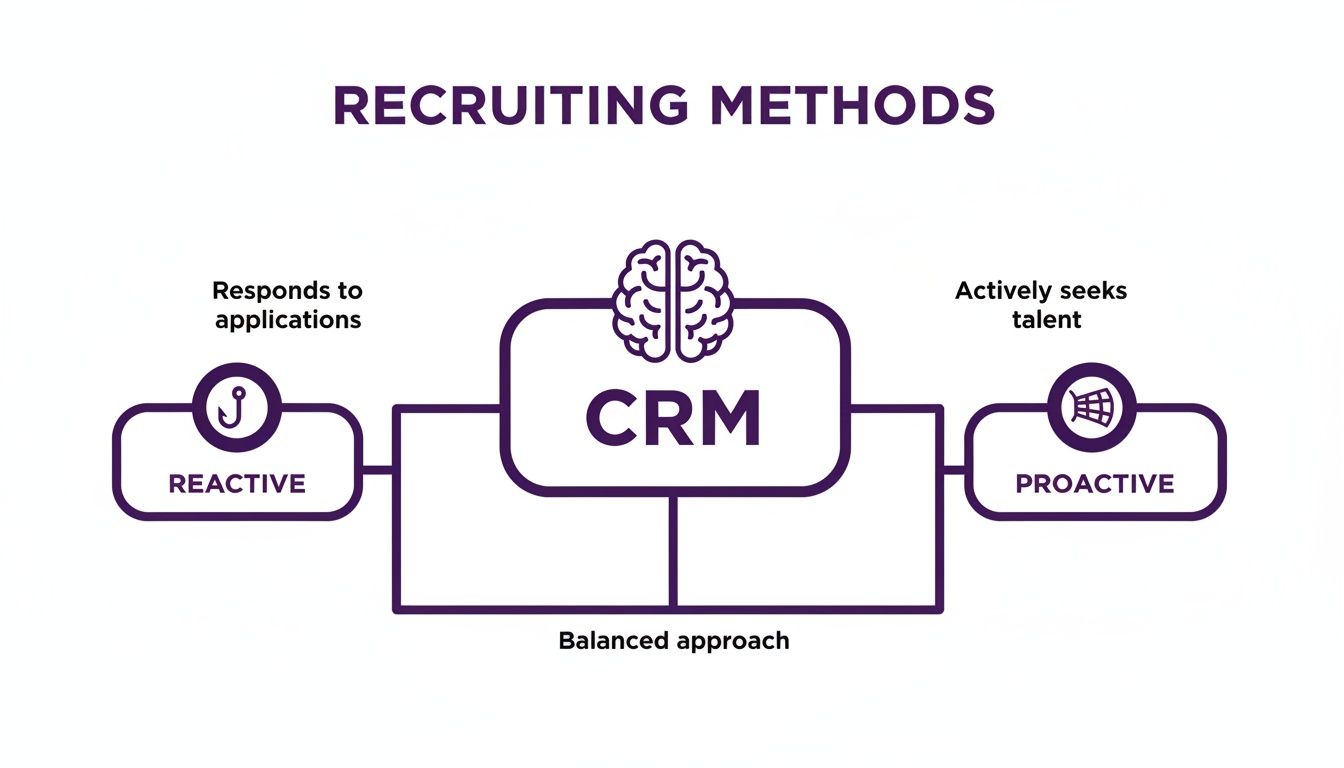
ALT: Candidate relationship management diagram showing reactive (job applicants) and proactive (sourcing) methods feeding into a central CRM talent pool.
As you can see, a CRM strategy becomes the hub that merges reactive inputs (like past applicants) with proactive sourcing efforts, creating a single, high-value talent pipeline. But what does that actually look like in practice?
Most recruiting tools were built for a different era. They force you into clunky Boolean searches and are often walled off in a single data source like LinkedIn. This is where an AI-native platform like Juicebox flips the script. Instead of wrestling with complex search strings, you can use plain English to source talent across 30+ platforms and over 800 million profiles.
This isn't just about making the process easier; it makes it smarter and way more cost-effective. Ramp, for example, used PeopleGPT to hire a senior engineer in just two weeks, a process that normally takes months. By letting AI handle the tedious parts of sourcing and engagement, you get to focus on what actually matters: building real connections. This is the new foundation of effective candidate relationship management.
A top-tier candidate relationship management strategy isn't just a list of things to do; it's a well-oiled machine built on three core pillars that feed each other. Think of it less like a checklist and more like a flywheel.
But how do you get that flywheel spinning?
The first pillar is about more than just slapping tags on candidates based on their skills. It's the art of segmenting your talent network by their potential, engagement, and career goals. You're organizing people into strategic groups that make sense for your business:
When you segment like this, every message you send is instantly more relevant. But there’s a problem most tools ignore: this pool is useless if you can't activate it with effective outreach.
This is where the real relationship-building happens. Nurture Campaigns are personalized, multi-step outreach sequences designed to give people value without always asking for something.
A solid nurture sequence might look something like this:
The goal is to stay top-of-mind by being helpful, not annoying. Over time, these touchpoints build trust and make future hiring conversations feel natural. Getting this right is crucial, and there are tons of proven candidate engagement strategies you can borrow from.
The final pillar is the glue that holds the whole system together. It's about making sure every single interaction someone has with your company—whether they get the job or not—is positive and respectful. One bad experience can poison your talent pool and wreck your employer brand.
This isn't a "nice to have"; it's a must-have. A staggering 75% of employees who had a positive hiring experience said it was a key reason they accepted the job. When these three pillars work in concert—smart pooling, valuable nurturing, and a stellar experience—you get that powerful flywheel effect. This is how you streamline your recruitment process.
For too long, most recruiters have seen their CRM as a digital Rolodex. The truth is, that's old-school thinking. AI fundamentally flips the script on candidate relationship management, turning it from a passive record-keeping chore into an active, intelligent sourcing engine.
You might think that AI just automates existing tasks. Why that fails is that it misses the biggest opportunity: creating entirely new capabilities. AI doesn't just make you faster; it makes you smarter. Let’s dig into three key areas where it makes the biggest waves.

For decades, sourcing has been chained to the rigid world of Boolean strings. AI completely does away with this. Instead of wrestling with cryptic operators, you can use natural, conversational language. This is the magic behind PeopleGPT. You can just type a prompt like:
"Find senior backend engineers in San Francisco who previously worked at a YC-backed fintech startup and have experience with Stripe's API."
The AI gets what you mean, then instantly scans over 800 million profiles from more than 30 platforms. This simple shift unlocks a massive pool of talent beyond LinkedIn’s walled garden, where you may encounter LinkedIn Recruiter pricing limitations.
Fast-growing companies like Ramp and Perplexity use PeopleGPT to close critical roles 5x faster by finding niche talent their competitors simply can't surface with traditional tools.
So you've found the right people. Now what? Blasting a generic email and hoping for the best is a surefire way to get ignored.
AI analyzes huge datasets on candidate behavior to predict the perfect time, channel, and even message tone for your outreach. It can quickly scan a candidate's public profiles to suggest personalized icebreakers, dramatically boosting your response rates when sending recruitment emails. This data-driven approach turns outreach from a guessing game into a calculated strategy.
What if your CRM could just do the sourcing for you, even while you sleep? That's the idea behind autonomous agents. You give an agent a role, provide quick feedback, and then it gets to work 24/7, constantly scouring the web for new profiles that fit your criteria. It learns your preferences and delivers a steady stream of warm, qualified candidates right to your inbox. This is just one of many ways to harness the power of AI in recruitment to build a stronger pipeline.
A strong candidate relationship management strategy feels like the right thing to do, but leadership wants to see the numbers. Forget vanity metrics; success is measured in speed, cost, and quality. A powerful CRM strategy moves the needle in three critical areas.
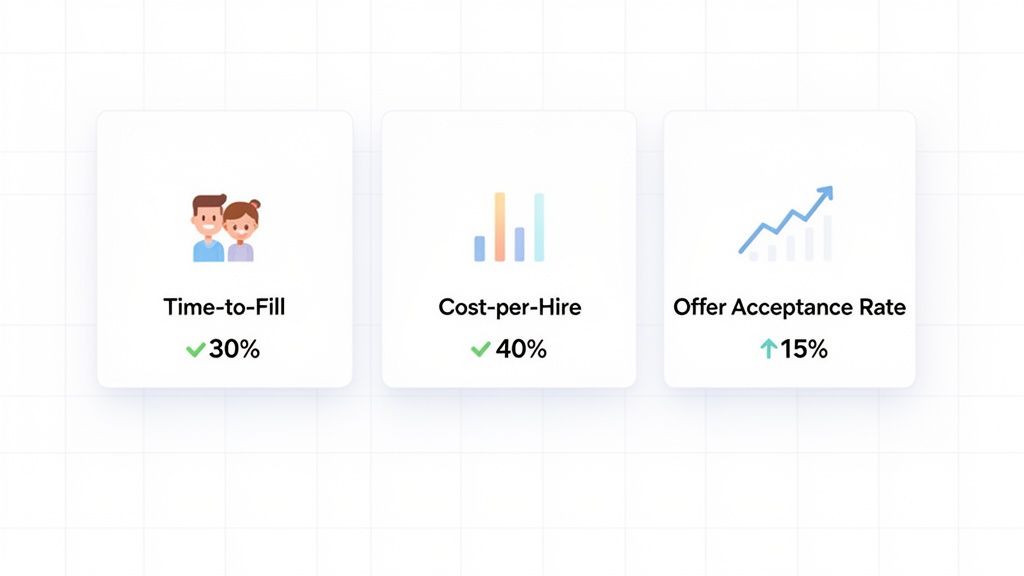
The clock starts ticking the second a role opens up. The real magic of CRM happens when you hire directly from your pre-built talent pool. When you can source from a warm pipeline, you skip the most agonizingly slow parts of the process: posting jobs, sifting through resumes, and sending cold outreach.
But here’s the catch most tools ignore: a huge database is useless if the contacts have gone cold. This is why platforms that merge sourcing with outreach are so powerful. For instance, Juicebox's built-in email verification and multi-step sequencer drive a 3x lift in reply rates, proving that your talent pool isn't just large—it's actually responsive. A healthy pipeline is one of the most important recruiting metrics you can track.
Let's talk money. A proactive CRM approach attacks the two biggest drains on a recruiting budget: agency fees and ad spend. When you hire from your own talent community, you don't have to lean so heavily on external agencies that charge 20–30% of a candidate's first-year salary. For a closer look, you can explore the factors that go into your cost-per-hire calculation in our detailed guide.
The financial upside here is huge. It’s no surprise that on average, every $1 invested in CRM brings back $8.70.
The final gatekeeper of your ROI is the Offer Acceptance Rate. A low rate is a painful sign of a broken process. When you've spent months building a genuine relationship, a job offer feels like the natural next step, not a cold proposal. Candidates who feel valued are far more likely to say yes.
A high acceptance rate is a direct reflection of a great candidate experience, which is what candidate relationship management is all about.
Picking the right platform for candidate relationship management can feel overwhelming. With so many tools promising to solve your problems, it’s easy to get lost.
But here’s the problem most tools don’t solve: they help you manage candidates, but they don’t help you find and engage them in the same place. This creates a clunky, disconnected workflow. The best tools today bring that entire workflow under one roof. For a full breakdown, check out our recruiting software comparison or explore top AI recruiting tools.
When you’re weighing your options, zero in on three non-negotiable criteria.
To see what this looks like, let’s compare an AI-native platform like Juicebox with older players:
| Feature | Juicebox (PeopleGPT) | LinkedIn Recruiter | SeekOut |
|---|---|---|---|
| Sourcing Engine | AI-powered natural language search | Boolean & keyword-based filters | Boolean & keyword-based filters |
| Data Sources | 30+ platforms (800M+ aggregated profiles) | LinkedIn only | Multiple external sources |
| Workflow | Search, verify, and email in a single prompt | Siloed search and messaging workflows | Separate sourcing and outreach tools |
| Pricing Model | Transparent pricing, starts free | Opaque, enterprise-focused contracts | Demo-gated, enterprise sales motion |
| Key Differentiator | Autonomous sourcing agents that execute end-to-end | Largest professional social network | Strong, tech-focused talent database |
This table points to a critical difference: Juicebox is built to be an end-to-end sourcing and engagement engine. For agile teams, that consolidated workflow is a total game-changer, exploring the best Indeed alternatives and beyond.
What's the difference between a CRM and an ATS?An ATS manages active applicants for open jobs. A CRM proactively builds relationships with passive talent for future roles. One is reactive, the other is proactive.
How long does it take to build a talent pipeline?It typically takes 3-6 months. However, AI-powered tools can slash that timeline by automating the identification and engagement of qualified passive candidates.
Can a small startup benefit from a recruiting CRM?Absolutely. A CRM helps startups build a high-quality talent network from day one, reducing reliance on expensive agencies and improving hire quality when it matters most.
Effective candidate relationship management isn't just about organizing contacts; it’s a strategic shift that turns hiring into a predictable growth engine. What this truly unlocks is the power to hire the best person for the role on your terms—not just the best person who happened to be looking that week. This is how you win the war for talent.
{{large_cta}}
Run your first search for free. Find and engage top talent across 800M+ profiles. Trusted by 5,000+ customers.




.png)