.svg)
SIGN UP FOR JUICEBOX (IT’S FREE!)

Who are you looking for?
Thank you! Your submission has been received!
Oops! Something went wrong while submitting the form.

At its core, candidate matching is the art and science of connecting the right person to the right job. It’s about looking beyond keywords to understand a candidate's skills, experience, and potential, and seeing how they align with a role's true needs.
This is a huge leap from just sourcing candidates; it’s about intelligently matching people to opportunities to guarantee a much better fit.
The goal? Stop chasing keywords and start finding genuinely qualified people who are perfect for your roles. For any team trying to win the war for talent, this shift is no longer optional.
For decades, finding talent felt like hunting for treasure with a torn map. Recruiters were armed with keyword lists and complex Boolean strings, meticulously trying to piece together clues from resumes. This traditional approach to candidate matching was a rigid game of exact inputs yielding exact—and often, very limited—outputs.
If a job description listed “Java Developer,” the system would only look for that exact phrase. A brilliant engineer who instead wrote “JVM languages” would be completely missed.
Let’s be blunt about it:
Relying on keyword search is like trying to find a book in a library with no catalog. You’re going to miss more than you find.
This is why we need to shift from a keyword 'search' mindset to an AI-powered 'match' mindset. You're not just looking for a "Senior Software Engineer" with "Python" on their resume. You're really looking for someone who has scaled backend systems at a high-growth startup and contributes to open-source projects. That’s a match, not a search. And it requires a solid understanding of Applicant Tracking Systems (ATS) to support this smarter approach.
But there’s a problem most tools ignore: they only look within your existing applicant pool or a single platform like LinkedIn. This creates a talent echo chamber where you see the same candidates over and over again, while a huge market of talent remains untapped.
For example, our data shows that over 80% of hires made through Juicebox are found on platforms outside of LinkedIn. This isn't just a new tool; it's a strategic overhaul that delivers speed and precision.
Optional Reading: Top 12 Linkedin Recruiter Alternatives (in 2026).
The first major leap forward was semantic search. Instead of just matching keywords word-for-word, semantic systems started to understand the meaning and relationships between them. This tech can recognize that "Java," "Spring Boot," and "Hibernate" are related concepts. This was a huge improvement, but even with semantic understanding, these systems are mostly reactive. They analyze the information candidates provide but struggle to infer what's not explicitly stated.
The real game-changer is AI-native candidate matching, the engine powering platforms like PeopleGPT. This isn't just a better map; it's a real-time GPS guiding you directly to your destination. This approach moves beyond analyzing individual words to understanding entire careers.
AI-native systems are built to:
This is the critical difference between finding someone who has the right keywords and finding someone who is the right fit.

Most recruiters believe crafting complex Boolean strings is a core skill. The opposite is true. Relying on them creates a barrier, preventing you from seeing the full talent landscape. A far more effective strategy is to describe your ideal candidate in plain English and let AI build a comprehensive search for you.
(For those still working with legacy systems, our guide on advanced Boolean search strategies can help.)
This shift isn't just a trend. By 2026, modern platforms are projected to achieve 67% better matching by using predictive analytics—a massive advantage when 73% of the workforce are passive candidates not browsing job boards.
Effective candidate matching isn't about how many profiles you can stuff into a pipeline; it’s about the quality of those profiles. Too many teams get hung up on vanity metrics like "total candidates sourced," but that number is just noise.
You might think that a bigger pipeline is always better. That’s a myth. The real goal isn't to build a massive database. It’s to build a smaller, better-qualified shortlist—and to do it faster than ever before.
Success is measured by how quickly you can narrow a huge talent pool down to a handful of people the hiring manager is excited to meet.
To get a real sense of what's working, you need to track KPIs that measure both speed and quality. These are the numbers that tell you if your candidate matching tech is a time-saver or just another time-sink.
Start with these three critical metrics:
Focusing on these KPIs gives you an honest look at your sourcing engine. Dig deeper into how these metrics roll up into the ultimate recruiting KPI: quality of hire.
It’s easy to think of AI as a "black box" that makes decisions you can’t see or influence. But the best systems are built for transparency and constant learning. You must audit the results from your AI candidate matching tool to make sure it's not just fast, but also fair and accurate.
But here’s the crucial part: don’t just review the results—give the AI feedback. Modern platforms like Juicebox use your input to get smarter. When you tell the system a candidate is a good or bad fit and why, you're actively training the model.
This creates a powerful feedback loop. Every single search becomes a learning opportunity. Your AI evolves from a static tool into a dynamic sourcing partner that actually understands what you're looking for.
This is what separates basic automation from true AI-powered sourcing. That's how you fine-tune your candidate matching engine for maximum relevance.
Theory is great, but tactical execution is what actually fills roles. Shifting to an AI-powered candidate matching workflow doesn't mean you have to burn your old playbook. It's about swapping out the slow, manual steps with smart automation.
You might think building a new workflow sounds complicated. Just think about the time you’re already losing to legacy processes. Endless Boolean revisions and juggling five different sourcing platforms—that’s what’s truly draining your time. An AI-native process clears the clutter so you can focus on engaging top candidates, not just finding them.
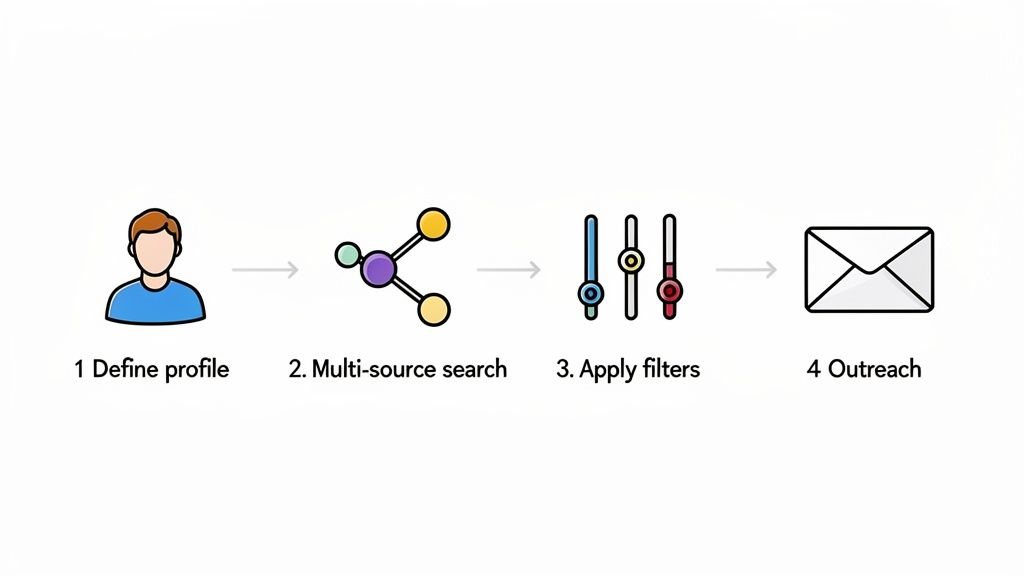
First things first: forget complex Boolean strings. The starting point in a modern workflow is to simply describe your ideal candidate like you would to a colleague.
Instead of typing this:("Senior Software Engineer" OR "Staff Engineer") AND ("Python" OR "Django") AND ("AWS" OR "GCP")
You can just write this:
“Senior backend engineer with deep experience in Python, who has scaled systems at a high-growth startup and understands cloud infrastructure like AWS or GCP.”
This small change is actually a huge leap forward. It allows the AI to grasp the intent and context behind your search, looking for real evidence of skills instead of just matching keywords. This is the cornerstone of effective candidate matching.
With your ideal profile defined, the AI scours over 30 different platforms—from GitHub to professional networks—to build a curated list of top-tier talent.
The system doesn't just dump a list of names on you. It delivers a scored and ranked shortlist, clearly showing you why each person is a strong match for your role. This turns hours of searching into minutes of review.
Now, it's time to zero in on the best of the best. This is where you can apply advanced "power filters" to slice the data in ways that are impossible with traditional search tools. For a deeper dive, check out our guide on modern sourcing strategies for recruiters.
You can instantly narrow your list based on criteria like:
The final piece is engaging your shortlisted candidates. An integrated AI platform closes the loop from sourcing to outreach by finding verified contact information and letting you launch personalized email sequences directly from your search results.
This entire workflow—from a simple English prompt to a list of engaged candidates—is built for speed and quality. Just look at Cognition Labs, which was able to slash its time-to-hire by 60% in only two months. By using Juicebox's AI-powered candidate matching to source senior engineers, they found incredible talent far beyond the usual confines of LinkedIn.
Let's be honest: fairness hasn't always been built into hiring. For decades, the standard recruiting playbook has unintentionally baked bias right into the sourcing process. When recruiters default to searching for specific university names or a handful of "prestigious" past employers, they're essentially fishing in a very small, very homogenous pond.
This is what’s known as pedigree bias. It’s a sneaky trap that rewards privilege over actual proficiency and systematically shuts the door on diverse talent.
But there’s a much smarter way to build a team.
Well-designed AI actively dismantles these old biases by shifting the focus from pedigree to actual, provable skills.

AI-powered candidate matching tears down the old walls. Instead of getting hung up on superficial signals like an Ivy League degree, it digs into a candidate’s entire professional footprint to find hard evidence of their skills and potential.
It does this by:
It's about what someone can do, not where they went to school. To get a handle on the legal side of this, our guide on understanding adverse impact in hiring is a great place to start.
You might think, "Doesn't AI just introduce its own 'black box' bias?" It's a fair question, but it’s usually based on a misunderstanding of how modern AI works. The uncomfortable truth is that human bias—which is often unconscious and nearly impossible to measure—is far more dangerous.
When designed correctly, AI operates on objective data. In fact, a recent report found that 55% of companies using AI hired more diverse candidates, which in turn helped them outperform their peers by 36% in profitability. The most effective hiring process isn’t AI alone; it's a partnership between human judgment and AI efficiency.
Is your recruiting toolkit starting to feel more like a messy garage than a high-performance workshop? So many teams suffer from tool fatigue, juggling separate platforms for sourcing, email verification, and outreach. This fragmented approach isn't just inefficient; it's a silent killer of productivity.
When your sourcing tool doesn't talk to your email sequencer, and neither syncs properly with your ATS, you create dangerous data silos.
It's a costly way to work, both in time and missed opportunities. The real problem is a disconnected stack forces recruiters to spend more time managing tools than actually engaging with top-tier talent.
The answer isn't just adding another niche tool. It's about consolidating around an integrated, all-in-one platform that brings candidate matching into a unified workflow.
An integrated system acts as the central nervous system for your recruiting operations. Every action, from initial sourcing to final hire, is tracked in one place, giving you a complete view of your entire talent pipeline.
With deep, two-way syncs for leading applicant tracking systems like Greenhouse and Lever, every candidate profile and interaction is automatically logged. This creates a single source of truth, ensuring no candidate ever falls through the cracks again. It's worth it to explore automated data integration to see how this works.
You might think that consolidating tools means sacrificing functionality. The opposite is often true. Legacy recruiting stacks make you pay for multiple subscriptions. An integrated platform delivers more power for less cost and complexity.
Think about how it works:
Our own data from over 2,500 companies shows that teams using an integrated stack close roles 5x faster than those relying on a fragmented toolkit.
By moving away from a siloed approach, you can learn more about our available integrations and build a powerful, cost-effective tech stack that drives real results.
Does AI candidate matching replace recruiters?
No, it empowers them. AI handles the time-consuming sourcing and filtering, freeing recruiters to focus on building relationships and closing top candidates.
How does AI find passive candidates?
AI scans dozens of online sources beyond job boards—like code repositories and professional networks—to find talent based on their actual skills, not just an application.
Is setting up an AI matching tool difficult?
Not anymore. The best modern tools are designed for immediate use. You can start sourcing in minutes just by describing your ideal candidate in plain English.
Can I trust the quality of AI-suggested matches?
Good tools explain why a candidate is a strong match, pointing to specific skills or projects, and use your feedback to get smarter over time.
Candidate matching eliminates the bottleneck between knowing who you need and actually finding them. Instead of building boolean strings or clicking through filters, you describe your ideal hire—PeopleGPT searches 800M+ profiles across 60+ sources and returns ranked matches in seconds.
For recruiting teams, this means compressing days of sourcing into minutes, with shortlists built on fit rather than keyword proximity. The time you recover goes back into the work that actually closes candidates.
Try PeopleGPT (by Juicebox) free →
{{large_cta}}
Run your first search for free. Find and engage top talent across 800M+ profiles. Trusted by 5,000+ customers.
.png)