.svg)
SIGN UP FOR JUICEBOX (IT’S FREE!)

Who are you looking for?
Thank you! Your submission has been received!
Oops! Something went wrong while submitting the form.


In 2026, the war for talent is won or lost on the candidate experience. Most TA teams believe sending personalized emails and responding quickly is enough. But this is a dangerous myth. While those are table stakes, the real leverage comes from the underlying technology and processes that create speed, transparency, and respect at scale. A poor experience doesn't just lose you one candidate; it damages your employer brand for years.
A Glassdoor report found that 72% of candidates share their negative recruitment experiences online, creating a ripple effect that repels future applicants. The core problem is that traditional recruiting stacks, often reliant on legacy tools like LinkedIn Recruiter or clunky ATS platforms, make delivering an exceptional experience nearly impossible. They are slow, siloed, and create unnecessary friction for both recruiters and candidates. This friction is a silent killer of your hiring pipeline.
This guide moves beyond generic advice and outlines a modern framework for candidate experience best practices. We will provide specific, actionable tactics you can implement immediately, covering everything from autonomous sourcing and data-driven DEI initiatives to transparent job requirements. The goal isn't just to be 'better'; it's to build a recruiting engine so efficient and compelling that the best candidates choose you. At Juicebox, we've seen this approach help leading companies like Ramp and Perplexity consistently win top-tier talent.
The foundation of an exceptional candidate experience begins before you even send the first outreach email. It starts with how you find and identify talent.
Relying solely on a single platform like LinkedIn Recruiter or inbound applications severely limits your talent pool and often overlooks passive candidates who are not actively job-seeking but are perfect for a role. A modern approach to candidate experience best practices involves multi-source discovery, which expands your reach across diverse platforms where top talent congregates.
But there’s a catch.
Sourcing across multiple platforms manually is a logistical nightmare. That's why top teams use tools that search sites like GitHub, Twitter, Crunchbase, and niche professional communities simultaneously. Instead of forcing candidates to find you through a rigid application portal, you meet them where they are.
This proactive strategy not only uncovers underrepresented and high-quality passive talent but also significantly accelerates the hiring timeline.
By sourcing from multiple platforms, you demonstrate a deeper understanding of a candidate's professional footprint. Recognizing a developer's contributions on GitHub or an executive's industry insights on Twitter shows you've done your homework, making your initial outreach far more personalized and impactful than a generic InMail. The result? Tech company Cognition used this exact multi-source tactic to slash their time-to-hire by 40% in just two months. This comprehensive approach is a cornerstone of effective candidate sourcing strategies.
Top talent isn't just available Monday to Friday, 9-to-5. The best candidates are often discovered and engaged outside of standard business hours, but manual sourcing can't keep up. To solve this, leading recruitment teams are deploying autonomous AI agents that work around the clock to source, qualify, and initiate outreach. This shift from manual searching to continuous, automated discovery ensures your pipeline is always full of high-quality, relevant candidates, directly enhancing the candidate experience by reaching them at the right time.
Here’s the deal:
This modern approach moves recruiters from the tedious "search" phase to the high-impact "engagement" phase. Instead of spending hours sifting through profiles, recruiters can focus their energy on building relationships with warm, pre-vetted leads. For example, scale-ups like Perplexity uses Juicebox's agent-driven sourcing to maintain full pipelines across multiple demanding roles, ensuring that no opportunity to connect with a top-tier candidate is missed.
This is a crucial element of today's candidate experience best practices.
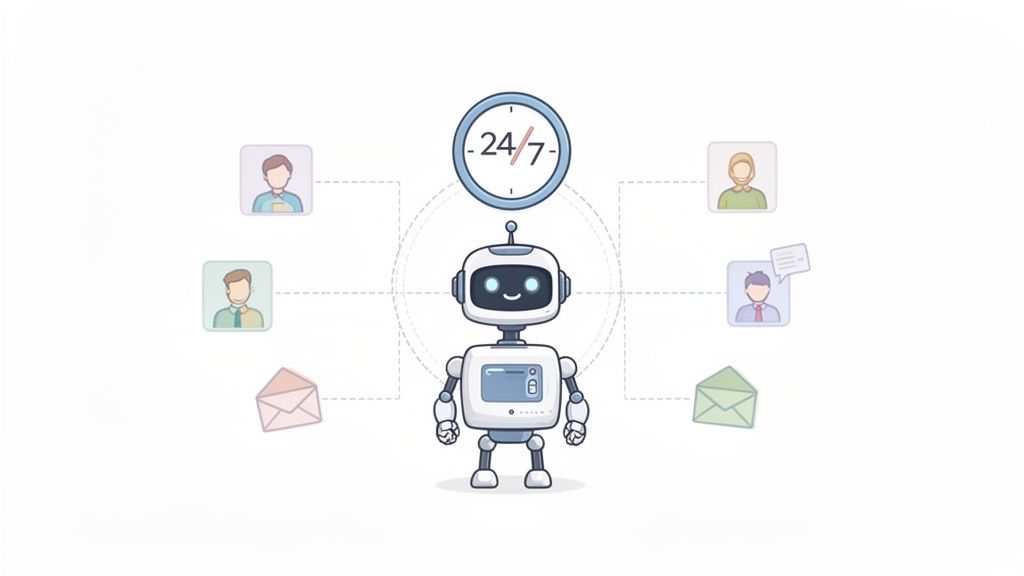
Autonomous sourcing creates a proactive and persistent recruitment engine that never sleeps. When a new candidate who fits your ideal profile appears online, an AI agent can identify and contact them almost instantly. This rapid engagement makes candidates feel valued from the first touchpoint, setting a positive tone for the entire process. Tools like Juicebox Agents enable even a solo founder to simultaneously source for multiple open roles, a task that would otherwise require a full-time hire.
The anachronism of modern recruiting is that while we seek human connection, the tools we use often rely on robotic, complex search syntax. Opaque algorithms and rigid Boolean strings create a barrier, not just for recruiters but for the candidates they seek to find. Shifting to plain-English job requirements is a pivotal one of the candidate experience best practices because it democratizes talent discovery. It allows anyone, from a founder to a hiring manager, to find qualified individuals based on their actual skills, not just how well their profile matches a string of metadata.
But what does this actually look like?
This approach ensures candidates are seen for the holistic value they bring, rather than being filtered out by a missing keyword. When you can search for "a backend engineer who has worked on scaling payment systems at a fintech startup" instead of crafting a convoluted Boolean query, you connect with talent on a more human and intuitive level. This method removes technical hurdles and ultimately finds better-aligned candidates.
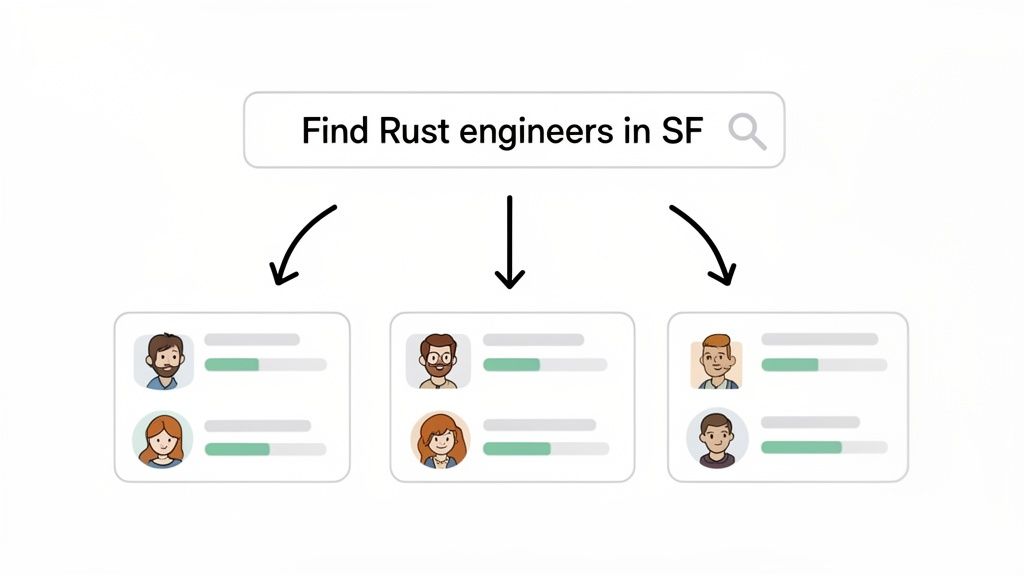
Using natural language search significantly enhances the experience on both sides. For the talent team, it drastically cuts down on sourcing time. For instance, an in-house recruiter at Ramp reduced their search time from over three hours to just 15 minutes by replacing complex LinkedIn Recruiter searches with plain-English queries in Juicebox's PeopleGPT. For candidates, it means they are discovered for the substance of their experience. Their projects and skills are interpreted contextually, leading to more relevant outreach.
A personalized, thoughtful outreach message is useless if it never reaches the candidate. Sending emails to inactive or incorrect addresses not only wastes time but also harms your sender reputation, leading to future messages landing in spam folders. An essential component of candidate experience best practices is implementing rigorous data verification and email validation before you ever click "send." This foundational step ensures your outreach is professional, effective, and respectful.
This practice involves using automated tools to confirm that an email address is active and deliverable. Instead of a "spray and pray" approach that results in high bounce rates, verification builds a clean, reliable contact list. This proactive quality control prevents the poor experience of a candidate being missed due to bad data. It’s a simple check that significantly boosts the integrity of your entire hiring funnel.
Validating contact information is a sign of respect. It demonstrates that you are intentional and detail-oriented. When your first message lands successfully in the right inbox, you avoid the unprofessionalism of bounce-backs. For instance, recruiting teams using verified-only outreach consistently see 25-30% higher reply rates compared to those using unverified bulk lists. Furthermore, maintaining verified contact logs is crucial for GDPR compliance, proving that you've taken steps to ensure data accuracy.
A single outreach email, no matter how well-crafted, is often insufficient to capture the attention of a busy, high-value candidate. The modern standard for exceptional candidate experience involves a strategic, multi-step email sequence. This approach uses a series of personalized, automated follow-ups to maximize the chances of a reply without overwhelming the recipient. Instead of a one-and-done attempt, you create a thoughtful cadence of communication that respects the candidate's time while keeping your opportunity top-of-mind.
Now, you might be thinking: "Isn't this just sophisticated spam?"
Not when done right. A well-designed sequence dynamically adjusts its messaging, offering different value propositions with each touchpoint. This persistence, when executed professionally, demonstrates genuine interest and significantly improves engagement. For instance, tech recruiters using Juicebox’s sequencer have seen reply rates jump from a typical 5% with single emails to over 15% with a multi-step approach.
A thoughtful email sequence shows respect for a candidate's busy schedule. It acknowledges that a great prospect might miss the first email but still be interested. This methodical approach is a core component of modern candidate experience best practices because it feels less like spam and more like a persistent, professional invitation. It also ensures your outreach doesn't get lost in a crowded inbox. Effective sequencing is detailed further in our guide on how to write a recruiting email.
An exceptional candidate experience is not just about communication; it's about setting realistic expectations from the start. A data-driven sourcing strategy, informed by real-time talent market intelligence, moves recruiting from guesswork to a predictable, strategic function. This approach involves leveraging insights on candidate supply, salary benchmarks, and skill availability to make informed decisions about everything from compensation to hiring timelines.
Look, here’s the reality.
Instead of operating in a vacuum, you align your strategy with market realities. This prevents you from overpromising and under-delivering, a major source of candidate frustration. When you know the true supply of "Rust engineers with crypto experience" is low, you can proactively manage expectations with hiring managers and set a recruitment cycle that reflects reality. This transparency builds trust and is a cornerstone of advanced candidate experience best practices.
Using talent intelligence tools allows you to ground your entire hiring process in objective data. When a DEI officer can show that the market supply of women in a specific engineering role is 12% according to 2024 Bureau of Labor Statistics data, it helps set a realistic hiring goal of 15-20% instead of an arbitrary 50% target. Similarly, a startup can benchmark salaries and discover its compensation is 15% below market, allowing them to adjust offers and reduce time-to-hire from 90 to 45 days. This demonstrates respect for a candidate's value. For more on this, explore the fundamentals of Talent Intelligence.
A fragmented tech stack is a hidden tax on your recruiting team's efficiency and a direct hit to the candidate experience. When your sourcing tools, email platforms, and Applicant Tracking System (ATS) don't communicate, recruiters waste hours on manual data entry, increasing the risk of errors and letting great candidates fall through the cracks. True candidate experience best practices demand a single source of truth where every interaction is tracked seamlessly from first contact to hire.
But there’s a problem most tools ignore.
Integrating your sourcing platform directly with your ATS and CRM is often clunky. A truly seamless integration means sourced candidates automatically populate your ATS, eliminating tedious copy-pasting. This deep integration reduces context switching, providing end-to-end visibility into every candidate's journey. Instead of juggling multiple logins, your team can focus on what matters: building relationships.
When your systems are unified, no candidate gets a duplicate email or a delayed response. An integrated pipeline means recruiters have immediate access to a candidate's full history, allowing for more personalized communication. For example, a recruiter using Juicebox integrated with Greenhouse can see the entire candidate timeline, from initial sourcing to offer, all in one place. This cohesive approach prevents missteps and ensures a smooth experience. Implementing robust ATS and CRM systems integration is vital for this efficiency.
A truly inclusive hiring process goes beyond well-intentioned statements; it requires a data-driven approach to building equitable talent pipelines. Relying on intrusive, self-reported demographic surveys during the application process can create friction and deter candidates. Instead, modern candidate experience best practices leverage anonymized diversity intelligence to measure, track, and improve inclusion outcomes without compromising candidate privacy. This strategy focuses on understanding market-level diversity data to set realistic goals.
This method allows recruiting teams to move from performative DEI to proactive, data-informed inclusion. By analyzing anonymized data at the top of the funnel, you can benchmark your pipeline's diversity against the available talent market. This enables you to identify where underrepresented groups may be dropping off and adjust your sourcing or interview processes accordingly. It's about building a fundamentally fair system.
Using anonymized data respects candidate privacy while still holding your organization accountable for its diversity goals. This approach demonstrates a commitment to equity that is rooted in strategy, not just rhetoric. When you can set realistic, market-aligned goals, you build a more sustainable and authentic inclusion strategy. A 2022 McKinsey study confirmed that companies in the top quartile for gender diversity on executive teams were 25% more likely to have above-average profitability. This data-backed approach fosters trust and shows candidates you are serious about meaningful change. Learn more by exploring effective strategies for improving diversity in recruiting.
In a competitive talent market, speed is a decisive advantage. A slow, bureaucratic hiring process is a leading cause of candidate drop-off and offer rejection. Accelerating your time-to-hire isn't just an internal efficiency metric; it’s a core component of modern candidate experience best practices. It signals to candidates that your organization is decisive, respects their time, and is serious about bringing them on board.
This approach means optimizing the entire workflow, from initial discovery to the first interview. By leveraging rapid sourcing, immediate outreach, and streamlined scheduling, you compress a timeline that traditionally takes weeks into a matter of days. This agility prevents your top candidates from accepting competing offers while they wait for you to move forward.
Candidates interpret a fast hiring process as a reflection of a dynamic and efficient company culture. When you can source, contact, and schedule an interview within 24-48 hours, you create powerful momentum. For example, Juicebox customer Cognition filled a key engineering role from posting to offer in just 18 days, a stark contrast to the 60-90 day industry average cited by sources like SHRM in 2023. This velocity is achieved by removing decision lag, which candidates notice and appreciate.
The candidate experience doesn’t just depend on recruiters; it’s shaped by everyone involved in hiring, especially founders and hiring managers at early-stage companies. Traditional recruiting software, however, often creates friction with steep learning curves, mandatory demos, and complex enterprise contracts. This gatekeeping prevents the very people driving the hiring need from participating effectively, leading to delays that negatively impact candidates.
A superior approach to candidate experience best practices involves adopting self-service recruiting platforms with transparent pricing. This democratizes access to powerful sourcing tools, enabling non-recruiting professionals to quickly find and engage talent without bureaucratic hurdles. When a founder can sign up and start sourcing their first critical hires in minutes, the entire process becomes faster and more authentic.
When founders or hiring managers can directly use a recruiting tool, they bring unparalleled context and passion to the outreach. A message from a founder is fundamentally more compelling than one from a freelance recruiter. Transparent pricing models build trust and enable rapid adoption. For instance, Juicebox’s product-led growth model allowed it to scale to over 25,000 users with a tiny team, proving that powerful tools don't require enterprise sales cycles. This speed is critical; startups can adopt a tool and begin hiring in a week, versus the months-long process for legacy systems.
How can I measure the ROI of improving candidate experience?
Track time-to-hire, offer acceptance rate, and quality of hire. A 10% improvement in these KPIs often translates to significant cost savings.
What's the first step to improving our recruiting process?
Audit your current workflow. Identify the biggest bottleneck—usually candidate sourcing—and implement a tool to solve that specific pain point first.
How do AI tools like Juicebox ensure fairness and reduce bias?
By sourcing from a wider talent pool and using data-driven insights, AI can surface diverse candidates that manual processes might miss, mitigating unconscious bias.
You might think that overhauling your entire process is a monumental, year-long project. But that thinking is flawed. The reality is that targeted, high-impact changes can yield immediate results. For most tech companies, the biggest bottleneck isn't interviewing; it’s finding and engaging the right passive candidates in the first place. By focusing on the top of the funnel with automated, intelligent sourcing and personalized outreach, you solve the biggest problem first.
The true implication of mastering candidate experience is transforming your talent function from a reactive cost center into a proactive, strategic growth engine. When you engineer a high-velocity, predictable talent pipeline, you build an insurmountable competitive advantage—one that directly fuels business innovation and market leadership. The framework we've discussed provides the blueprint.
{{large_cta}}
Run your first search for free. Find and engage top talent across 800M+ profiles. Trusted by 5,000+ customers.
.png)

.png)
.png)