.svg)
SIGN UP FOR JUICEBOX (IT’S FREE!)

Who are you looking for?
Thank you! Your submission has been received!
Oops! Something went wrong while submitting the form.


For years, Bullhorn was the undisputed king of the hill in the staffing world. But times have changed. Top recruiters are now actively hunting for Bullhorn alternatives, and it’s not hard to see why. The game is all about speed, better data, and a user experience that doesn’t feel stuck in the early 2000s. Modern recruiting moves too fast for legacy systems to keep up.
But there's a problem most tools ignore: sourcing is still fundamentally broken. While platforms focus on managing candidates you already have, the real bottleneck is finding top-tier talent in the first place. That’s why the best Bullhorn alternatives aren’t just another ATS—they are intelligent sourcing engines designed to uncover hidden talent pools.
Bullhorn cemented its place by packaging an Applicant Tracking System (ATS) and a Customer Relationship Management (CRM) tool into one massive, enterprise-grade solution. For a long time, it was the dream: a single source of truth for every candidate and client.
But the very thing that made it a powerhouse for huge agencies—its all-in-one complexity—is now causing major friction for agile, modern recruiting teams.
What's the bottom line?
The platform’s rigid structure, clunky feel, and surprisingly high total cost are pushing recruiters to find smarter, more intuitive Bullhorn alternatives.
That monthly subscription fee? It’s just the tip of the iceberg. With Bullhorn, the real costs are lurking beneath the surface in mandatory implementation fees and endless training sessions.
A 2023 survey from Staffing Industry Analysts was pretty revealing: 62% of Bullhorn users pointed to steep pricing as a major issue, with implementation fees hitting an average of $20,000. On top of that, 45% griped about a brutal learning curve that demands over 40 hours of training just to get comfortable. That kind of investment in time and money is a huge roadblock, especially for growing agencies that need to stay nimble.
Most recruiters believe that mastering complicated software is just part of the job. The opposite is true. The best tools should feel invisible—they should speed you up, not get in your way. While Bullhorn is packed with features, users often describe the interface as clunky and unintuitive.
Simple tasks can mean clicking through a maze of tabs and menus, which is a classic sign of outdated design.

This philosophy forces recruiters into rigid, step-by-step processes instead of letting them work fluidly. The result? More time spent on admin work and less time actually talking to great candidates.
Bullhorn was built for an era of manual data entry. Today’s best recruiters need a single system where sourcing, verifying, and outreach all happen in one smooth motion. That disconnect is a huge reason why teams are ditching their old setup and looking for Bullhorn alternatives that can truly consolidate their tech stack. Understanding modern AI recruiting tools is the first step.
You’d think the toughest part of leaving a legacy system like Bullhorn is moving all the data.
It’s actually the opposite.
The real challenge is getting your team to break old habits. Recruiters have spent years mastering complex Boolean strings and clunky workarounds. The key to successful adoption is showing them how a new, AI-driven workflow gives them back their time.
The search for better Bullhorn alternatives isn't just about finding a cheaper tool or a prettier interface. It's about a fundamental shift in how recruiting gets done. Instead of duct-taping a clunky ATS to separate sourcing tools, email finders, and outreach sequencers, teams want one intelligent platform that does it all.
The goal is simple: reduce the number of clicks and context switches between finding a candidate and starting a conversation. Modern AI-driven platforms achieve this by integrating disparate functions into a seamless workflow.
To put it in perspective, here’s a quick look at how the old way of doing things stacks up against the new breed of AI-powered systems.
The table below breaks down the core differences in philosophy and function between Bullhorn’s legacy model and the approach of next-generation recruiting platforms.
The contrast is pretty stark. While Bullhorn acts as a central hub you plug other tools into, modern alternatives like these top 10 AI recruiting tools for 2026 aim to be the only tool you need for the top of your funnel, creating a much more streamlined workflow.
Bullhorn built its empire on being a central database—a system of record. But modern sourcing is an active, outbound function, and for that, a passive database just doesn't cut it. The core issue is a sourcing engine that feels anchored to recruiting methods from a decade ago.
The platform’s heavy reliance on manual Boolean search is a major bottleneck.
Here's why:
Deep Boolean knowledge was once a recruiter's badge of honor, but the approach is fundamentally slow and exclusionary. Spending hours crafting complex strings to find a "Senior Java Developer with fintech experience who has worked at a Series B startup" is tedious. Worse, it often misses high-quality candidates who simply describe their skills differently.
Bullhorn’s sourcing capabilities are often tethered to its LinkedIn integration, treating it as the primary—and sometimes only—source for top-tier talent. This creates a massive blind spot.
What about the best engineers on GitHub, designers showcasing their work on Behance, or sales leaders active in niche industry communities? A LinkedIn-only sourcing model ignores these rich talent pools, effectively making huge segments of the candidate market invisible. It's a critical reason why teams start looking for Bullhorn alternatives that aggregate data from dozens of sources.
The numbers back this up. Bullhorn dominates the staffing world with over 1 million users, but its old-school, Boolean-heavy interface leaves a staggering 70% of talent undiscovered, according to Juicebox data. Recruiters tell us they waste 15-20 hours every week on manual searches. Bullhorn's integration limitations don't help—it has only 41 ATS connections, a fraction of what modern platforms offer.
The most significant flaw in a legacy sourcing engine is that it forces the recruiter to think like a database. Modern tools flip this script, allowing the technology to think like a recruiter.
This frustration is a common theme. Just look at user reviews on G2, where feedback often points to the search being "difficult" and "clunky."
When it's a chore to find qualified candidates already in your system, sourcing new ones feels nearly impossible. And if you're exploring other platforms, our guide on Indeed alternatives offers more insights.
The sourcing challenge isn't just about search logic; it’s baked into the entire workflow. Finding a profile is just step one. Next, you have to find verified contact info, write personalized outreach, and track engagement—often juggling separate, poorly integrated tools.
This fragmented process creates friction and kills productivity. A recruiter might find a promising candidate in Bullhorn, jump to another tool for an email, then paste a template into their email client. Every context switch is an opportunity for error and a drain on time.
The alternative?
A single, cohesive platform where sourcing, verification, and outreach happen in one fluid motion. This is where AI-powered Bullhorn alternatives are creating a huge competitive advantage. Instead of building complex Boolean strings, recruiters can use simple, natural language prompts like:
This approach doesn't just save hours; it uncovers candidates that manual searches would miss. By moving beyond rigid keywords, AI understands context, skills, and career trajectory, delivering a far more relevant and diverse talent pool. The future of talent acquisition depends on these advanced AI sourcing techniques to stay ahead.
Picking a replacement for Bullhorn isn't just about switching one ATS for another. It’s about giving your team a real upgrade in how they find and connect with top talent. To do that, we have to look past the usual pros and cons and dig into what actually drives results: sourcing technology, data coverage, and pricing transparency.
Let's break down how the main Bullhorn alternatives—Juicebox, Loxo, and HireEZ—actually perform in the real world.
The biggest split between modern recruiting tools is their approach to search. Older systems like Bullhorn are stuck on Boolean logic, which makes recruiters think like a database. Newer platforms use AI, letting you search like a human.
Your choice of sourcing tech really comes down to whether you're trying to expand your talent pool or just narrow down a list you already have. This decision tree makes it pretty clear.
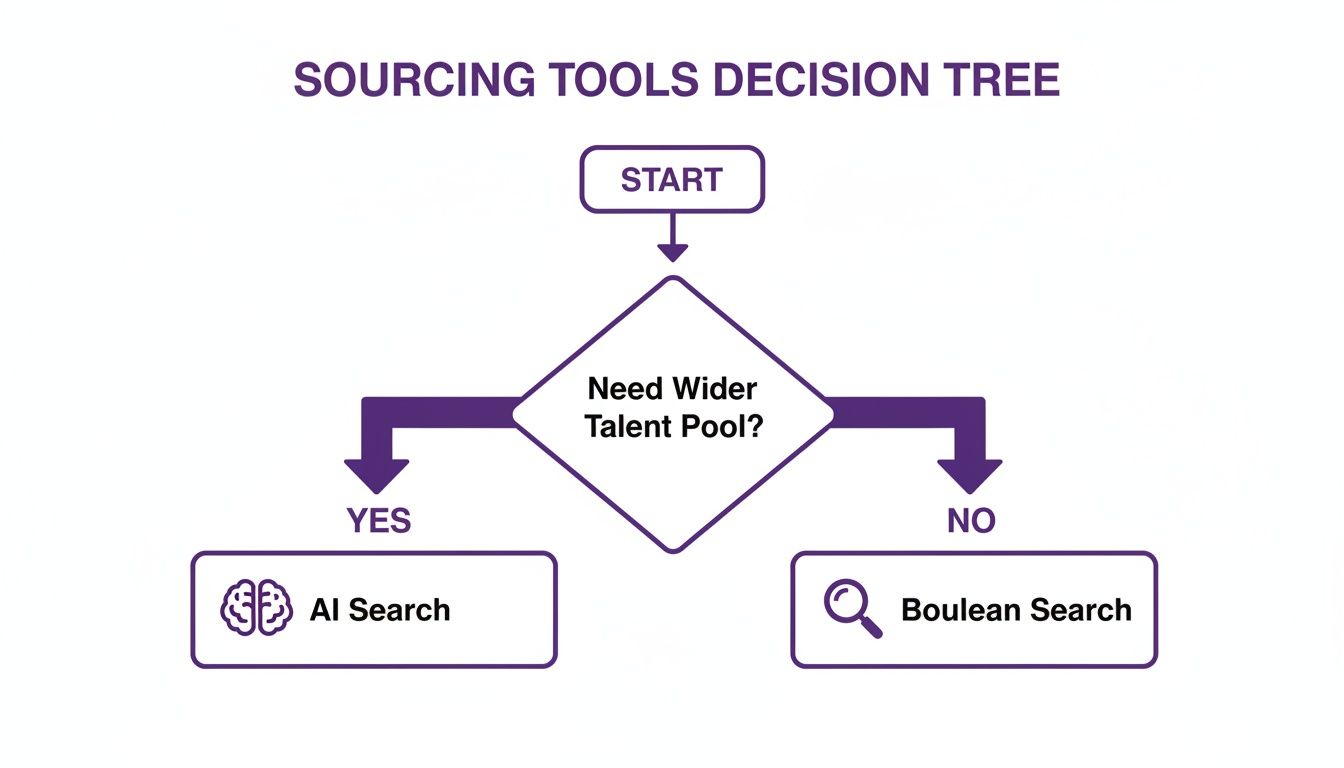
As you can see, if you want to uncover hidden gems and broaden your reach, AI-powered search is the way to go. It’s just fundamentally better for discovery than old-school Boolean.
Bullhorn's universe is heavily tied to its LinkedIn integration. But let's be real—the best talent isn't just hanging out on one social network. Top engineers are on GitHub, designers are on Behance, and experts are active in niche online communities. The best Bullhorn alternatives get this and pull data from everywhere.
Loxo is a good ATS for managing candidates you already have, but it is not a great sourcing tool for finding new ones. This limitation often stems from a data pool that, while large, may not have the depth or freshness of multi-source aggregators.
HireEZ does a much better job here, sourcing from over 45 platforms to give you a more complete picture of a candidate. That’s a huge improvement over a LinkedIn-only view.
Juicebox operates on the same multi-source principle, pulling data from 30+ professional networks and public sources. This means you’re finding people based on their entire digital footprint, not just a single, polished profile. In fact, 80% of hires made through Juicebox are found outside of LinkedIn, which says a lot about the power of diversifying your data.
One of the biggest headaches with Bullhorn is its enterprise sales process. The pricing is hidden, you have to sit through a demo, and the final bill gets padded with mandatory implementation and training fees. It's no surprise that recruiters are looking for Bullhorn alternatives with clear, predictable costs.
To help you see the differences side-by-side, here’s a breakdown of how each platform stacks up on the core features and philosophies we've discussed.
This table highlights the core trade-offs. Your "best" choice really depends on what you're trying to achieve and how your team likes to work.
Ultimately, the right platform is the one that fits your team's specific workflow. HireEZ is great for teams running high-volume, structured outbound campaigns. Recruiterflow is a strong choice for executive search firms needing an AI-native ATS and CRM. Loxo works well for agencies that need an integrated ATS/CRM without breaking the bank. And Juicebox is designed for nimble teams that want to use AI to find top-tier, hard-to-reach talent before anyone else does. Knowing how to use modern AI recruiting software is what will give you the edge.
When you’re looking at Bullhorn alternatives, it’s tempting to get hung up on the monthly subscription price. But that’s just the tip of the iceberg. The real cost of any software comes into focus when you look at the Total Cost of Ownership (TCO)—a figure that includes all the hidden fees, wasted hours, and bolt-on tools you need just to make things work.
Let’s be clear: switching from Bullhorn isn’t just about finding a cheaper platform. It’s a strategic move to invest in efficiency, one that should deliver a measurable return. Legacy systems often create a financial drag with mandatory implementation fees, extensive paid training, and the need to patch together a dozen different tools.
To build a solid business case, you have to look past the sticker price. The true cost of your recruiting platform is a mix of both direct and indirect expenses that often fly under the radar.
When you consolidate these functions into one seamless platform, the savings really start to stack up. A great metric to watch here is your cost per hire, because a more efficient process will bring that number down significantly.
The global recruitment software market, valued at $2.39 billion in 2024, is expected to hit $3.71 billion by 2029. This growth is all about the shift toward smarter, AI-driven tools that don't break the bank. Cost-effective platforms are leading the charge, especially for small and mid-sized agencies.
A Juicebox Growth plan, for example, comes in at $129/month. That's up to 80% cheaper than comparable plans from tools like SeekOut or LinkedIn Recruiter, which can run anywhere from $200 to over $1,200 a month. This isn’t just a price difference; it’s a reflection of where the market is heading.
You might think consolidating your tools means you have to sacrifice functionality. It's actually the opposite. Modern, AI-native platforms are built to handle sourcing, verification, and outreach far more effectively than a patchwork of "best-in-class" tools, eliminating the friction and data silos that slow you down.
This approach delivers a powerful one-two punch: it slashes your direct software costs while giving recruiter productivity a massive boost. For instance, Juicebox customer Ramp saved over $50,000 in annual software spend and cut their time-to-hire by 40% in just six months after they consolidated their tech stack with PeopleGPT.
This kind of upfront, transparent pricing allows you to accurately forecast your costs without worrying about hidden enterprise fees. It makes building a clear business case for switching from opaque Bullhorn alternatives a whole lot easier. Understanding the true cost of other tools, like SeekOut pricing, further strengthens this case.
Switching from Bullhorn isn't just about moving data—it’s about evolving your entire workflow. You’re not just swapping out one piece of software for another; you're upgrading your team's whole way of thinking. The real goal here is to ditch the manual, clunky processes that slow everyone down and jump into an AI-first approach that speeds up the entire recruiting cycle.
Think of this less as a logistical headache and more as a strategic power-up. When you frame it as a workflow upgrade, your team will see the new platform as a genuine competitive edge, not just another tool they have to learn.

Before you even think about ripping and replacing, you need a clear picture of what’s actually going on. Let's be honest, most recruiting teams are dealing with serious tech bloat. It's a patchwork of single-purpose tools for sourcing, another for email verification, and yet another for outreach sequences, all duct-taped together.
Start by mapping out a typical sourcing project from A to Z. Ask your team a few direct questions:
This audit does more than just show you where you're wasting money. It highlights the true, hidden cost of a fragmented workflow and builds a rock-solid case for finding one of the better Bullhorn alternatives that’s built for efficiency, not just features. If you're deep in the Bullhorn ecosystem, checking out your Bullhorn integration options can also be a good first step to see where you can consolidate.
It’s tempting to go for a big-bang, company-wide launch to get it over with quickly. Don't. That approach almost always backfires, creating chaos and immediate resistance. A much smarter move is to start small with a motivated pilot team.
Pick two or three of your most tech-savvy recruiters and have them run a live search on the new platform. This does two critical things: it creates early, visible wins that build momentum, and it lets you iron out any real-world workflow kinks before you go all-in. For example, time them on a search that usually takes hours in Bullhorn and see how fast they can do it with the new AI system.
The biggest hurdle in moving to an AI platform isn’t learning where the buttons are—it’s unlearning old habits. The muscle memory your team has for building complicated Boolean strings needs to be replaced with a much simpler, more intuitive skill: asking a question in plain English.
Your training needs to focus on this mental shift:
("Java" OR "J2EE") AND "fintech" AND ("startup" OR "early-stage"), you just ask, "Find me Java engineers with experience at early-stage fintech companies."Understanding the impact of AI in business operations is about more than just software; it's about fundamentally changing how work gets done.
The most successful migrations focus on demonstrating value, not just features. A recruiter who sees a 10-hour sourcing project shrink to 30 minutes becomes your biggest advocate for change.
This mindset shift is what separates a successful rollout from a failed one. It turns the migration into a genuine opportunity for growth, making it one of the most powerful reasons to look for modern Bullhorn alternatives. Learning how to streamline the recruitment process is key to this transformation.
How long does it take to migrate from Bullhorn to a new system?A phased rollout with a pilot team usually takes 4–6 weeks. This allows time for proper testing, training, and feedback before a company-wide launch.
Will we lose our historical candidate data from Bullhorn?No. Most modern platforms offer data migration services or deep integrations to ensure your existing candidate database is moved over seamlessly.
What is the biggest challenge when switching from Bullhorn?The main hurdle is team adoption. Getting people to embrace change requires strong leadership buy-in and training focused on workflow benefits.
How does AI sourcing differ from advanced Boolean search?Boolean matches keywords; AI understands intent. It analyzes career paths and skills to find talent that rigid searches miss, unlocking a wider talent pool.
Switching from a legacy system isn’t just about new software. It’s about reclaiming your team’s most valuable asset: time. By consolidating your tech into a single, intelligent platform, you remove the friction that slows recruiters down. This unlocks their ability to move faster, build better relationships, and ultimately close the critical roles that drive your business forward.
{{large_cta}}
Run your first search for free. Find and engage top talent across 800M+ profiles. Trusted by 5,000+ customers.
.png)

.png)
.png)