.svg)
SIGN UP FOR JUICEBOX (IT’S FREE!)

Who are you looking for?
Thank you! Your submission has been received!
Oops! Something went wrong while submitting the form.


A biweekly pay schedule simply means employees get paid every two weeks, which adds up to 26 paychecks per year.
It’s a steady, predictable rhythm that differs from a semi-monthly schedule, where paychecks land twice a month for a total of 24 paydays. For employers, this consistency streamlines operations; for employees, it provides a stable cash flow they can count on.
It’s a core reason why our data shows it's the preferred choice for growing tech companies.
TL;DR: The Biweekly Pay Advantage
A biweekly pay schedule means 26 paychecks a year (every two weeks), not 24 like semi-monthly. This consistency simplifies overtime calculations for employers and gives employees two "extra" paycheck months annually, improving their financial stability. The U.S. Bureau of Labor Statistics confirms this is the most common schedule, used by 43% of private businesses. In rare years like 2026, a calendar quirk can even lead to a 27th paycheck.
For recruiters and talent acquisition pros, the difference between pay schedules isn't just some minor HR detail—it's a critical piece of the candidate experience. If you’re building out your team with top talent, you need to understand every lever you can pull. To find candidates with this specific experience, you might use various AI recruiting tools.
If you miscommunicate how and when someone will get paid, you can erode trust before they even sign the offer letter. Getting this right from the start shows you’re transparent and on top of your operations, setting a positive tone for the entire relationship.
The confusion almost always boils down to biweekly versus semi-monthly pay. They sound similar, but their impact on an employee's personal budget and cash flow can be huge.
But there’s a problem most tools ignore.
Simply knowing the definition isn't enough; you must be able to articulate why your company chose this schedule and how it benefits the employee. This is where a simple visual can clear things up instantly.
As the chart shows, that biweekly schedule gives employees two more paychecks a year. This is where those magical "extra paycheck" months come from—something anyone on a biweekly plan looks forward to twice a year.
For a deeper dive, check out our complete guide comparing semi-monthly vs bi-weekly schedules.
It's no surprise this structure has become the standard. The U.S. Bureau of Labor Statistics found that 43% of U.S. private businesses use a biweekly pay frequency, making it the most common schedule out there.
Why? It strikes the perfect balance. Employers get a streamlined payroll process, and employees get that steady, predictable income stream. For recruiters, knowing this context is key to talking confidently about compensation. If you're building a recruiting team from scratch, you might also be interested in hiring a freelance recruiter.
The two most common pay schedules—biweekly and semi-monthly—are often confused, but they have distinct differences that impact both employees and employers. This table lays out the core distinctions side-by-side.
| Attribute | Biweekly | Semi-Monthly |
|---|---|---|
| Pay Frequency | Every two weeks | Twice a month |
| Paydays Per Year | 26 | 24 |
| Payday Consistency | Same day of the week (e.g., every other Friday) | Specific dates (e.g., the 15th and 30th) |
| “Extra” Paychecks | Two months per year have three paychecks | None |
| Best For | Hourly, non-exempt employees (simplifies overtime) | Salaried, exempt employees |
| Employer Benefit | Consistent processing; easier overtime calculations | Aligns cleanly with monthly accounting cycles |
| Employee Benefit | Predictable cash flow; “bonus” pay months | Consistent pay dates for monthly budgeting |
Ultimately, a biweekly schedule offers a predictable rhythm for employees and simplifies things like overtime for employers, which explains its widespread popularity.
The move to a biweekly pay schedule isn't just a random choice; it's a strategic decision that hits the sweet spot between operational sanity and employee happiness. For employers, running payroll 26 times a year instead of 52 (like with weekly pay) literally cuts the administrative work in half.
This simplifies just about everything. Think tax withholding, benefits deductions, and especially calculating overtime for non-exempt employees. It becomes a much smoother, more manageable process.
For employees, the benefits are even more tangible. Getting a consistent paycheck every other Friday creates a predictable rhythm for their personal finances. That stability makes budgeting far easier than trying to plan around a single, less frequent monthly paycheck.
One of the most loved (and often overlooked) features of a biweekly schedule is what I call the "bonus" paycheck effect. Since a year has just over 52 weeks, employees end up getting a third paycheck in two separate months every year.
This visual really brings it to life, showing how those 26 pay periods shake out and lead to those much-anticipated three-paycheck months.
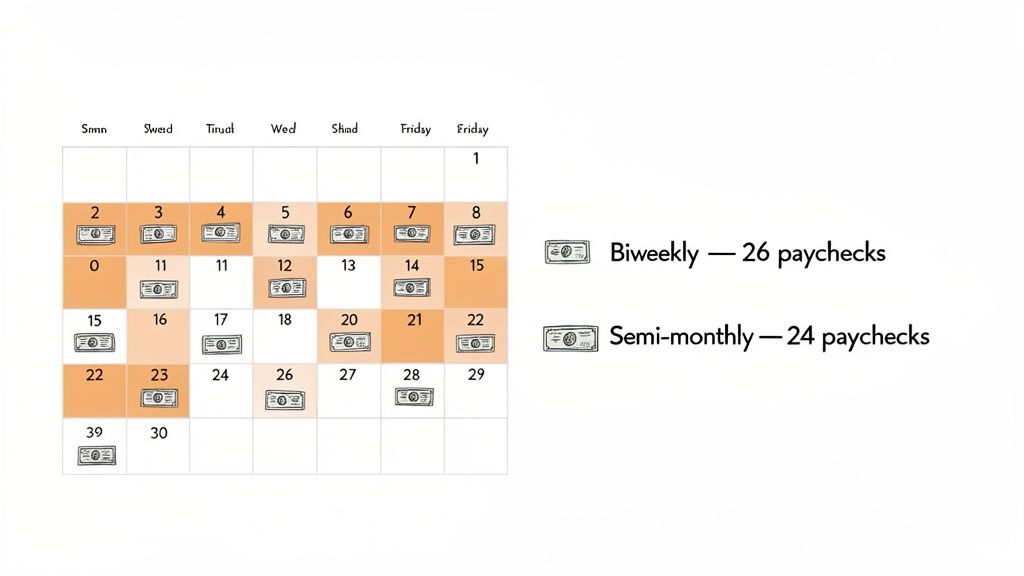
For employees, these months feel like a mini-windfall. It’s extra cash they can sock away for savings, invest, or put toward a big purchase without messing up their regular budget.
But here’s where a lot of recruiters get it wrong.
Most believe pay frequency is just a minor detail candidates don't really care about. The truth is the complete opposite. This seemingly small logistical choice has a direct line to an employee's financial wellness, which is a proven driver of retention and offer acceptance rates.
Presenting a clear, stable biweekly pay schedule is a subtle but powerful way to frame your offer. You’re not just talking about a process; you’re connecting a simple HR policy to the candidate’s financial peace of mind. To truly understand its impact, it's worth exploring how to streamline the recruitment process. This is how a simple policy becomes a core part of your talent strategy.
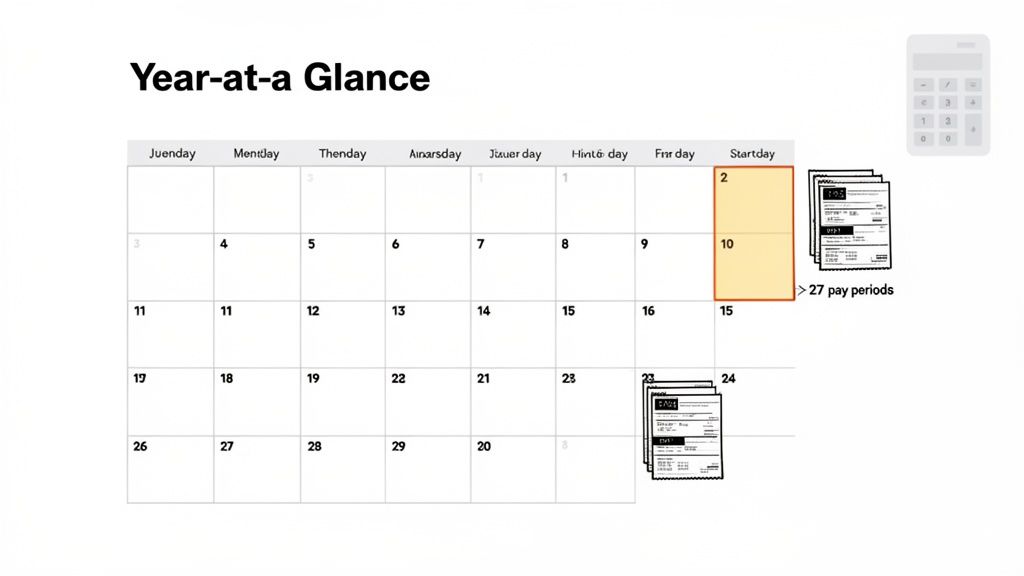
The steady rhythm of a biweekly payroll schedule has a fascinating secret that most people—recruiters included—tend to overlook. It’s a simple calendar quirk that leads to a rare but powerful event: the 27-paycheck year.
Here’s how it works. A year has 365 days, and a biweekly pay period covers 14 days. If you do the math (365 ÷ 14), you get 26.07. That tiny .07 fraction might not seem like much, but it adds up. Every year, an extra day or two quietly accumulates, and about every 11 years, it creates an entire extra pay period. This isn't just payroll trivia; it has a real impact on a candidate's annual take-home pay.
Let's say a candidate accepts an offer for $104,000 a year. They're probably expecting 26 paychecks of $4,000 each. But in a 27-paycheck year, they'd actually receive an extra $4,000, bringing their total earnings to $108,000.
This isn't some far-off hypothetical, either. This payroll phenomenon happens roughly every 11 to 12 years, with 2026 being one of those rare instances for many companies. You can actually read more about this upcoming payroll event on littler.com.
For recruiters, this is where you can really shine. Instead of just being an intermediary, you become a strategic advisor who can explain this to candidates and hiring managers before it ever becomes a point of confusion. It shows a level of expertise that builds trust from day one. It’s a lot like explaining the nuances of a 9-80 work schedule—a small detail that proves you’re looking out for the candidate's entire experience.
When you master these kinds of details, you turn a standard compensation chat into a masterclass on transparency and deep industry knowledge. It’s a simple way to set yourself far apart from the competition.
It’s one thing to understand the mechanics of a biweekly pay schedule, but it's another thing entirely to use it to close top candidates. This is where savvy recruiters can go beyond logistics and tap into the powerful behavioral science behind compensation. A seemingly small detail like how often you pay can become a surprising competitive advantage.
You might think candidates only care about the big annual salary number. Why that fails? It misses a crucial, often unspoken need: cash flow stability. Getting paid more frequently creates a stronger sense of financial security and can even make people feel wealthier, even when the total annual salary is identical.
This isn’t just a gut feeling; it’s backed by solid research. For example, a 2021 study in the Journal of Consumer Research found that more frequent payments reduce the uncertainty people feel about having enough money, which in turn boosts their feelings of subjective wealth. You can dive into the full research on payment frequency and perception to really get a handle on this psychological driver.
So, what's the bottom line here?
A steady, predictable biweekly paycheck provides a psychological comfort that a less frequent schedule just can't match. It transforms a routine administrative detail into a compelling part of your total offer. Of course, candidates also weigh the entire compensation package, including how their base salary stacks up against industry standards, like the benchmarks you see for machine learning job salaries in Germany.
Instead of just stating the pay schedule as a fact, frame it as a benefit during negotiations. This simple shift in language shows you’re thinking about the candidate's holistic financial well-being, not just the company’s payroll process. To compete effectively, many companies also look for Indeed alternatives to find talent.
Key Takeaway: Position your company’s biweekly pay schedule as a real benefit. It offers greater financial stability and predictability—a subtle but powerful tool to have in your negotiation toolkit.
This approach is especially effective when a candidate is weighing multiple offers with similar annual salaries. After you've used the right salary benchmarking tools to ensure your core offer is competitive, highlighting the stability of a biweekly schedule can be the small detail that tips the scales in your favor.
Knowing the definition of a biweekly payroll is one thing. Actually using that knowledge to close candidates? That’s where you get a real edge.
When you’re vague about pay schedules, it creates doubt. But when you’re crystal-clear, you build instant trust and stand out from the competition. The goal is to move from theory to a repeatable workflow. Don’t just mention a pay frequency—embed that clarity into every single candidate touchpoint, from the job description all the way to the final offer call.
Mastering this isn't just an admin task. It’s a core part of your employee value proposition that shows you respect a candidate’s time and their financial planning.
But here’s the problem most tools don’t solve: How do you find candidates who already get these operational details?
Let's say you need to find finance managers who have direct experience with a complex payroll system transition—a very specific skill set. With a tool like PeopleGPT, you can ditch the clunky Boolean strings and just use plain English to find these experts in seconds.
Here’s a simple prompt you could use:
Find Finance Managers in San Francisco with experience in ADP to Workday payroll migrationsThis kind of laser-focused search immediately brings up qualified candidates who understand the nuances of payroll systems. When you can tap into this kind of detailed knowledge, including expertise with specific systems like tutor payroll software, your recruiting efforts get a serious boost.
This screenshot shows you exactly what PeopleGPT does with that prompt.
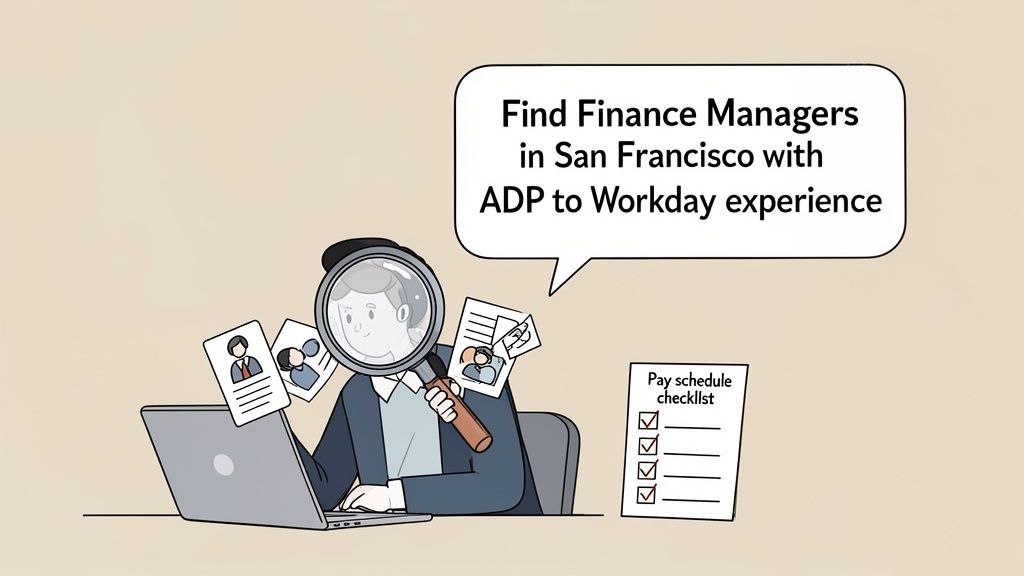
The platform instantly pinpoints candidates with the exact payroll migration experience you asked for. Juicebox, through PeopleGPT, enabled one client to reduce sourcing time by 75% within three months by using similar plain-language prompts. It’s a direct line from payroll knowledge to a much better sourcing strategy.
Here are quick, clear answers to the most common questions candidates ask about a biweekly pay schedule.
No, your annual salary is the same. A biweekly schedule just splits that salary into 26 smaller paychecks instead of 24 slightly larger ones.
This happens twice a year, but the specific months depend on your company's payday calendar. Your HR or payroll team can provide the exact dates.
Companies handle this rare event differently. Some continue regular payments, while others may adjust the per-paycheck amount to keep the annual salary consistent.
Mastering the nuances of a biweekly pay schedule does more than just clarify an administrative detail—it builds trust. When you can confidently explain how compensation flows, from the predictable rhythm of 26 paychecks to the rare 27-paycheck year, you signal a level of transparency that top candidates value.
This unlocks a more strategic relationship with candidates, allowing you to move beyond being a recruiter and become a trusted advisor who helps them see the full picture of their financial well-being at your company.
{{large_cta}}
Run your first search for free. Find and engage top talent across 800M+ profiles. Trusted by 5,000+ customers.


.png)