.svg)
SIGN UP FOR JUICEBOX (IT’S FREE!)

Who are you looking for?
Thank you! Your submission has been received!
Oops! Something went wrong while submitting the form.


Finding the right recruiting partner is a high-stakes decision that can determine your company's growth trajectory. The wrong choice leads to wasted time, budget overruns, and subpar hires. The right one becomes a strategic extension of your team, delivering top-tier talent that drives real business results.
Yet, the market is saturated with options, making it nearly impossible to distinguish between the truly exceptional and the merely adequate.
In this guide, we'll share a definitive list of the 12 best recruiting agencies (including directories and marketplaces). This isn’t a generic roundup; we provide a detailed analysis of each option, covering crucial factors like their ideal use cases, pricing structures, and potential limitations. You'll get a clear, honest assessment to help you make a well-informed decision, fast.
Without further ado, here are the 12 best recruiting agencies to help you land your next great hire:
Clutch is not a recruiting agency itself but a B2B reviews and ratings marketplace that aggregates and verifies information on thousands of service providers, including a robust category for the best recruiting agencies. Its primary value for hiring teams is providing a structured, data-driven way to shortlist and vet potential agency partners based on verified client feedback, company focus, and project scope.

The platform’s standout feature is its Leaders Matrix, which plots agencies on a quadrant based on their "Ability to Deliver" and "Focus." This visual tool, combined with deep-dive profiles showing pricing bands (e.g., $10,000+ project minimums), industry specializations, and detailed case studies, allows for effective apples-to-apples comparisons. You can quickly filter for firms specializing in tech, executive search, or specific hiring models like contingency. You can learn more about how contingency recruitment works and use Clutch to find firms that specialize in it. It's an excellent first step for finding a partner, especially when you need to understand the nuances of things like malicious compliance in vendor relationships.
Best for: Startups and mid-market companies needing to quickly build a shortlist of vetted agencies that fit a specific budget and industry niche. It’s particularly useful for finding U.S.-based firms with a strong, recent track record.
Website: https://clutch.co/us/hr/recruiting
ClearlyRated operates as a third-party directory grounded in Net Promoter Score (NPS) surveys, surfacing the top staffing and recruiting agencies across the U.S. and Canada. Its core value is identifying award-winning firms based on validated service quality metrics. For hiring managers, it's a reliable way to find partners celebrated for exceptional client, talent, and employee experiences, making it a strong signal for service-oriented partnerships among the best recruiting agencies.

What's the secret?
The platform’s standout feature is its annual "Best of Staffing" awards, which recognize agencies that achieve industry-leading satisfaction scores from their clients and placed candidates. Users can filter this exclusive list by job sector, such as IT, engineering, finance, or healthcare, and browse by city or state to find highly-rated local partners. This approach shifts the focus from an agency's marketing claims to its proven ability to deliver a positive experience—a crucial but often overlooked factor in the selection process. This focus on experience is similar to how a well-structured 9-80 work schedule can improve employee satisfaction.
Best for: Companies prioritizing a proven, high-quality service experience and looking to identify top-rated local or specialized agencies based on third-party-validated satisfaction data.
Website: https://www.clearlyrated.com/staffing
Fact Check: According to the American Staffing Association, the U.S. staffing industry employed an average of 3.2 million temporary and contract workers per week in 2022, showcasing the massive scale of agency-led hiring.
While primarily known as a software review marketplace, G2 also hosts a comprehensive category for staffing and recruiting agencies. Its core value lies in aggregating a massive corpus of user reviews, allowing hiring managers to compare potential partners based on satisfaction scores, company size focus, and user-provided feedback. G2 functions less as a curated directory and more as a raw data source for social proof.
The platform's strength is its side-by-side comparison feature, which lets you select several agencies and view their ratings on key metrics like "Ease of Doing Business With" and "Quality of Support." You can filter results by location served (e.g., Kansas City, MO) and easily see which firms have transparent pricing available. This makes G2 a powerful tool for validating a shortlist or discovering agencies that excel in customer service within a specific geographic or industry segment. For technical roles, pairing an agency with the best sourcing tools for recruiters can amplify results.
Best for: Teams that have a preliminary list of agencies and want to validate their choices with a large volume of user reviews, or for discovering highly-rated regional players. It's also useful for understanding which agencies serve specific company sizes (e.g., small business vs. enterprise).
Website: https://www.g2.com/categories/staffing-agencies
Similar to Clutch, GoodFirms is a global B2B directory rather than a direct recruiting agency. Its value lies in providing a broad, filterable database of service providers, including a dedicated category for the best recruiting agencies worldwide. The platform helps hiring teams discover and perform initial due diligence on potential partners, especially when looking for firms in specific geographic regions or with niche specializations.

GoodFirms differentiates itself with a straightforward layout that highlights key decision-making data upfront, such as hourly rates, minimum project budgets, and employee counts. Its search functionality allows users to quickly narrow down options by location, service focus (e.g., IT staffing, executive search), and industry expertise. While it lacks the visual quadrant analysis of Clutch, its list-based view and verified client reviews provide a solid foundation for building an initial shortlist of agencies to contact. The platform is especially useful for sourcing international or cross-border recruitment support.
Best for: Companies seeking to expand their search for agency partners globally or find specialist recruiters in less-saturated markets. It’s effective for quickly gathering basic budget and service information to create a preliminary list.
Website: https://www.goodfirms.co/business-services/recruiting
Here’s the thing: Directories are great for finding agencies, but they don't help you manage them effectively. That's a different skill set entirely.
DesignRush operates as a curated B2B marketplace known for its editorial rankings and directories of professional services, including a dedicated section for the best recruiting agencies. While similar to other directory sites, its strength lies in practical, budget-oriented filters that help companies quickly find agencies aligned with their financial constraints, such as minimum project size and hourly rates. The platform focuses heavily on U.S.-based providers and frequently updates its editorial roundups.

The platform organizes agencies into clear categories like "Recruiting," "Staffing," and "Creative Staffing," making it easy to navigate. Each agency profile provides a snapshot of its core services, client reviews, and key leadership. Its editorial team also publishes articles and "best of" lists that offer an additional layer of curation, though these can sometimes feature agencies that are active participants on the platform. This makes DesignRush a useful tool for initial discovery, especially when budget is a primary decision-making factor. When evaluating costs, understanding competitor pricing models like SeekOut pricing can provide valuable context.
Best for: Small to mid-sized businesses looking for U.S.-focused recruiting agencies that fit specific budget or hourly rate requirements. It is particularly effective for sourcing firms for project-based or creative staffing needs.
Website: https://www.designrush.com/agency/hr-outsourcing/recruiting?utm_source=openai
Expertise.com operates as a curated directory that identifies and lists top local service professionals across various industries, including a specific focus on employment and staffing agencies. Rather than being an open marketplace, it presents pre-vetted, city-by-city shortlists. Its core value for hiring managers is rapidly identifying reputable, locally-based firms when an in-market presence is a critical hiring factor.

The platform’s standout feature is its proprietary selection process, which it claims includes checks for licensing, reputation analysis, and even "mystery shopping" to gauge responsiveness. This results in a concise, manageable list of the best recruiting agencies for a given metropolitan area (e.g., NYC, Los Angeles, Chicago). Each agency profile provides a quick snapshot of their services and direct contact information, removing the need for extensive initial research when a local partner is the priority. Understanding core recruiting metrics is key to evaluating any partner, local or not.
Best for: Companies that need to quickly find a trusted staffing or recruiting agency within a specific city or region, especially when local market knowledge and physical presence are non-negotiable.
Website: https://www.expertise.com/employment-staffing-agencies
The American Staffing Association (ASA) Member Directory is not an agency but the official search portal for the U.S. staffing industry's largest trade association. Its value lies in providing a vetted, nationwide database of member firms that adhere to the ASA's code of ethics. This makes it a go-to resource for companies, particularly those in regulated industries or with strict compliance requirements, that need to find credible and professional staffing partners.

The platform allows users to find some of the best recruiting agencies by searching by state, service type (like temporary, direct hire, or RPO), and specific occupations. Unlike commercial directories, the ASA directory’s primary filter is membership, which signifies a baseline of professional conduct and industry engagement. For those interested in the operational side, you can explore resources that detail how to start a staffing agency and understand the business models of the firms listed here.
Best for: Corporate procurement and HR teams prioritizing compliance, ethics, and industry certification when sourcing U.S.-based staffing and recruiting vendors for local or national needs.
Website: https://americanstaffing.net/asa/asa-member-directory/?utm_source=openai
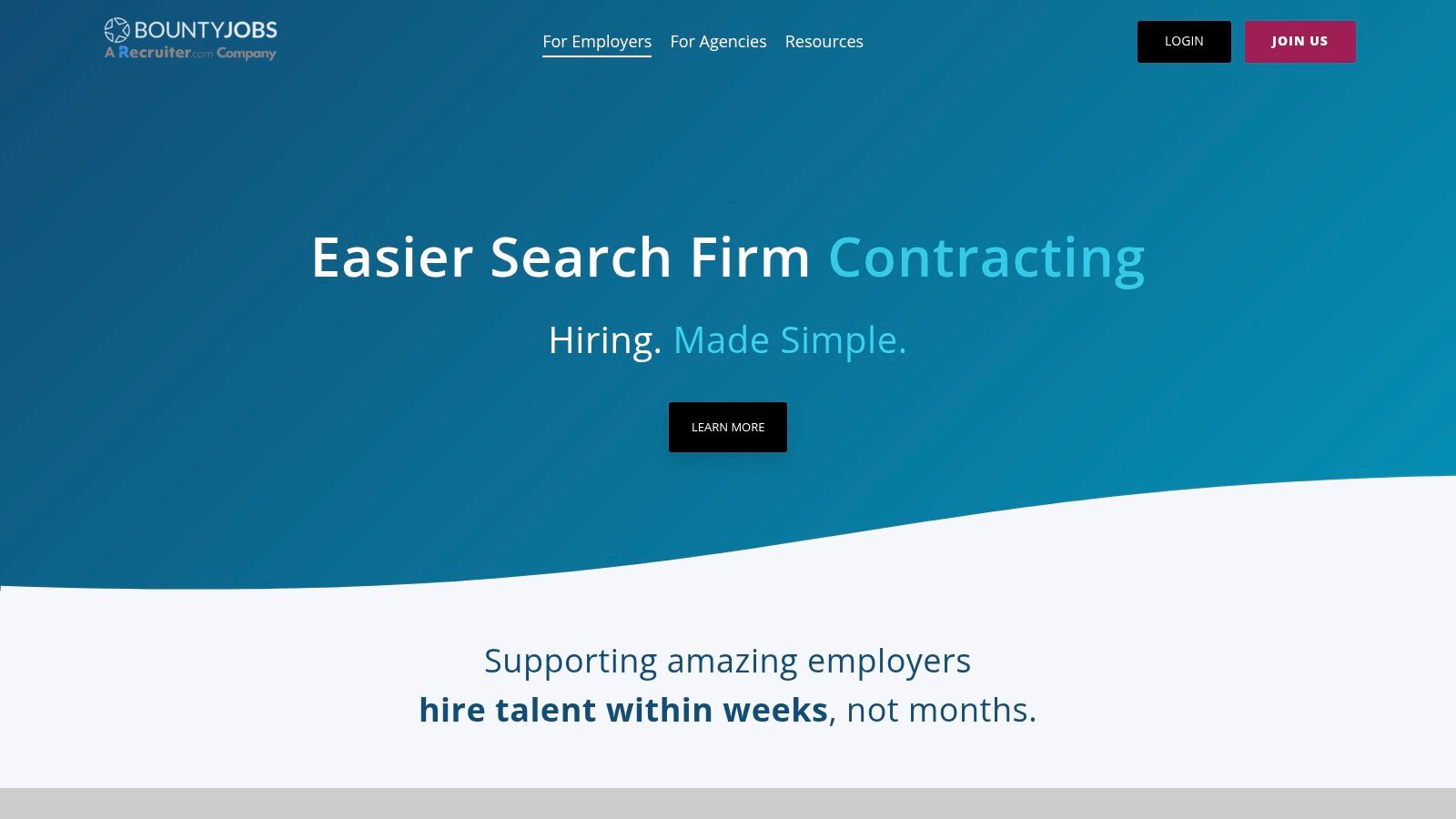
BountyJobs operates as an employer-agency marketplace, streamlining how companies manage multiple third-party recruiting agencies. Instead of juggling numerous contracts and invoices, employers use BountyJobs to engage, manage, and pay a network of over 14,000 vetted recruiters under a single agreement. This centralized model is designed to improve efficiency, control costs, and provide performance data on agency partners.
Here's the real magic.
The platform’s core value lies in its vendor management capabilities. It offers analytics to track agency performance, ATS integrations to prevent duplicate candidate submissions, and a standardized process for posting roles (or "bounties") to a curated selection of specialized firms. This data-driven approach helps hiring teams identify which of the best recruiting agencies are most effective for specific role types, turning agency sourcing into a more strategic, measurable function rather than a reactive one.
Best for: Mid-to-large-sized companies that regularly engage multiple recruiting agencies and need a centralized system for contracting, performance tracking, and payment processing.
Website: https://bountyjobs.com/
Recruiter.com offers a flexible talent acquisition model that stands apart from traditional success-fee agencies. It operates as a network of thousands of independent recruiters available for on-demand, month-to-month engagements. This "Recruiters on Demand" service is designed for companies that need to scale their recruiting capacity quickly without the long-term commitment or high costs of hiring full-time internal staff or engaging a contingency firm.

The platform’s core value lies in its flat monthly pricing, which makes hiring costs predictable and manageable. Instead of paying a percentage of a new hire's salary, companies pay a fixed fee to have a virtual or on-site recruiter join their team. This model is particularly effective for businesses facing fluctuating hiring needs, allowing them to scale their recruiting team up or down based on their current requisition load. It’s a practical hybrid solution that combines the expertise of an external specialist with the integration of an in-house team member, making it one of the more innovative options among the best recruiting agencies for agile workforce planning.
Best for: Growth-stage companies and enterprises that need to rapidly expand their recruiting bandwidth for a specific project or hiring surge without incurring unpredictable percentage-based fees.
Website: https://www.recruiter.com
LinkedIn’s Services Marketplace is not a traditional agency but a platform connecting businesses with independent recruiters and small firms directly. It leverages LinkedIn's vast professional network, allowing companies to post service requests and receive proposals from various talent acquisition providers. The primary value lies in its direct access to a wide pool of freelance recruiters and the profile transparency that helps with initial vetting.

The platform’s standout feature is its request-for-proposal (RFP) system, which matches your needs with relevant service providers. You can search service pages for recruiting, review provider profiles, see recommendations, and initiate contact. While this direct access is a significant advantage, it’s a different model than a full-service agency and requires more hands-on management. It also functions differently from LinkedIn's primary sourcing tool, and companies often explore LinkedIn Recruiter alternatives to find a better fit for their specific sourcing needs.
Best for: Companies seeking freelance or contract recruiters for specific projects, or startups wanting to test multiple independent providers without committing to a large agency retainer. It’s ideal for finding talent specialists with niche industry experience.
Website: https://www.linkedin.com/help/recruiter/answer/a567616?utm_source=openai
Upwork is a massive freelance marketplace that also serves as a flexible platform for hiring recruiting agencies, individual sourcers, and talent acquisition specialists on a project or hourly basis. Unlike traditional agencies, its value lies in providing direct access to a global talent pool where companies can define the exact scope of their recruiting needs, from sourcing-only projects to full-cycle placements, and engage support almost immediately.

The platform’s key features include detailed agency and freelancer profiles that showcase hourly rates, Job Success Scores, and verified client reviews, creating a transparent environment for vetting potential partners. Its built-in contract and payment system with escrow protection simplifies the financial and administrative aspects of hiring external help. This model makes it one of the more accessible platforms for finding some of the best recruiting agencies for short-term or highly specific needs. For more context on different hiring models, you can learn more about engaging a freelance recruiter and how it compares to traditional agency partnerships.
Best for: Companies needing on-demand, flexible recruiting support for specific tasks like candidate sourcing, short-term contract hiring, or augmenting an in-house team during a hiring surge.
Website: https://www.upwork.com/agencies/recruiting-companies/?utm_source=openai
Fiverr is an on-demand marketplace for freelance services, including a surprisingly robust category for talent acquisition and recruiting. Unlike traditional firms, Fiverr allows companies to engage freelance recruiters and boutique agencies for fixed-price, project-based tasks. This model is ideal for companies needing specific, clearly scoped support, such as candidate sourcing for a single role, resume screening, or crafting job descriptions, without committing to a long-term contract or high percentage fee.
The platform’s key feature is its "gig" structure, where recruiters package their services with transparent, upfront pricing. You can browse offerings for everything from sourcing tech talent on GitHub to conducting initial phone screens. For higher-quality assurance, Fiverr Pro vets and verifies top-tier freelancers, providing a layer of trust for more critical hiring needs. This a la carte approach makes it one of the more flexible platforms for augmenting an in-house team with specialized skills.
Best for: Startups and small businesses needing low-friction, budget-friendly support for one-off recruiting tasks or to trial a freelance recruiter before a larger engagement.
Website: https://www.fiverr.com/gigs/talent-acquisition
Navigating the landscape of the best recruiting agencies can feel overwhelming. We've explored a dozen platforms, from B2B review sites like Clutch to specialized marketplaces like BountyJobs. But there’s a problem most tools ignore: finding a partner is only half the battle. The true challenge is integrating them effectively to deliver a tangible ROI and reduce your time-to-hire.
Many believe that simply outsourcing recruitment automatically solves the problem. But the opposite is often true. Without a clear strategy and the right partner, you can end up spending more time managing the agency than you would have spent sourcing yourself. This is because the fundamental benefit of a great recruiting partner isn't just delivering candidates; it's creating a repeatable, high-quality talent pipeline.
You might think that a high agency fee guarantees top-tier service. But that often fails because the fee is tied to a single placement, not to building a sustainable, long-term talent capability for your company. For instance, top tech firm Atlassian reduced its agency spend by 60% in one year by building an in-house sourcing function, demonstrating the power of owning the process.
This shift in thinking—from "renting" a recruiter to "building" a recruiting engine—is what unlocks true competitive advantage. It gives you direct control over your talent brand, candidate experience, and hiring costs, turning a reactive expense into a strategic, scalable asset.
Q: When is it better to use an agency over an in-house tool?
A: Use an agency for highly specialized, one-off executive searches or when you have zero internal recruiting resources to dedicate to the process.
Q: How do I vet a recruiting agency found on a directory?
A: Check their case studies, ask for client references in your industry, and interview the specific recruiters who will be working on your roles.
Q: What's the biggest mistake companies make with recruiting agencies?
A: Treating them as a "set it and forget it" solution. Agencies require clear communication, consistent feedback, and a strong partnership to succeed.
The most effective talent acquisition strategies don't just fill seats; they build a scalable, in-house sourcing machine. Instead of paying hefty fees per hire, you can build a direct, sustainable pipeline to top talent on your own terms.
{{large_cta}}
Run your first search for free. Find and engage top talent across 800M+ profiles. Trusted by 5,000+ customers.


.png)