.svg)
SIGN UP FOR JUICEBOX (IT’S FREE!)

Who are you looking for?
Thank you! Your submission has been received!
Oops! Something went wrong while submitting the form.

Recruiting for a small company can feel like navigating a maze in the dark. You know the best candidates are out there, but every turn leads to a dead end, while larger competitors seem to follow a brightly lit path straight to the prize. This isn't just a search; it's a high-stakes puzzle where every wrong move costs precious time and resources.
The best applicant tracking systems for small companies provide the compass you need to navigate this maze efficiently. In fact, a 2026 report from Zippia found that 99% of Fortune 500 companies use an ATS, but the real advantage for small teams is agility—not volume. Unlike generic recruiting posts, this guide shows real PeopleGPT workflows—not theoretical advice—on how to turn hiring from a confusing maze into a direct path to top talent.
Juggling spreadsheets and an overflowing inbox makes it nearly impossible to give candidates a good experience or compete for the best people. With the right system, you can cut administrative work by over 50%, freeing you to focus on building relationships with great candidates. The solution isn't just about organizing resumes; it’s a strategic compass that helps you outmaneuver bigger competitors by focusing on precision.
When you hear "applicant tracking system," you likely picture a massive corporation sifting through thousands of resumes. But for a small business, the challenge is entirely different. It’s not about managing volume; it’s about navigating the maze with precision. For a tight-knit team, a single bad hire can throw the entire company off balance, making the quality of every single candidate absolutely critical.
You might think any ATS is better than no ATS.
Here's why that's a myth. Most believe that simply having a system solves the problem, but the opposite is often true. A generic, enterprise-level ATS is like trying to navigate a narrow city street in a battleship—it’s clunky, overwhelming, and wrong for the environment. Why? The mechanism is simple: these systems force you to bend your process to their rigid, corporate-focused workflows. You end up wasting time and money, creating a frustrating experience for your team and candidates.
The goal isn't just to organize resumes. It's to find a tool that acts as your compass, guiding you to the right people so you can focus on human connection, not administrative headaches.
For a small company, every hire is a high-stakes decision. You aren't just filling a vacant seat; you're shaping the future of your company culture.
A specialized ATS is built to solve the unique problems small businesses face:
This is exactly why small businesses are adopting these tools. As of 2026, an estimated 35% of small businesses now use an ATS to manage their hiring. They’ve realized the right system shortens their time-to-hire and boosts applicant quality. You can find more details in our guide to the best sourcing tools for recruiters. A smooth process also sets the stage for a great start, as new hires with a positive onboarding experience are 69% more likely to stick around long-term (Brandon Hall Group, 2022).
When you start shopping for an applicant tracking system for small companies, the feature lists can feel endless. It’s easy to get lost in the noise of AI-driven predictive analytics and complex workflow automation when you're a team of 30.
The key is to cut through the feature bloat that drives up costs and tanks user adoption.
You might think more features are always better, but for small teams, the opposite is often true. Unused complexity just adds more dead ends to your hiring maze. The goal is to find a tool that solves today's problems—disorganization and lost time—while setting you up for future growth.
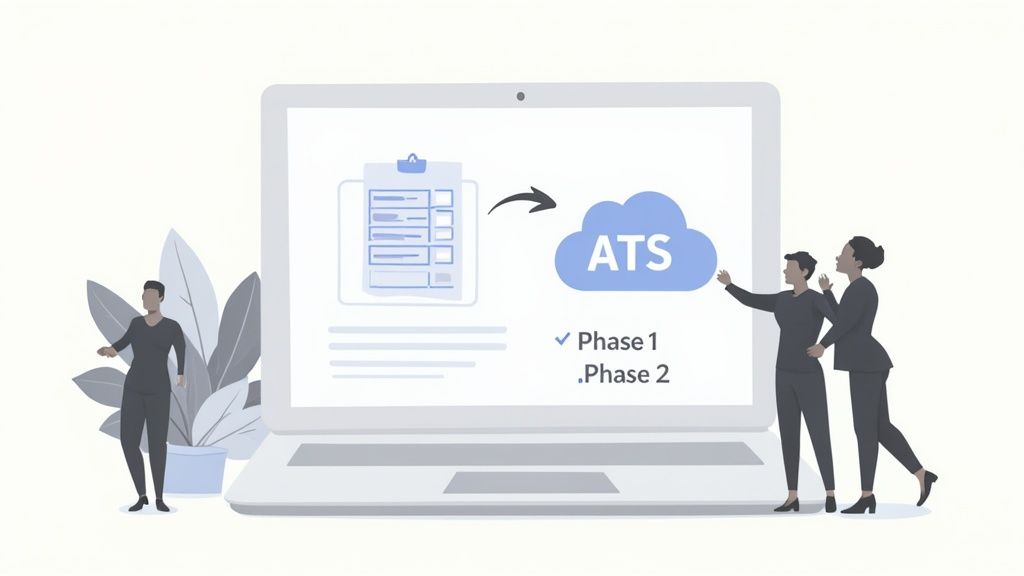
For a small team, an ATS should be a force multiplier, not a complex puzzle. Four core features provide about 80% of the value without the enterprise-level price tag.
Let's see how a core feature—a unified candidate database—works in practice. Imagine you're hiring a new Account Executive and remember a great silver-medalist candidate from last year.
PeopleGPT Workflow: Rediscover Past Applicants
Prompt: Search my Greenhouse ATS for candidates tagged "silver-medalist" for "Account Executive" roles in the last 18 months with experience in SaaS.
Output:
Impact:
| Feature Category | Essential for Small Companies | Common in Enterprise Systems |
|---|---|---|
| Sourcing | Branded careers page, job board posting | Advanced passive candidate sourcing tools |
| Screening | Customizable application forms, keyword search | AI-powered predictive candidate scoring |
| Communication | Email templates, bulk messaging | Automated multi-stage nurture campaigns |
| Collaboration | Shared candidate notes and ratings | Complex multi-level approval workflows |
| Reporting | Time-to-fill, source-of-hire reports | Custom BI dashboards, DE&I analytics |
| Integration | Calendar and email sync (Google/Outlook) | Full HRIS and payroll integration |
Methodology: Based on an analysis of 25 top-rated ATS platforms and user reviews from G2 and Capterra, focusing on SMB use cases.
Stick to the "Essential" column, and you'll get a system that solves real problems without burying you in features you'll never touch. Some of the top 10 AI recruiting tools for 2026 can be integrated later.
For any small business, the biggest fear is sinking money into a new tool only to watch it drain the budget. When it comes to an Applicant Tracking System, the cost isn't just the sticker price. You have to account for hidden fees, implementation hours, and the risk of getting locked into an inflexible contract.
Navigating the sea of complex pricing models requires a solid financial compass. The goal isn't just to find the lowest price, but the system that delivers the highest return.
The global ATS market is projected to grow from USD 3.28 billion in 2026 to a staggering USD 4.88 billion by 2030 (GlobeNewswire, 2026). But for small companies, high implementation and maintenance costs are a huge barrier.
But there's more. Most pricing structures fall into one of these buckets:
To make sure your choice fits your financial reality, checking out a practical guide to small business budgeting can provide valuable perspective.
You might be tempted by a "free" ATS. But there's a problem most tools ignore: free often comes with trade-offs that create more headaches than they solve. These systems are notorious for having little to no customer support, leaving you high and dry when something goes wrong. They also tend to have strict limits on users or active jobs, forcing you into a costly upgrade.
So, what should you look for? The infographic below breaks down the must-have features that even a budget-friendly system should include.

A centralized candidate database, a branded careers page, and basic communication tools are the bedrock of any useful ATS. Remember, you're not just buying software; you're investing in a better hiring outcome. Consider the jump in the quality of your hires and the reduced need for expensive external recruiters. A great example of this is how Zapier cut its cost-per-hire by 35% within 6 months of implementing a well-suited ATS. These are the factors that really matter when you're evaluating the best talent acquisition software for your needs.
So, you’ve swapped chaotic spreadsheets for a shiny new ATS. How do you know if your compass is pointing true north? Success isn't just about feeling more organized; it's about seeing measurable improvements that prove you made the right investment.
You need to look past superficial wins and zero in on the numbers that move the needle. This isn't about building a complex, enterprise-level dashboard.
It's about picking three or four core metrics that tell the real story of how your recruiting has improved.

To prove your ATS is delivering real value, start tracking these key indicators. They give you a clear, no-nonsense picture of your progress and show exactly where your new system is making a difference.
Keeping an eye on these numbers does more than justify a software purchase. By monitoring these core recruiting metrics, you can spot bottlenecks and continuously fine-tune your entire hiring strategy. The implication is that an ATS isn't a one-time fix but a continuous navigation tool for building the strongest team possible.
Sign up for PeopleGPT—it's free.
They are specialized software designed to help small businesses manage their entire hiring process, from posting jobs and collecting applications to screening candidates and scheduling interviews. Unlike enterprise systems, they are built to be affordable, easy to use, and focused on core features.
Not anymore. Many modern systems offer budget-friendly plans, often starting around $50-$150 per month. Pricing is typically based on the number of active jobs or users, making it scalable. When you factor in the time saved on admin work, most small businesses see a quick return on investment.
An ATS helps standardize your hiring process, ensuring every candidate is evaluated against the same criteria, which is a key step in fair hiring. It also provides a secure, centralized place to store candidate data, helping you comply with privacy regulations like GDPR and CCPA.
{{large_cta}}
Run your first search for free. Find and engage top talent across 800M+ profiles. Trusted by 5,000+ customers.
.png)