.svg)
SIGN UP FOR JUICEBOX (IT’S FREE!)

Who are you looking for?
Thank you! Your submission has been received!
Oops! Something went wrong while submitting the form.

An applicant tracking system for small business isn't some enterprise luxury anymore—it's the core engine you need to compete for talent.
This software takes the tedious, soul-crushing hiring tasks off your plate, like posting jobs everywhere and sifting through resumes. It frees up your small team to do what actually matters: building relationships with great candidates and making smart hires, faster.
This core benefit—speed through automation—is what turns hiring from a painful chore into a competitive advantage.
TL;DR: For a small business, an ATS isn't just about getting organized; it's about survival and growth. It automates the low-value admin work (scheduling, screening), freeing you up to connect with high-value candidates. While old systems are bloated and expensive, modern AI-native platforms like Juicebox are built for the speed and agility small teams need, turning hiring from a cost center into a powerful growth driver.
So many small businesses are still stuck in the dark ages of manual hiring. If you're wrestling with spreadsheets and an overflowing inbox, you know the pain. An applicant tracking system for small business fixes this by pulling every candidate interaction into a single, clean pipeline. Think of it like a CRM, but for your talent.
But here’s the problem most tools ignore: the legacy platforms were built for giants like Google and Amazon. They’re often packed with features you’ll never touch, come with a shocking price tag, and take weeks to set up. That’s a terrible fit for a nimble team.
This is where things are finally changing. The global ATS market is projected to hit $30.51 billion by 2032, and it's small businesses like yours driving the fastest growth. A huge 78.5% of users report better quality hires, which is the whole point of investing in software in the first place.
You might think a basic system is "good enough" just to get organized. But organization alone doesn't help you find better candidates faster. That approach fails because a passive database can’t fill your pipeline. A modern applicant tracking system for small business has to do more than just track applicants; it needs to actively help you source them.
This is the fundamental difference with an AI-native platform. Instead of just managing the candidates who happen tofind you, it gives you the power to proactively find the best people across the entire web.
It’s a totally different approach. Traditional systems just give you a static list of applicants to scroll through.
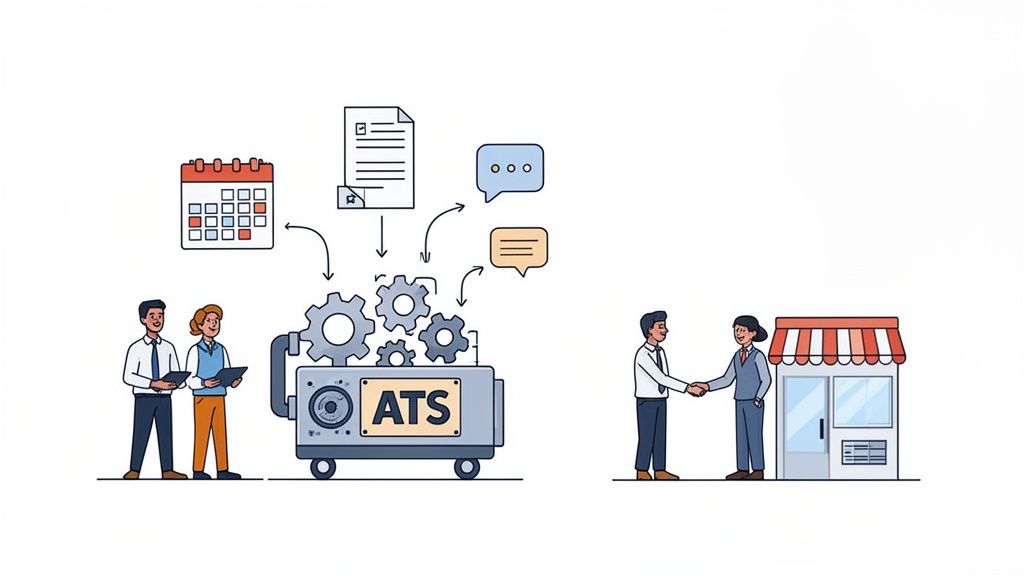
But an AI-powered system lets you search for your ideal candidate in plain English, instantly scoring millions of profiles to find the perfect fit. It’s the difference between waiting for fish to bite and having a sonar to find exactly where they are.
The implication here is massive. You're no longer limited to whoever clicks "Apply." Instead, you can pinpoint top-tier talent from a pool of over 800M+ profiles and engage them directly. This gives your small business the kind of sourcing power that was once reserved for major corporations.
Adopting an applicant tracking system for small business isn't just about efficiency—it's about fundamentally changing how you build your team. For a deeper dive, check out our guide on what is an ATS.
Most believe that a better applicant tracking system is one with more features. The exact opposite is true for a small business. Why? Because bloated, complex software slows you down, drains your budget, and distracts from the only thing that matters: finding and hiring great people.
Forget the complexity.
What you really need is a simple, intuitive, and powerful tool built for speed. The goal isn't to buy the most feature-packed system; it’s to find the one that removes friction and helps you hire faster. To streamline your recruitment process, you need clarity, not clutter.
To cut through the sales noise, you need a framework. Ignore the endless feature checklists from vendors and focus on what actually moves the needle. This scorecard is a practical model for defining your needs across four make-or-break pillars.
It’s designed to help you ask the right questions, spot the red flags, and choose an applicant tracking system for small business that fits your reality—not some enterprise fantasy.
| Evaluation Pillar | What to Prioritize | Key Questions for Vendors | Common Red Flags |
|---|---|---|---|
| Intuitive Design & Onboarding | A clean UI that requires minimal training. The whole team should understand it instantly. |
“Can my team be fully operational within one hour?” “What does onboarding look like for a non-technical user?” |
Mandatory multi-day training, cluttered dashboards, or “dedicated implementation specialist” required for basic setup. |
| Core Sourcing & Outreach | Proactive talent discovery. The ATS must help you find candidates, not just track applicants. |
“How does your platform help me find passive candidates?” “Is email outreach integrated directly into the workflow?” |
Only manages inbound applicants. If it can’t source talent, it’s a digital filing cabinet. |
| Transparent & Scalable Pricing | Clear, public pricing with monthly options. Costs should scale with hiring volume. |
“Are there any setup fees or hidden costs?” “What happens if we need to pause hiring for a few months?” |
Pricing hidden behind demos, multi-year contracts, and add-on fees for essentials like support. |
| Crucial Workflow Integrations | Seamless connection to your calendar and email for scheduling and communication. |
“Does it integrate with Google Calendar/Outlook?” “How does the email integration prevent manual data entry?” |
No native calendar/email integrations — creates more admin work, not less. |
This scorecard isn’t just a checklist; it's a filter. Use it to quickly disqualify vendors that don't align with the lean, fast-moving nature of a small business.
Your team doesn't have weeks to spare for training. A new tool has to be usable in minutes, not days. A confusing interface is the fastest way to kill adoption, defeating the entire purpose of the investment.
Here’s the bottom line: an ATS that only tracks inbound applicants is just a digital filing cabinet. For a small business to compete for talent, your system must actively help you find people. This is the single most important function.
An ATS without built-in sourcing is like a fishing boat with no nets. It might float, but it won't help you catch anything. The ability to proactively find candidates is what separates a passive database from a growth engine.
Your platform needs to give you direct access to a massive talent pool far beyond the usual job boards. Look for AI-powered search that lets you find candidates in plain English, getting rid of the need for complicated Boolean strings. Integrated email outreach is also non-negotiable; you have to be able to engage candidates the moment you find them, similar to the strategies used in effective recruitment emails.
A great system turns your reactive application process into a proactive sourcing machine. You'll need a solid recruitment and hiring plan to make the most of these capabilities.
Hidden fees, long-term contracts, and confusing pricing tiers are poison for a small business budget. You need predictable costs that scale with your growth, not with a sales rep's commission goals.
Finally, your applicant tracking system for small business has to play nice with the tools you already use every day. A disconnected system just creates more manual work, not less.
Focus on the integrations that actually matter for your daily hiring workflow. This really just means your company calendar (Google Calendar, Outlook) for scheduling interviews and your email provider (Gmail, Outlook) for seamless communication. These two are the bare minimum for avoiding administrative headaches.
Picking an applicant tracking system for a small business isn't about chasing the longest feature list. It's about finding the right tool for where you are right now. Instead of getting bogged down comparing dozens of vendors, it's way more effective to understand the three main archetypes of ATS platforms out there today.
Each category serves a totally different need. Pick the wrong one, and you’re looking at wasted money, a frustrated team, and killer candidates slipping through your fingers. We'll break down these three groups—Free & Freemium, Traditional Mid-Market, and AI-Native Sourcing Platforms—to help you figure out which path makes sense for you.
This decision tree gives you a quick visual guide on how to think about your needs across four key areas: design, sourcing power, pricing, and workflow.
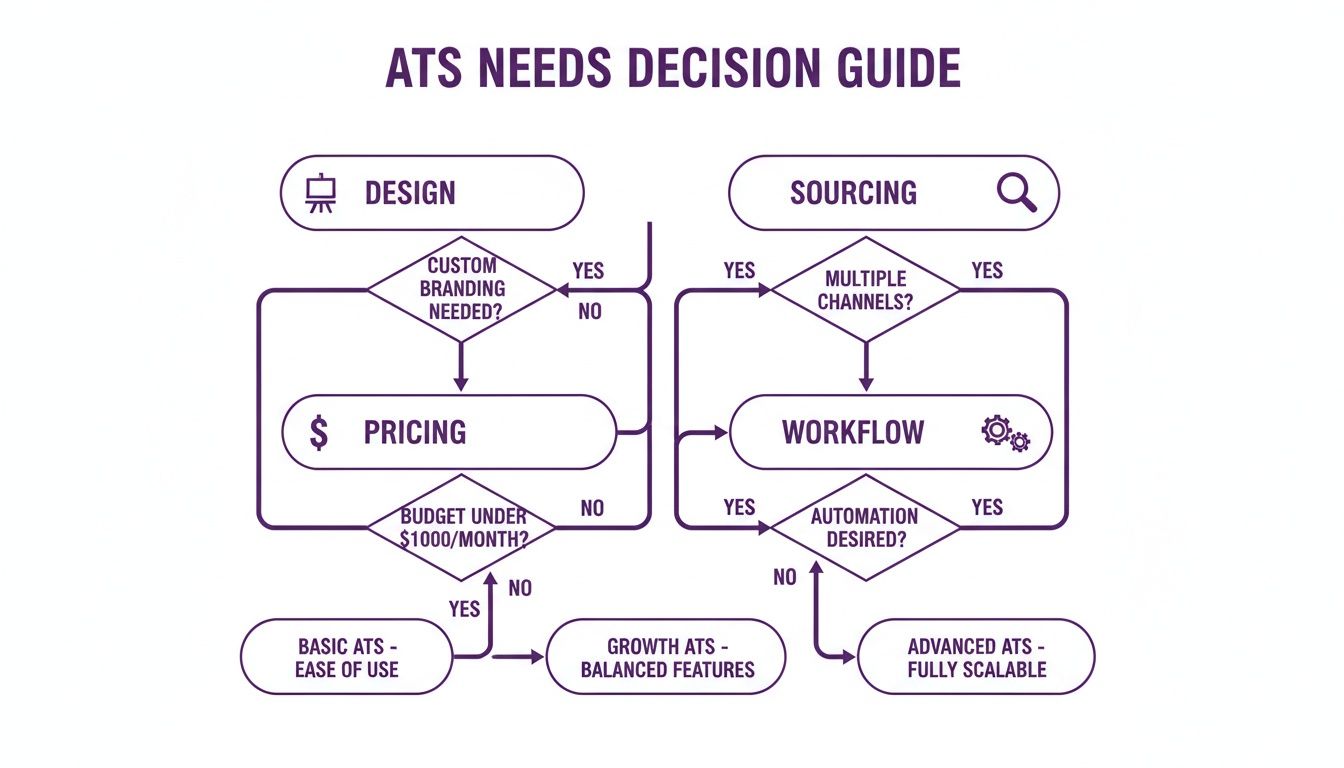
As you can see, the right applicant tracking system for a small business really boils down to what you’re optimizing for: saving cash, locking down a rigid process, or pure hiring speed.
For a startup watching every penny, free and freemium systems are hard to ignore. They offer a basic, no-cost way to ditch the hiring spreadsheet and get organized. If you're only hiring one or two people a year, these can be a perfectly fine place to start.
But "free" almost always comes with a catch.
The biggest issue with most free ATS platforms is that they're completely reactive. They help you organize the candidates who happen to find you, but they do absolutely nothing to help you find the talent you actually need.
These tools usually hit you with tight limits on active jobs, users, or the number of candidates you can store. Key features you’ll eventually need—like custom pipelines, analytics, or integrations—are often locked behind a paywall, forcing an upgrade right when the tool becomes useful.
Best for:
The problem most free tools don't solve is sourcing. If you aren't getting enough good applicants in the first place, a free ATS just helps you organize a pipeline of people who aren't the right fit. For any ambitious small business, that’s a critical flaw.
This category is home to the big names you've probably heard of, like Greenhouse and Lever. These are powerful, feature-packed systems built to create structured, repeatable hiring processes. They're fantastic at managing high-volume pipelines, keeping you compliant, and giving talent ops teams deep analytics.
It's tempting to think this process-heavy approach is what your small business needs to "get serious" about hiring.
The reality? All that complexity can be a straight-up burden. These platforms often require a ton of setup, mandatory training sessions, and can feel bloated for a small team that just needs to move fast. Their pricing is also built for bigger companies, with annual contracts and high per-seat costs that can be a non-starter for a small business budget, unlike some Indeed alternatives.
Make no mistake, these platforms are dominant. Over 98% of Fortune 500 companies use an ATS, with giants leaning on systems like Workday. But mid-market favorites like Greenhouse (19.3%) and Lever (16.6%) have grabbed huge market share, paving a path for the 33 million small businesses in the US to automate their hiring.
Let's be honest: the biggest challenge for a small business isn’t tracking applicants—it’s finding them. This is where the third archetype, the AI-native sourcing platform, completely changes the game.
Tools like Juicebox are built on a different foundation. They combine lightweight ATS features with a powerful, AI-driven sourcing engine. Instead of just managing whoever applies, their main job is to help you proactively discover amazing talent from a massive pool of over 800M+ profiles across more than 30 sources.
Here's how Juicebox flips the old model on its head:
This new breed of applicant tracking system for a small business gives you the sourcing firepower of a massive corporation without the cost or complexity. It fundamentally shifts the advantage back to you. To help you decide, check out our detailed breakdown of the best ATS for recruiters.
Let's cut through the noise. Vendor websites love to show off endless checklists of features, but for a small business, most of those bells and whistles are just distractions. The real value isn't in having a hundred different functions; it's about having the critical few that directly lead to faster, better hires.
This isn't just about "sourcing tools." It's about AI-powered discovery that uncovers hidden talent pools you'd never find otherwise. We need to focus on outcomes, not software functions. A feature is only useful if it solves a core problem—like an empty pipeline or losing great people to a slow, clunky process.
The right features act as force multipliers for a small team, giving you the same firepower as competitors with massive HR departments.
The single biggest bottleneck for any small business is simply finding enough qualified people to talk to. Manual sourcing is a soul-crushing time sink, and relying only on inbound applications is a recipe for mediocrity. This is where AI-native platforms completely change the game.
Forget spending hours trying to master Boolean search strings. An AI-powered system lets you describe your ideal candidate in plain English, and the platform instantly scans a massive talent pool of hundreds of millions of profiles. It scores and ranks the best matches in seconds.
This flips the entire script.
You're automating the most grueling part of recruiting, going from an open role to a qualified shortlist in minutes, not days.
Proof: Companies like Ramp and Perplexity use Juicebox to close roles 5x faster. How? By skipping Boolean and sourcing directly from over 800M profiles. That's the power of replacing manual screening with intelligent discovery.
Finding a great candidate is only half the battle. If you can’t get them to respond, you've wasted your time. That's why integrated, multi-step outreach tools are non-negotiable in a modern applicant tracking system for small business.
But there's a problem most tools ignore: disconnected workflows. You find a candidate in one tab, verify their email in another, then jump to a third tool for outreach. That friction costs you time and causes great candidates to fall through the cracks.
A truly effective system brings all three steps into a single, seamless flow. You should be able to:
This unified approach is what drives real results. We’ve seen that users who run multi-step sequences get 3x higher reply rates compared to those sending one-off emails. It ensures your outreach is persistent and professional without burying you in administrative work. To learn more, see how other companies are using automated recruitment software to get ahead.
Your ATS can't live on an island. If it doesn't connect smoothly with the tools you already use, it creates more work, not less. For any small business, two integrations are absolutely essential: email and calendar.
Look for deep, native integrations with platforms like Gmail and Google Calendar (or their Outlook equivalents). This lets you schedule interviews, send messages, and track all your communication without ever leaving the ATS. Without this, you're back to manually copying and pasting information between systems—the very thing you’re trying to eliminate.
Finally, you can't improve what you don't measure. A good applicant tracking system for small business gives you simple, visual dashboards that offer an instant snapshot of your hiring health.
You don't need dozens of complex reports. Just focus on a few key recruiting metrics:
These simple data points help you spot bottlenecks, fine-tune your strategy, and make smarter hiring decisions over time. It transforms hiring from a guessing game into a predictable, data-informed growth engine.
Thinking an applicant tracking system for small business is just another expense is a common mistake. It's easy to see the monthly fee as a luxury your lean budget can't afford. But that view completely misses the expensive reality of not having one. Slow hiring, endless admin work, and the soul-crushing cost of a bad hire are already draining thousands from your business.
Let's reframe this. The right ATS isn't a cost center; it's an investment with a clear, measurable return. When you automate the repetitive, low-value tasks bogging you down, you're not just buying software. You're buying back your time and building a more resilient company.
Here’s how to think about the real return on investment (ROI), broken down into three core drivers.
Start with the most obvious metric: hours saved. Think about how much time you or your team currently waste each week on stuff like manually posting jobs, sifting through resumes, and the endless email tennis match of trying to schedule a single interview.
Now, put a dollar value on that time. An ATS takes over that grunt work, freeing up your most important people to focus on things that actually make money.
Proof: Research shows small businesses can save up to $10,000 annually by automating manual hiring tasks. What’s more, employees are 69% more likely to stick around if they have a great onboarding experience, which the right system streamlines. That’s a direct impact on your bottom line.
A bad hire is one of the most expensive landmines a small business can step on. The U.S. Department of Labor estimates the cost can be as high as 30% of that employee's first-year salary. For a role paying $70,000, that's a $21,000 mistake. Ouch.
An applicant tracking system for small business is your quality control filter. By using smart tools to source from a wider, more qualified talent pool and standardizing how you evaluate everyone, you dramatically lower the odds of making that costly misstep.
Finally, let's talk about the opportunity cost of an open role. Every single day a critical position sits empty, your business is leaking money. It could be lost sales, delayed projects, or just burning out the rest of your team who are picking up the slack.
A modern applicant tracking system for small business directly boosts your hiring velocity. By building an efficient, automated pipeline, you can fill roles much faster—sometimes cutting your time-to-hire in half. That means getting a productive person in the door sooner, which has an immediate and direct impact on your revenue. If you really want to get a handle on the numbers, you need to know how to accurately calculate your cost per hire.
When you add up the time saved, the bad hires avoided, and the value of hiring faster, the financial case becomes a no-brainer. You can get even deeper into the numbers with our full guide on calculating your cost-per-hire.
Switching to a new piece of software can feel like a huge project, but a smooth transition is totally achievable with the right game plan. A successful ATS launch isn't about just flipping a switch one day. It’s a structured process that makes sure your team is ready, your data is clean, and your candidates get a great experience from day one.
Think of it like setting up a new retail shop. You wouldn't just unlock the doors without organizing the inventory, training your staff on the register, and planning a grand opening. The same logic applies here—it helps you sidestep the common migration pitfalls that can derail the whole thing.
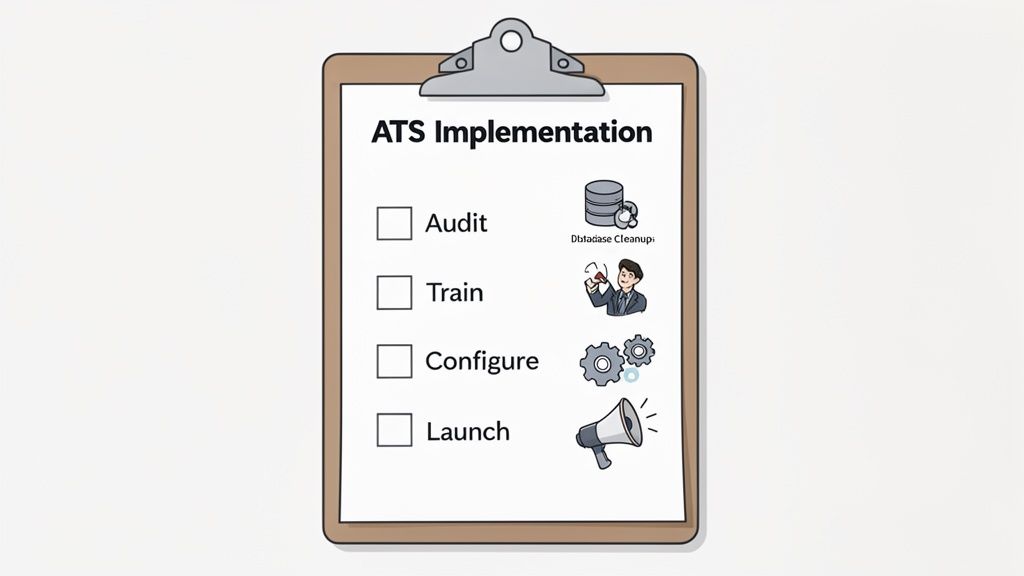
Before you move anything, you need to take stock of what you actually have. This means auditing all your existing candidate info, whether it's buried in spreadsheets, email folders, or a clunky old system.
An ATS is only as good as the team using it. Getting your people trained up early and effectively is the key to making sure the new tool actually gets used.
Your goal here is to get everyone excited about how much easier hiring is about to become. Focus on the "what's in it for me"—less admin for hiring managers, faster sourcing for recruiters. Most modern systems are pretty intuitive, so a single one-hour session is often all you need.
This is where you make the applicant tracking system for small business your own by customizing it to match how you hire.
The goal isn't to replicate your old, clunky process. It's to build a new, more efficient one. Use this as a chance to design a hiring pipeline that eliminates bottlenecks, not one that just digitizes them.
Start by defining the key stages in your hiring process (e.g., Sourced, Screening, Interview, Offer). Then, create standardized email templates for everyday communications like interview confirmations and rejection notes. It’s a small step that ensures consistency and will save your team hours every single week.
Alright, it’s time to go live. Make sure you communicate the change to the entire company, explaining the new process for submitting referrals or flagging open roles.
Even more important: update your careers page and ensure all application links point directly to the new system. This final step is crucial for a professional rollout and makes sure you’re creating a seamless experience for your candidates.
For small teams, focus on simplicity and sourcing power. AI-native platforms offer free or low-cost plans that give you a competitive edge without complexity.
A good benchmark is $100-$300 per month. This should include modern AI sourcing, integrated outreach, and analytics. For an example, see our simple pricing.
Yes, absolutely. Look for systems with blind screening and DEI analytics to build a more diverse pipeline and reduce unconscious bias in your hiring process.
The core benefit of the right applicant tracking system for small business isn't just organization—it's speed. By automating the low-value administrative work that drains your time, you reclaim the hours needed to build relationships with exceptional candidates. What this unlocks is the ability to compete for top-tier talent and build your team faster than your rivals, turning hiring into your company's true growth engine.
Explore PeopleGPT inside Juicebox
{{large_cta}}
Run your first search for free. Find and engage top talent across 800M+ profiles. Trusted by 5,000+ customers.