.svg)
SIGN UP FOR JUICEBOX (IT’S FREE!)

Who are you looking for?
Thank you! Your submission has been received!
Oops! Something went wrong while submitting the form.

Navigating the talent market often feels like searching a vast, uncharted wilderness for a hidden prize. You know exceptional candidates exist, but traditional methods are like a faulty compass—spinning you in circles, leading to dead ends, and wasting precious time. The best ai tools for recruiters act as a modern navigation system, providing a clear, direct path to the right people. These tools don't just speed up the journey; they reveal entirely new routes to passive candidates you would have otherwise missed. In fact, a 2024 Deloitte report found 79% of talent professionals believe AI gives them more time for human-centric work. This guide cuts through the noise to show you how modern platforms, including our conversational AI search tool PeopleGPT, can build a curated talent pipeline in minutes.
Sifting through hundreds of mismatched profiles on outdated platforms is a frustrating cycle that delays critical hires and limits your strategic impact. We promise to show you how to cut sourcing time by over 70%, allowing you to focus on building relationships with qualified, interested candidates. This article previews a different approach, one where AI serves as your compass, enhancing your intuition rather than trying to replace it. Unlike generic recruiting posts, this guide shows real PeopleGPT workflows—not theoretical advice.
AI recruiting tools find candidates by using machine learning models to search, match, and rank profiles from vast datasets far more efficiently than humans can. Instead of relying solely on keyword matching, these platforms analyze skills, career trajectories, and contextual data from hundreds of sources—like professional networks, code repositories, and academic sites—to identify best-fit talent, including passive candidates who aren't actively looking.
The process has fundamentally evolved. You might think that relying on AI search diminishes the "human touch." Here's why that's wrong. By automating the high-volume, repetitive task of sourcing, AI liberates recruiters to focus on strategic work: building relationships, advising hiring managers, and closing candidates. The machine provides the map, but the recruiter still steers the ship. This shift turns a tactical function into a strategic one, directly impacting quality-of-hire and speed.
But there's a problem most tools ignore.
Many platforms are just faster versions of old databases, still requiring recruiters to become expert Boolean operators. The most advanced systems, however, use conversational AI. You simply describe your ideal candidate in plain language, and the AI agent translates that into a complex search, builds a shortlist, verifies contact info, and even drafts personalized outreach.
The best AI tool for candidate sourcing is one that combines a massive, multi-source talent pool with an intuitive, conversational search interface. For experienced recruiters, this means a platform that can understand complex, nuanced requirements and deliver a high-quality, pre-vetted shortlist without demanding hours of manual refinement.
Juicebox stands as a definitive leader among ai tools for recruiters, designed to transform complex hiring briefs into high-quality talent pipelines with remarkable speed. It operates on a powerful AI-first foundation, using its PeopleGPT engine to interpret natural language. This allows recruiters to describe their ideal candidate in plain English, completely sidestepping the need for intricate Boolean search strings. The platform's core mission is to replace manual, time-consuming sourcing with an intelligent, automated workflow that delivers precision and scale.

This approach is especially powerful for sourcing specialized or passive candidates who are not actively searching for roles. By accessing over 600 million profiles from 60+ real-time sources, Juicebox uncovers talent that other platforms often miss. Its AI Agents then take over, autonomously discovering, ranking, and organizing these candidates into actionable shortlists. This isn't just theory; recruiting firm Pillar used PeopleGPT to place a senior software engineer in just three weeks.
PeopleGPT Workflow: Finding a Founding Engineer
Juicebox offers a free trial. Paid tiers include Growth and Business plans, with custom Enterprise options available.
Juicebox is a formidable AI sourcing and engagement platform that directly addresses the most significant bottlenecks in modern recruiting. While the AI-driven matches still benefit from a final human review, the efficiency gains are undeniable. Its deep ATS integrations make it a compelling choice for any data-driven hiring team.
Website: https://juicebox.ai
As the undisputed heavyweight of professional networking, LinkedIn Recruiter remains a foundational tool. Its value is direct access to the largest professional graph. While its core function is sourcing, recent updates have infused more AI capabilities, positioning it as a key player among ai tools for recruiters.
The platform's AI-assisted search helps surface relevant candidates beyond simple keyword matching. For teams at scale, the mature workflows and analytics create a reliable recruiting hub. To get the most from it, go beyond basic searches. For an in-depth guide, explore How to Master LinkedIn as a Recruiter.
While powerful, its premium price can be a drawback. Many teams explore LinkedIn Recruiter alternatives for more specialized solutions.
As one of the largest job sites globally, Indeed incorporates AI to manage high-volume recruiting. Its strength is its massive, active candidate pool, making it a go-to for roles from hourly workers to corporate professionals. The platform uses AI-driven matching to connect employers with relevant candidates from its database, streamlining the initial hiring stages.

Its AI automates scheduling, facilitates virtual interviews, and powers hiring events. For recruiters managing multiple openings, these features are essential. The pay-per-click model offers flexibility but requires careful budget management.
While its reach is undeniable, the sheer volume can lead to mixed candidate quality. For more targeted sourcing, exploring Indeed alternatives can provide specialized solutions.
Top AI platforms for passive talent sourcing are those that aggregate data from sources beyond a single professional network. They excel at creating holistic candidate profiles by pulling from code repositories, academic publications, and social media, then use AI to identify individuals who have the right skills but are not actively applying for jobs.
SeekOut positions itself as an AI-powered talent intelligence platform designed to find and engage passive talent from a vast, aggregated database. It goes beyond a single social network by pooling data from numerous public sources, giving sourcers a more holistic view. Its standout feature is a conversational, ChatGPT-style search that allows recruiters to use natural language to find candidates, making it a powerful asset among AI tools for recruiters focused on unearthing hard-to-find technical and diverse talent.

The platform’s strength is its comprehensive profile coverage and robust search capabilities. However, access requires a demo to get custom pricing, and the software has a three-seat minimum, making it better suited for established teams. For those evaluating similar platforms, exploring top SeekOut alternatives can provide a clearer picture.
hireEZ is an AI-first outbound recruiting platform, consolidating sourcing, CRM, and analytics. Its strength lies in aggregating data from over 45 open web platforms, creating enriched candidate profiles. This provides a sourcing reach that extends well beyond single-network platforms.
Here's the deal.
Its EZ Agent acts as an autonomous AI sourcer that ranks candidates and automates outreach based on recruiter criteria. This agentic workflow, combined with diversity filters and market insights, equips teams with a strategic toolkit.

The platform’s pricing is quote-based and requires direct sales contact. For teams evaluating similar solutions, exploring different hireEZ alternatives can be useful.
Eightfold AI is a comprehensive, AI-native talent intelligence platform for the entire talent lifecycle. Its strength is a deep-learning model built on a massive global dataset of skills and career paths. This allows it to serve as a powerful compass for both external hiring and internal mobility, making it one of the most robust AI tools for recruiters in the enterprise space.

The platform uses its skills graph to go beyond keyword matching, uncovering adjacent skills and predicting potential. It excels at candidate rediscovery, surfacing high-potential applicants from a company’s existing ATS.
Eightfold is an enterprise-grade solution with a corresponding price tag, available via custom quote only.
AI automates repetitive recruiting tasks like scheduling, initial screening, and answering common candidate questions, freeing up recruiters for more strategic work. Conversational AI chatbots, in particular, can engage applicants 24/7, qualify them against basic criteria, and schedule interviews directly onto a recruiter's calendar, dramatically reducing administrative overhead and speeding up the hiring process.
In high-volume recruiting, speed and candidate experience are paramount. Paradox, with its AI assistant Olivia, focuses on automating top-of-funnel interactions. It excels at engaging candidates instantly through chat, turning a website visit into a scheduled interview in minutes. This conversational approach aims to capture and qualify frontline and hourly workers applying on mobile devices.
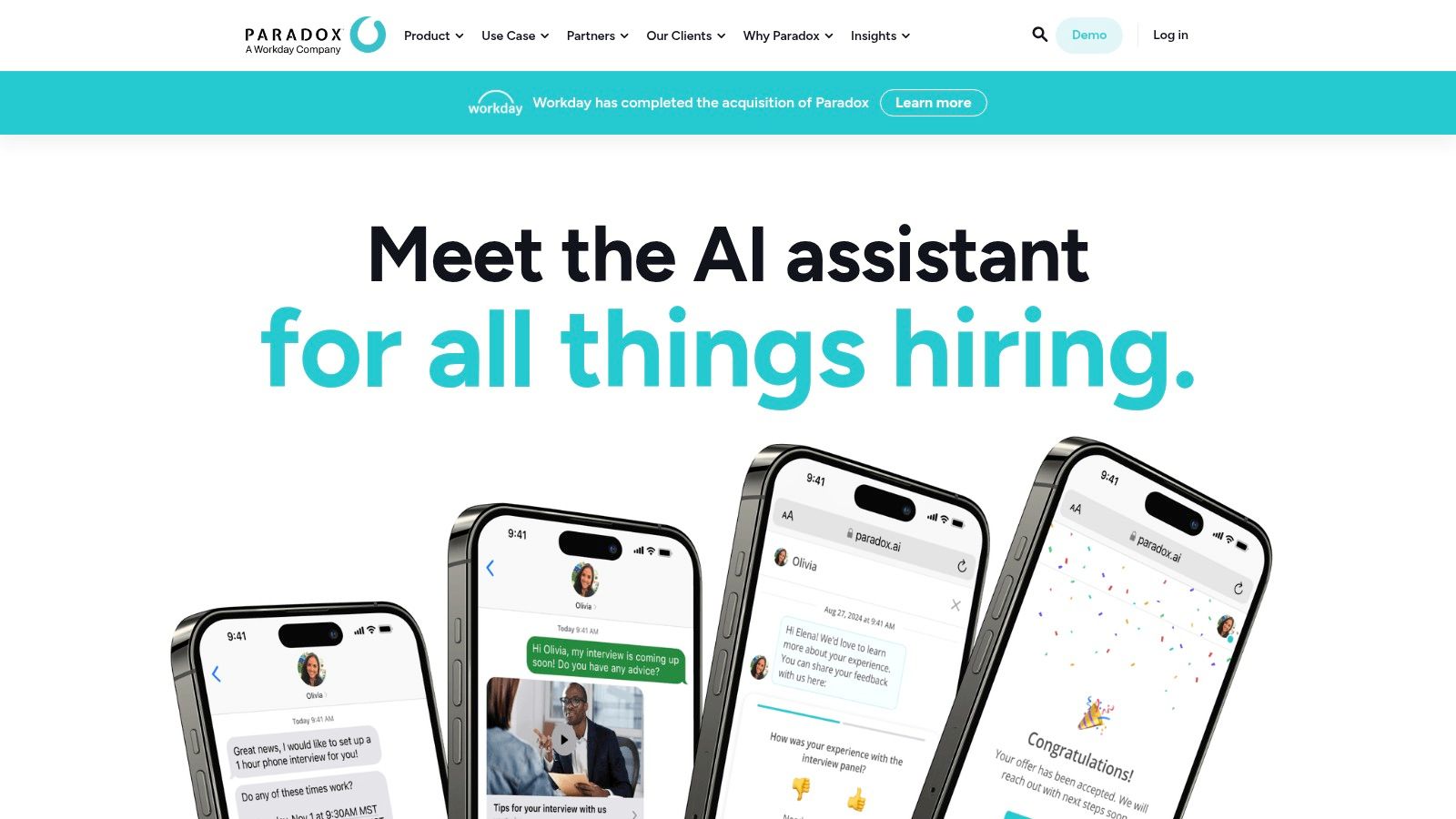
The platform’s real strength is its 24/7 availability and multilingual support via SMS, WhatsApp, and web chat. Olivia handles tedious tasks like answering FAQs, initial screening, and coordinating interviews. For a deeper dive, visit the official Paradox website.
Paradox is an enterprise-grade solution, making it less suitable for smaller teams or specialized professional recruiting.
Gem is an AI-first, all-in-one recruiting platform designed to consolidate a fragmented tech stack. It combines a CRM and ATS with sourcing and outreach automation. Its core value is unifying talent pipelines, from sourcing to analytics, into a single workflow, which is a key benefit for any freelance recruiter.
But there's more.
Gem’s LLM-powered search across its proprietary database and 20+ other sites offers a significant advantage. The platform is built to streamline outreach through AI-personalized campaigns and provide deep visibility with its integrated analytics.

As teams scale, it is useful to evaluate Gem alternatives to ensure the platform continues to meet evolving needs.
Fetcher operates as a "sourcing-as-a-service" platform, combining its AI engine with a human-in-the-loop verification process to deliver curated candidate slates. This hybrid approach is for teams that want automation without removing the human touch from the top of the funnel. It automates both candidate discovery and initial outreach.
Its core value is saving recruiters time on manual sourcing and follow-ups. Instead of building complex boolean strings, recruiters receive batches of qualified candidates and can launch multi-stage email campaigns with a few clicks.

The primary limitation is its pricing model, which isn't publicly listed and requires a sales call.
Yes, AI tools can significantly improve candidate assessment by standardizing the evaluation process with structured interviews and skills-based challenges. These platforms use AI to analyze responses against predefined criteria, helping to reduce unconscious bias and enabling recruiters to make more objective, data-driven decisions about a candidate's qualifications and potential for success in a role.
HireVue specializes in structured, AI-driven interviewing and assessments, a critical component for large-scale, compliance-focused hiring. It moves beyond sourcing to evaluate candidates' skills through on-demand video interviews, game-based challenges, and coding assessments. This makes it one of the most established AI tools for recruiters aiming to standardize evaluation and reduce bias.
Its platform is built around creating a fair and efficient assessment experience. By providing every candidate with the same set of questions, HireVue’s AI helps teams make more objective, data-backed decisions.
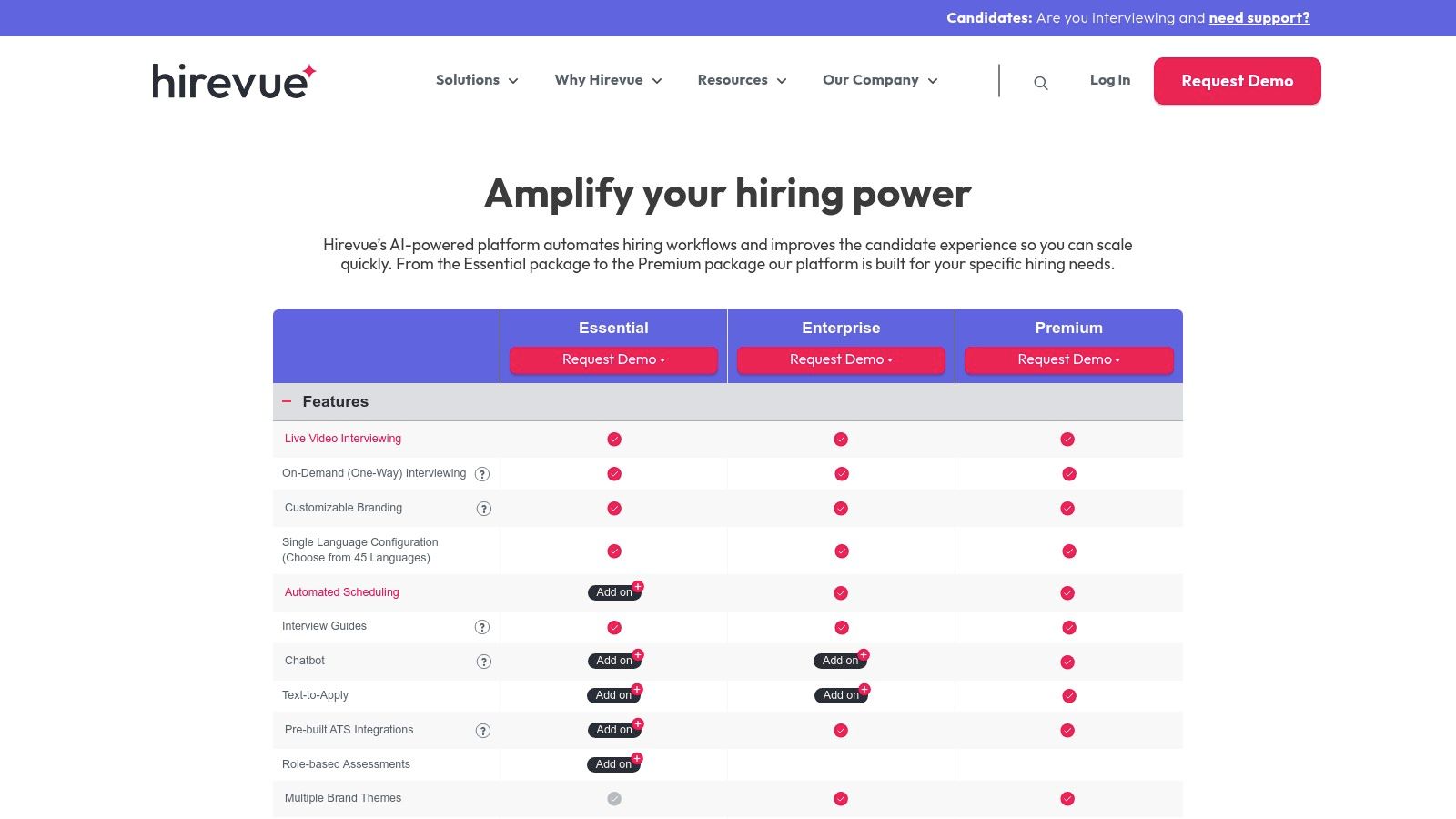
The primary drawback is its enterprise-focused pricing model, available only upon request. You can explore HireVue's platform at https://www.hirevue.com/pricing.
For high-volume recruiting, Harver offers a powerful suite of AI-driven assessments and workflow automation tools. It moves beyond simple resume screening to predict candidate success using scientifically validated, interactive assessments. By integrating game-based evaluations from Pymetrics, Harver provides an engaging candidate experience while gathering deep insights.
This approach helps organizations reduce early-stage turnover and accelerate time-to-hire by automatically identifying the best-fit candidates from a large applicant pool. Harver’s focus on predictive talent analytics provides data-driven support for hiring decisions.

Its specialized focus makes it exceptional for volume hiring but potentially overly complex for low-volume or executive search needs.
When the market for ai tools for recruiters becomes crowded, turning to a neutral marketplace for clarity is a vital step. G2 acts as a directory where teams can compare software based on verified user reviews. It provides a structured environment to evaluate solutions beyond vendor marketing claims.
The platform's strength lies in its aggregated user feedback, which offers insights into usability and support.
G2 is a discovery platform, not a vendor. Pricing information should always be verified directly.
ToolBest ForKey DifferentiatorEst. PricingPeopleGPTTechnical & Leadership SourcingConversational AI search across 600M+ profilesFree Trial / CustomLinkedIn RecruiterGeneral Professional SourcingLargest professional network database$$$$SeekOutPassive & Diverse TalentAggregated data from multiple web sources$$$hireEZOutbound Recruiting AutomationAI sourcing agent (EZ Agent)$$$Eightfold AIEnterprise Talent ManagementDeep learning skills graph for internal mobility$$$$$ParadoxHigh-Volume & Hourly RolesConversational AI for scheduling & screening$$$$GemStartups & Growth CompaniesAll-in-one sourcing, CRM, and analytics$$Methodology: Pricing estimates are based on publicly available data and user reviews, categorized from $$ (startup-friendly) to $$$$$ (enterprise-grade). Final pricing requires a direct quote.
No, AI will not replace recruiters. It automates repetitive, top-of-funnel tasks like sourcing and scheduling, allowing recruiters to focus on strategic work such as building candidate relationships, advising hiring managers, and closing offers.
AI recruiting tool costs vary widely, from around $200/month for basic startup plans to over $100,000/year for enterprise platforms. Pricing often depends on the number of users, features, and the volume of hiring.
The main benefit is a dramatic increase in efficiency and reach. AI can source and screen thousands of candidates in the time it takes a human to review a few dozen, significantly reducing time-to-hire while uncovering passive talent.
The journey through the wilderness of talent acquisition has a new map. The adoption of AI is not just about upgrading your compass; it’s about fundamentally changing your role from a simple navigator to the expedition's chief strategist. The core implication is this: by automating the manual, time-consuming parts of the search, you are freed to focus on the uniquely human elements of recruiting—strategy, relationship-building, and influence. This transition is how you secure a permanent seat at the leadership table.
The true value is unlocked when you spend less time searching and more time advising. You become the expert who can interpret market data, guide hiring managers away from biased decisions, and build talent pipelines that anticipate future business needs. The machine finds the candidates; you build the championship team. That is the new direction, and the right AI tools are the compass that will get you there.
Ready to stop searching and start building? Sign up for Juicebox—it's free
{{large_cta}}
Run your first search for free. Find and engage top talent across 800M+ profiles. Trusted by 5,000+ customers.
.png)
.png)