.svg)
SIGN UP FOR JUICEBOX (IT’S FREE!)

Who are you looking for?
Thank you! Your submission has been received!
Oops! Something went wrong while submitting the form.

Sourcing today feels like you’re searching for a needle in a global haystack.
This guide shows how the right AI sourcing tool helps you find incredible, hidden talent your competitors are completely missing.
You'll learn exactly how top teams use AI to build pipelines full of passive candidates and streamline the entire how to source candidates workflow.
Let's break it down.

Forget static databases and endless Boolean strings. An AI sourcing tool is less like a clunky rolodex and more like a brilliant research assistant working for you 24/7. It’s built to go way beyond the old-school limits of keyword matching and platform-specific filters.
Instead of just spitting back profiles with the right buzzwords, these tools actually understand context, infer skills, and can even help predict if a candidate is a good fit. This is a huge leap from reactive searching to proactive talent discovery. Its main job is to figure out what you need, scan profiles across the entire public web, and hand you a curated shortlist of top-tier, often passive, candidates.
The real magic is in how an AI sourcing tool interprets your request. It uses something called natural language processing (NLP) to understand what you mean, not just what you type.
This lets you stop thinking like a machine and start asking questions like a human. Instead of wrestling with complex logic, you can just ask, "Find me a senior software engineer in Austin with fintech startup experience."
The AI then breaks down that simple sentence:
But it doesn't stop there. It won’t just look for those exact words on a profile. It knows that someone who worked at "Stripe" or "Chime" has fintech experience, even if they never wrote the word "fintech." This contextual awareness is a cornerstone of modern AI for recruitment, unlocking talent pools you’d otherwise completely miss.
This ability to connect the dots—like knowing that a software patent signals innovation—is what separates a simple search bar from a true AI sourcing tool. It digs through millions of data points to build a complete picture of a candidate, giving you a massive head start on building your pipeline.
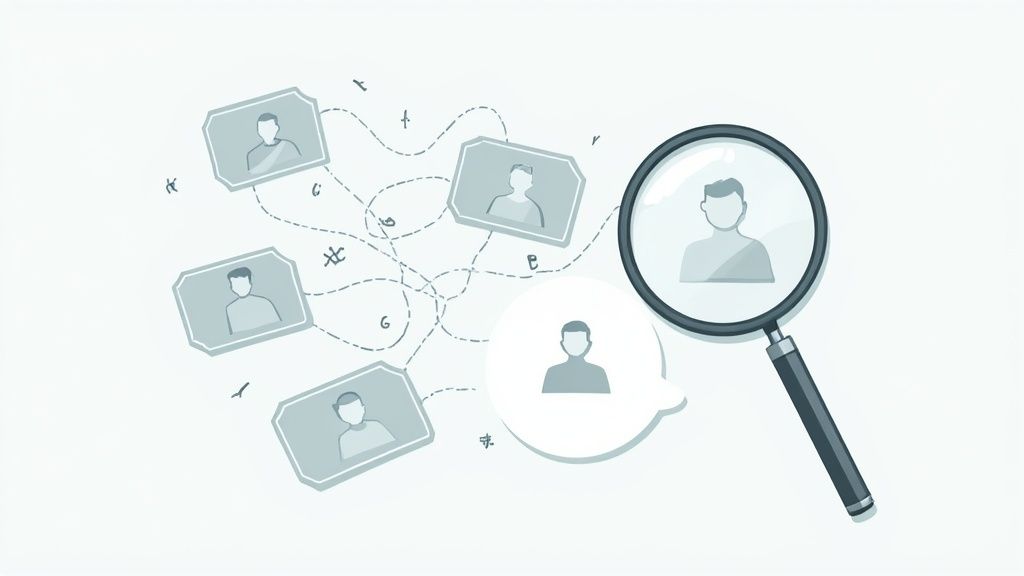
Let’s be honest: not every platform that slaps an “AI” label on its website is actually intelligent. A genuine AI sourcing tool is much more than a simple automation script. It’s a suite of smart features designed to fundamentally change how you find and connect with talent.
The absolute cornerstone is intelligent candidate matching. This isn't your old-school keyword search. True AI digs deeper, analyzing the full context of a candidate's profile to infer skills, weigh their experience, and even pick up on subtle clues about cultural fit. The goal is to surface people who are genuinely right for the role, not just a keyword match.
Then comes proactive candidate discovery. Instead of being stuck in one talent pool (like LinkedIn), the best tools are constantly scanning the entire public web. This means you’re finding fresh, passive talent from places your competitors probably aren't even looking.
Locating the perfect person is just step one. The next set of features is all about closing the gap between discovery and that first conversation—quickly and efficiently.
An AI-powered candidate summary is a massive time-saver. It pulls together a person's entire digital footprint—resumes, portfolios, social profiles—and spits out a concise overview. You can understand their entire career story in seconds instead of spending an hour digging.
A powerful AI sourcing tool doesn't just find names; it delivers actionable intelligence. It connects the dots from a promising profile to a verified inbox, making every discovery a potential conversation.
Finally, a great platform has to handle the last mile of sourcing:
We can see just how different this approach is when we compare it to the old way of doing things.
This new, integrated approach is exactly where the industry is heading. A 2026 survey found that 67.68% of companies are adopting AI to improve their decision-making, while 49.43% are focused on boosting productivity.
This shift highlights why tools that just find data are no longer enough. Recruiters need platforms that make that data immediately useful—especially when trying to build an AI skills map and make sense of complex technical profiles on the fly.
Let's be real—an AI sourcing tool isn't just another button on your dashboard. It fundamentally changes the entire rhythm of your work, shifting the process from reactive and manual to proactive and strategic. It gives you back the one thing you can never get more of: time.
Think about the last time you started a search. Instead of spending the first few hours wrestling with complex Boolean strings and then clicking through page after page of irrelevant profiles, imagine this: you just describe your ideal candidate in plain English. Within minutes, the AI serves up a qualified shortlist, complete with verified contact info. You get to skip the grunt work and jump straight to building relationships.
The true test of any sourcing tool is finding those "purple squirrel" candidates for your toughest roles. This is where an AI sourcing tool really shines. Let’s say you’re looking for a Senior Backend Engineer with experience in real-time payment processing and a background in a high-growth fintech company.
A manual search is slow and clunky, limited to whatever keywords you can dream up on the major platforms. An AI, on the other hand, understands the context behind the role:
This kind of deep-web analysis uncovers amazing candidates that manual keyword searches would completely miss, turning those impossible-to-fill roles into wins.
By understanding intent, not just keywords, an AI sourcing tool can identify, vet, and prepare candidates for outreach, dramatically accelerating your time-to-hire and helping you streamline the entire recruitment process from start to finish.
This is more than just an efficiency boost; it's a move from manual labor to strategic oversight. The best AI tools are evolving into autonomous agents that can deliver 15 to 30% efficiency gains by automating the repetitive tasks that don't add value. This frees up recruiters to do what they do best: connect with people. Industry analysis from ArtofProcurement.com shows how these agents are already reshaping both procurement and talent acquisition.
With the market for AI tools absolutely exploding, trying to pick the right one can feel like a shot in the dark. It’s critical to have a game plan for how you’ll evaluate these platforms, making sure whatever you choose actually lines up with your team’s hiring goals and, of course, your budget.
Your first move? Look past the flashy features and get back to basics. The single most important thing is the size and quality of the talent data fueling the AI. A great tool needs a massive, diverse pool of profiles to pull from if you want it to deliver top-tier candidates every time.
This boom in options isn't random; it reflects a huge industry shift. The global AI software market is on track to hit US$174.1 billion by 2026, and North America is leading the charge with 54% of that investment. The flood of new AI sourcing tools is a direct result of this growth.
When you’re sitting through demos, you have to ask the right questions. Don't just watch the slideshow—dig into how the platform actually works under the hood.
Here are the core areas you should be zeroing in on:
Picking the right tool is only half the battle. You also need a solid strategy for rolling it out. Following a practical guide to AI implementation can help your team get the most out of your new tech from day one. This process shows exactly how a tool fits into the core recruiting actions: building a pipeline, vetting candidates, and launching outreach.

At the end of the day, the best AI sourcing tool is the one that cuts through the noise and just plain works. If you want to see who’s leading the pack, check out our guide on the best sourcing tools for recruiters available right now.

The evolution of the AI sourcing tool is just getting started. We're moving way beyond simple keyword searches and into a new era of predictive, personalized talent acquisition. The next wave of this tech won't just find people—it'll help you predict who's most likely to respond, engage, and ultimately thrive in a new role.
This shift is also making recruiting a whole lot fairer. By zeroing in on verifiable skills, project histories, and actual capabilities instead of demographic details, AI is helping chip away at the unconscious bias that plagues hiring. Just look at how other industries are using tools like Artificial Design Intelligence (ADI) to build websites—it’s clear that AI is becoming a core part of how work gets done everywhere.
The key takeaway is this: an AI sourcing tool doesn't replace recruiters. It augments them. It takes over the repetitive, data-heavy grunt work, freeing you up to focus on the human side of recruiting—building real relationships and closing top candidates.
This isn’t just a niche trend; it's a massive technological wave. The global AI market is projected to hit a staggering USD 3,680.47 billion by 2034, proving just how deeply AI is being woven into business operations. Leaning into this technology isn’t just an option anymore. It’s essential for staying in the game. You can read more about AI market projections on PrecedenceResearch.com.
Still have some questions floating around? Let's tackle a few of the most common ones we hear from recruiters who are kicking the tires on AI sourcing tools.
Nope. The goal isn't replacement; it's augmentation. These tools are built to handle the repetitive, top-of-funnel grind—the endless searching and initial vetting that eats up your day.
This frees you up to double down on the high-value, human stuff: building genuine relationships with candidates, acting as a strategic partner to hiring managers, and closing complex offers. Think of it less as a replacement and more as the world's most efficient sourcing assistant.
It's a totally different ballgame. While both are essential parts of a modern toolkit, they operate on different principles. LinkedIn Recruiter is a closed database. You're limited to its ecosystem, and success depends on how well you can craft manual keyword and filter-based searches.
A true AI sourcing tool breaks out of that walled garden. It scours the entire public web, understands what you mean in plain English, and can even infer skills that a candidate forgot to list on their profile. It’s designed to proactively surface top-tier passive talent who may not even be logging into LinkedIn.
You'll feel the impact on time saved almost immediately. A search that used to take you a whole afternoon can now be done in the time it takes to grab a coffee.
As for the bigger picture metrics—like a drop in your time-to-fill and a noticeable jump in your quality-of-hire—those usually start to become crystal clear within the first couple of months. That's when you'll really see the power of building stronger, more relevant talent pipelines from day one.
Ready to stop searching and start connecting with the right talent in minutes? Juicebox gives you the AI-powered tools to build better pipelines, faster. Sign up — it’s free.
{{large_cta}}
Run your first search for free. Find and engage top talent across 800M+ profiles. Trusted by 5,000+ customers.