.svg)
SIGN UP FOR JUICEBOX (IT’S FREE!)

Who are you looking for?
Thank you! Your submission has been received!
Oops! Something went wrong while submitting the form.

Think of AI people search as a completely new way to find talent. Instead of being locked into a single platform like LinkedIn, it uses artificial intelligence to scan the entire internet for potential candidates. You stop wrestling with rigid keyword strings and start asking simple, conversational questions to find people from a massive, combined pool of public data. This is the new standard for finding candidates, moving beyond the limitations of traditional sourcing into a smarter, faster, and more effective workflow.
For years, recruiters have been stuck in the same loop: crafting complex Boolean search strings and deploying them inside walled gardens like LinkedIn Recruiter. That was the playbook. It was the only way to reliably build a pipeline.
But there’s a problem most tools ignore.
That model is painfully slow, incredibly repetitive, and traps you in the exact same saturated talent pool as every other recruiter on the planet. You waste hours tweaking keywords and sifting through irrelevant profiles, all while fighting for the attention of the same handful of active candidates. This isn’t just inefficient; it’s a strategic dead end. The best talent often isn't even on the platform you’re glued to. In fact, modern sourcing data shows that up to 80% of hires are now found outside of LinkedIn.
Here’s the hard truth about the old way:
What does this all mean?
Sticking to this old method is like trying to find a specific book in a giant library using nothing but the card catalog. Sure, it works eventually, but it’s slow and limited. What if you could just ask a master librarian to find that book for you, no matter what shelf—or even what library—it’s in?
That’s the fundamental shift AI people search brings to the table. It’s not just a better tool; it’s a total overhaul of how talent acquisition gets done.
Most people believe that if a candidate is truly top-tier, they'll be on LinkedIn. The opposite is true. This myth has held recruiting teams hostage for years, forcing them to fish in an over-crowded, increasingly shallow pond.
The reality? Top performers, especially in technical fields, are busy doing great work. They aren't obsessively polishing a single social media profile.
They’re pushing code to GitHub, speaking at conferences, appearing on company "About Us" pages, or getting involved in niche online communities. An AI people search platform pulls all this scattered data together from dozens of sources, building a rich, 360-degree profile of a candidate that one platform could never hope to capture. This is a core part of how using artificial intelligence in recruitment is changing the game.
To put this shift in perspective, by 2026, over 1.5 billion people were using standalone AI platforms globally. It’s a complete transformation in how we find information. This isn't about replacing recruiters. It's about upgrading their toolkit from a manual, single-channel process to an intelligent, web-wide engine.
It’s the difference between spending your day building Boolean strings versus asking a simple, intent-driven question like, "find me a founding engineer from a YC-backed fintech company," and getting a curated shortlist of perfect candidates in minutes, not hours.
Let’s be honest, traditional sourcing can feel like panning for gold in a single, overcrowded river called LinkedIn. AI people search works differently. Instead of one river, imagine having access to hundreds of them at once, with a smart system that instantly pinpoints the gold for you.
It all kicks off with a massive, non-stop data gathering operation. Platforms like Juicebox are constantly pulling in and refreshing profiles from over 30 public and private data sources. This goes way beyond social media—we’re talking company websites, conference speaker lists, niche developer forums, patent filings, and more. The goal is to build a complete picture of a candidate that no single website could provide.
This flips the sourcing model on its head.
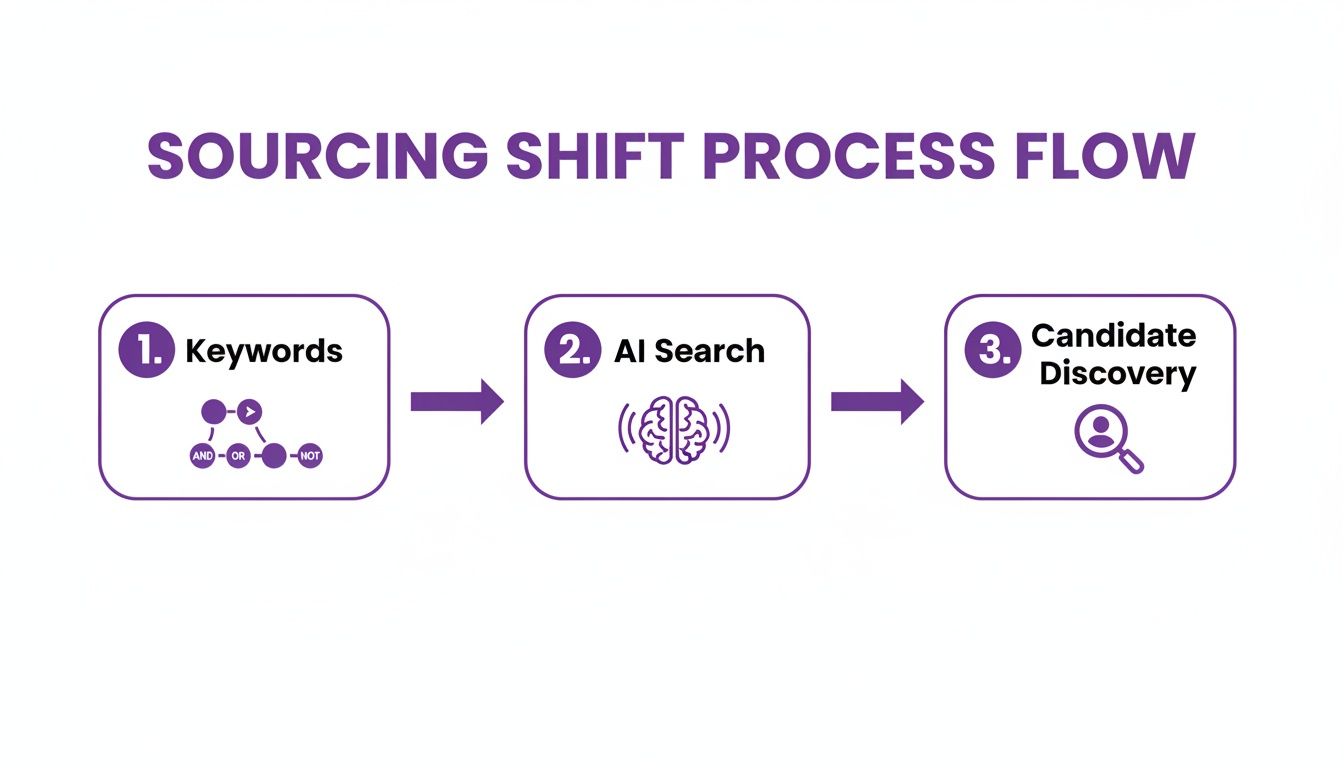
This visual really captures the core change: AI doesn't just search better; it understands what you're looking for on a deeper level.
But pulling in all this information creates a new problem, right? How do you possibly sift through hundreds of millions of profiles without drowning in noise? This is where the real magic of AI people search begins.
The next layer of the process is Natural Language Processing (NLP). This is the tech that finally lets you ditch the clunky Boolean strings and just talk like a normal person.
When you type a prompt like, "find a founding engineer from a YC-backed fintech," the NLP engine doesn't just hunt for those keywords. It gets your intent. It knows "founding engineer" implies early-stage experience and seniority. It understands "YC-backed" is a specific accelerator, and "fintech" is an entire industry. This ability to grasp context is what gives modern AI sourcing its incredible speed.
You might think more data just means more profiles to review. It's a fair point, but it overlooks the most critical part of the process: AI-powered scoring.
This is the system's brain. Once the NLP understands your request, the AI analyzes thousands of potential matches. It scores every one for relevance based on hundreds of data points, looking at things like:
A 2025 Apple study on Large Language Models found that these systems excel at recognizing statistical patterns—which is exactly how a scoring algorithm spots the subtle signals of a top-tier candidate. It’s what turns that ocean of data into a laser-focused shortlist. This is central to any good data-driven recruitment strategy.
Once the AI has a ranked list of top candidates, it moves to the final step: data verification. The system cross-references information across multiple sources to confirm details like their current role and—most importantly—their contact information.
This automated check ensures the email addresses you get are accurate, which seriously boosts the success rate of your outreach.
This is where the rubber meets the road. The quality of your results is a direct reflection of the quality of your prompts. Good news: you can forget the rigid, headache-inducing syntax of Boolean. This is about describing the person you want to hire in plain English.
Think of it like commissioning a portrait painter. You wouldn't just say, "paint a person." You’d give them the good stuff: "an experienced sailor with weathered hands and a stormy sea in the background." The more vivid your description, the closer the painting gets to your vision.
The same idea applies here.

Even though you can be conversational, a little structure goes a long way. The best prompts usually layer four key elements, starting broad and then zeroing in.
Here’s a simple but incredibly effective formula:
[Role] + [Experience] + [Context] + [Unique Identifier]
Let's break that down:
This framework forces you to think beyond just keywords. You're defining not just the what, but the where and how of a candidate's past success. That’s the real difference between a generic keyword match and a truly intent-driven AI people search.
Let's run through a real-world example. Say you're hiring a specialized software engineer for a payments company.
The Prompt:"Find me ex-Stripe software engineers with payments API experience who have worked at a company that went through a Series B round."
That one sentence is loaded with intent. "Ex-Stripe" sets a high bar. "Payments API experience" is the non-negotiable hard skill. And "Series B round" signals you need someone who knows high-growth scale-ups. This kind of nuance is something Boolean just can't touch. The freedom to use natural language for these searches is a massive time-saver.
An AI search would instantly surface a profile like this:
See how the AI connects the dots? It’s not just spotting keywords. It understands career arcs to give you a candidate who is a perfect fit.
Bringing an ai people search platform into your workflow isn’t just a tech upgrade. It's a strategic move with a clear ROI. The impact shows up in faster hiring cycles, stronger candidates, and serious cost savings.
You might think adopting a new tool means a long, painful ramp-up. But modern, AI-native platforms are built for immediate impact.
For example, a company like Cognition used PeopleGPT to slash their time-to-hire by 60% in a single quarter. The tactic? Sourcing top-tier talent completely outside of LinkedIn’s crowded pool. This isn't a small improvement; it's a fundamental shift in recruiting velocity.
The first thing you'll notice with an ai people search tool is how fast you can move. What used to take days of wrestling with Boolean strings now happens in minutes. This speed is a massive competitive advantage.
By generating a qualified shortlist almost instantly, you can start conversations with top candidates before your competitors even know they exist. This allows teams to close critical roles up to 5x faster.
The takeaway: Speed isn't just a feature. It's the ability to consistently win the best talent by being the first one in the door.
The most sought-after talent—especially in technical fields—is usually too busy building incredible things to polish a single social media profile.
This is where AI sourcing delivers its second major impact: quality. By searching across 30+ data sources, you break free from the same 20% of the market everyone else is chasing on LinkedIn. You can find engineers based on their GitHub contributions, product leaders from their conference talks, or designers from their Dribbble portfolios.
Here’s the bottom line.
Juicebox customers find that 80% of their hires come from sources outside of LinkedIn. The best candidates are often hiding in plain sight. This shift toward AI-powered discovery is happening everywhere. Gartner predicts that traditional search volume will drop 25% by 2026 as people move to AI search. Finding the best sourcing tools for recruiters is now about finding the smartest system.
The final pillar is pure bottom-line impact. A modern ai people search platform isn't just another tool; it's a chance to consolidate and save. Legacy platforms like LinkedIn Recruiter can cost upwards of $10,800 per seat, locking you into a single, overpriced data source.
By combining search, verification, and outreach into one platform, teams can eliminate redundant tools and cut their sourcing software costs by up to 80%. This isn't just about saving money; it's about reallocating that budget toward hiring great people.
Picking the right AI people search platform boils down to a few key questions. Not every tool is built the same, and the gap between a modern platform and a clunky, demo-gated one can seriously impact your team’s speed and success.
To cut through the noise, you need a solid way to evaluate them. This isn't just about ticking off features; it's about finding a tool that genuinely makes your job easier. Let's walk through the four things you should be looking at.
The very first question to ask is: Where is this data actually coming from? An AI people search tool is only as good as its data. If a platform is just pulling from one source, you're not getting anything better than old-school tools.
You want a solution that aggregates data from 30+ public and private datasets, including:
Freshness matters just as much as breadth. Make sure the platform has a rock-solid process for constantly updating its information.
Next, look at the search experience itself. Does the tool make you think like a computer, or does it understand how a human thinks?
So many platforms are still stuck in the past, forcing you to wrestle with complicated Boolean strings. A modern AI people search platform must be built on Natural Language Processing (NLP).
You should be able to type a normal prompt like, "Find me product managers who have scaled a B2B SaaS product past $10M ARR," and get back a clean, ranked list. If you have to pull out a manual just to figure out the syntax, the tool has failed.
Finding a great candidate is just step one. It doesn't help if you have no way to contact them. A lot of tools drop the ball here, forcing you to use one product for search, another for email verification, and a third for outreach.
That fragmented process is a massive time-waster. An effective platform brings the entire top-of-funnel workflow together:
Pulling these steps together saves time and money. You can learn more about how to find the right AI recruiting software that fits your team's needs.
Finally, look at the business model. Is the pricing right there on the website, or is it hidden behind a "Book a Demo" wall? This tells you everything.
Transparent companies are confident enough to let you see the value for yourself with clear pricing and free trials. Old-school, sales-led companies often use murky pricing and high-pressure demos to lock you into expensive contracts. To get a feel for the market, it’s worth checking out some top Seamless AI alternatives to understand your options.
The takeaway: Go with a partner who believes in their product enough to let you try it before you buy it.
The real magic of AI people search isn't just finding candidates faster. It’s about fundamentally changing the recruiter's job for the better. By automating the grunt work, AI frees your team from being "search operators" and lets them become true "talent advisors."
Think about it.
Instead of spending hours fighting with keywords, they can focus on what actually moves the needle: building real relationships, selling the company vision, and closing the best candidates. For any company, finding ways to streamline the recruitment process is a massive competitive advantage.
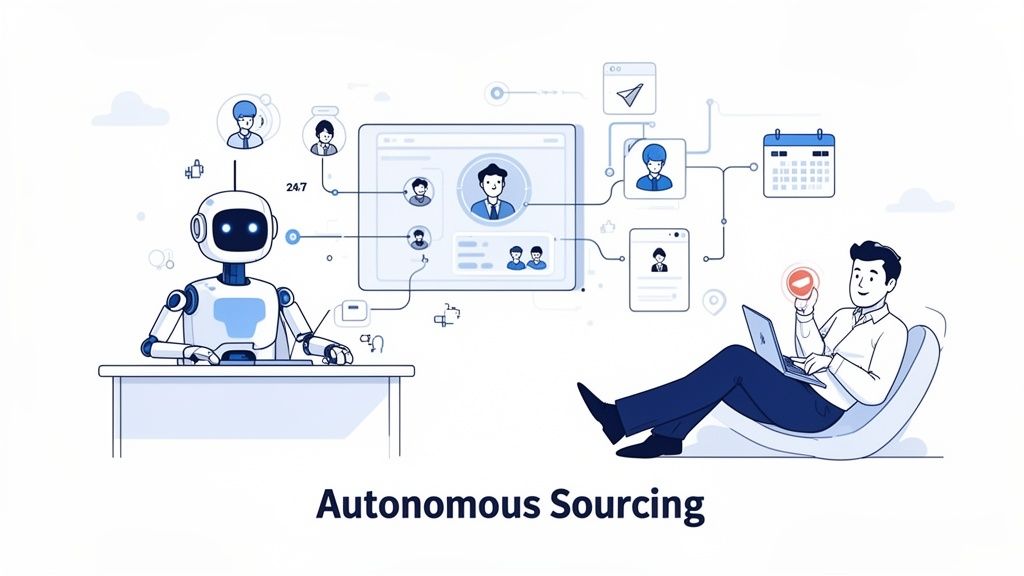
This shift is already underway, but it's just the start. The next big thing is agentic AI—systems that don't just wait for your commands.
Imagine an AI agent working for you around the clock. It’s constantly sourcing candidates for your open roles, learning from your feedback, and refining its searches based on what works. This isn't sci-fi; it's where the industry is headed. The best AI recruiting tools are already building this kind of autonomy.
Is AI people search compliant with GDPR and CCPA?
Yes, top platforms source from public data and have clear opt-out processes to respect all major privacy laws.
Does AI replace the need for human recruiters?
Absolutely not. It supercharges them by handling the time-sucking top-of-funnel work, freeing recruiters to focus on building relationships.
The core benefit of AI-driven sourcing isn't just speed; it's about elevating your entire talent function. When you automate the relentless search for candidates, you unlock your recruiters' true potential to become strategic advisors who forge meaningful connections and secure critical hires. This gives you the power to build a better team, faster and smarter than your competitors, creating a real advantage in any market.
{{large_cta}}
Run your first search for free. Find and engage top talent across 800M+ profiles. Trusted by 5,000+ customers.


.png)