
.svg)
SIGN UP FOR JUICEBOX (IT’S FREE!)

Who are you looking for?
Thank you! Your submission has been received!
Oops! Something went wrong while submitting the form.

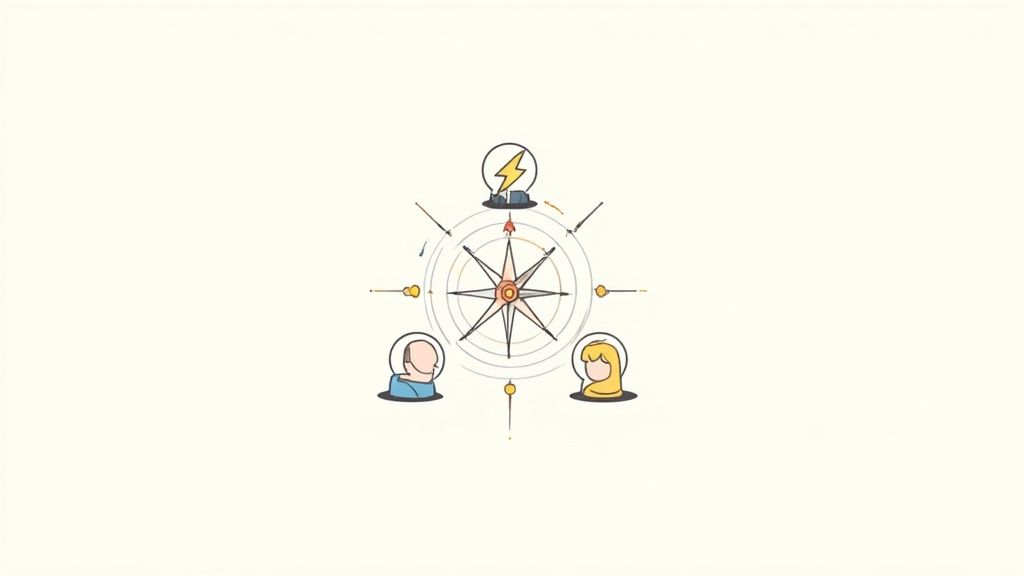
Navigating today's talent pool often feels like being lost in a dense, uncharted maze without a map. AI in recruitment is the modern compass that guides you through it. It provides a data-driven path to the right talent, cutting through the noise to find candidates you would have otherwise missed. A 2025 AI in hiring report from Insight Global found that 99% of hiring professionals are already using it.
Ready to find your way? You can start finding top-tier talent right now with PeopleGPT.
Sifting through hundreds of irrelevant resumes for a single role is exhausting and inefficient. This reactive approach means you're always a step behind, waiting for the right person to stumble into your inbox while your competitors are proactively engaging them. But you can transform this process, cutting sourcing time by over 70% and dramatically improving pipeline quality. The solution isn't just a faster search bar; it's a completely different way of navigating the talent market.
Unlike generic recruiting posts, this guide shows real PeopleGPT workflows—not theoretical advice.
TL;DR: How AI is Reshaping Recruitment
Thinking of AI sourcing as a smarter keyword finder is a common but costly mistake. That's like comparing a simple compass to a full-fledged GPS that maps the entire terrain. Traditional sourcing tools are stuck on keywords, forcing you to guess the exact phrases a perfect candidate might use on their profile. This old method is brittle and limiting. It completely misses high-potential people who describe their experience differently.
AI sourcing works by understanding context, not just words. Long sentences are often used to explain complex ideas, but a short one can make a point stick. It reads between the lines. This fundamental difference is what allows it to uncover talent your competitors will never find.

Here's the deal: AI uses Natural Language Processing (NLP) to interpret millions of data points from over 60 platforms—resumes, professional profiles, project repositories, and more. It learns what a successful career path in a specific domain looks like. For instance, an AI model might learn that top-performing product leaders at tech companies often have early experience in customer-facing roles. A keyword search for "product leader" would never surface those candidates. This contextual understanding is the core mechanism that moves you from a reactive to a proactive recruiting strategy. The focus shifts from finding people who are actively looking to identifying who is truly the best fit, a crucial topic covered in many guides to the best sourcing tools for recruiters.
But there's a problem most tools ignore...
Even with this technology, many platforms still force you into a box of filters and Boolean strings. True generative AI allows you to search the way you think. You can use natural language to describe the exact candidate DNA you're looking for, letting the AI act as your research partner.
PeopleGPT Workflow: Finding Niche Engineering Talent
Prompt: "Find software engineers in the Bay Area who have worked at a FAANG company and a Series B startup, with experience in distributed systems."
Output:
Impact:
Using AI in recruitment is less about incremental speed and more about gaining a decisive strategic advantage. It's the difference between having a compass that points north and one that reveals the fastest, safest, and most efficient route through the entire talent maze. For an experienced talent acquisition professional, this translates into measurable improvements in time-to-hire, quality of hire, and pipeline diversity. It moves you from being a tactical sourcer to a strategic talent advisor.
This isn't a future trend; it's an operational reality. According to TalentLMS (2024), 67% of organizations have already adopted AI in their hiring processes. The reason is simple: it delivers tangible results. Cloud software company Box implemented AI sourcing and slashed their average time-to-source for technical roles by 60% in just six months. They achieved this by letting AI handle the discovery phase, which freed up their recruiters to focus exclusively on engagement and closing.
You might think that focusing on speed compromises quality. But here’s why that’s wrong.
The highest quality candidates are often passive—they aren't actively searching for jobs or updating their profiles with convenient keywords. A legacy tool would miss them entirely. Because AI understands career paths and adjacent skills, it excels at spotting these individuals.
For example, it can identify a data analyst with a history of working on scaling projects as a prime candidate for a "Lead ML Engineer" role, even without the exact title. This capability directly improves your quality of hire by expanding the talent pool beyond the usual suspects.
This is a core principle of people analytics and how it drives business outcomes.
Not all tools waving the AI in recruitment flag are built the same.
It’s a common mistake to lump them all together, but the underlying technology determines everything—from the quality of your candidates to the efficiency of your workflow. Comparing them is like contrasting a basic magnetic compass with a modern GPS. Both provide direction, but only one gives you a detailed, real-time map of the entire landscape. Understanding this distinction is crucial to selecting a tool that actually elevates your strategy.
The myth most recruiters believe is that all AI platforms are just faster versions of LinkedIn Recruiter. The opposite is true.
Most legacy "AI" tools are still fundamentally based on boolean search and keyword filters. They are faster, yes, but they keep you fishing in the same overcrowded pond. OMmodern AI sourcing tools like PeopleGPT (by Juicebox) however, understand natural language and career trajectories, opening up entirely new talent pools.
This difference is explored in-depth in our guide to the top 10 AI recruiting tools for 2026.
| Capability | Traditional Sourcing (Manual) | Legacy AI Tools (e.g., SeekOut) | Generative AI Sourcing (PeopleGPT) |
|---|---|---|---|
| Search Interface | Complex Boolean strings | Keyword-based with filters | Natural language prompts |
| Data Sources | Single platforms (e.g., LinkedIn) | Aggregated professional networks | 60+ platforms, including niche & real-time sources |
| Candidate Qualification | Manual profile review | Keyword & title matching | Contextual analysis of career trajectory & skills |
| Bias Mitigation | Dependent on recruiter awareness | Limited, can reinforce keyword bias | Actively reduces bias by focusing on skills |
| ATS Integration | Manual data entry | Basic ATS/CRM sync | Deep, bi-directional (e.g., Greenhouse, Lever) |
Methodology: This comparison is based on publicly available feature sets and typical user workflows as of Q4 2026. Platforms like SeekOut, HireEZ, and Gem are competitors and this analysis reflects PeopleGPT's differentiated approach.
The takeaway is the leap from matching words to understanding intent. A legacy tool finds profiles that mention "distributed systems." A modern AI candidate search tool like PeopleGPT understands what a career in that field looks like and can spot top talent even if their profile doesn't use that specific phrase.
This isn't just a minor improvement. It’s a fundamental change that gives you a sustainable competitive advantage in the war for talent.
A common fear among experienced recruiters is that AI will strip the humanity from hiring, turning them into machine operators. This completely misses the point of the technology. The AI compass is there to guide you through the wilderness of data, not to pilot the ship. You are still the captain. Your role is to interpret the map, build relationships with your crew, and persuade top talent to come aboard. AI handles the logistics; you handle the people.
It’s a partnership, not a replacement. AI automates the low-value, high-volume tasks that cause burnout—sifting through profiles, identifying initial patterns, and verifying data. This frees you up to focus on what truly matters: understanding a candidate’s motivations, advising a hiring manager, and negotiating a complex offer.
The overwhelming consensus from the market confirms this. While 99% of HR professionals use AI, the same 2025 hiring report (from Insight Global) found that 93% of hiring managers believe human oversight is absolutely essential.
But there's more.
Good AI tools can actually improve candidate experience. Automation ensures communication is timely and relevant, preventing the dreaded "black hole" where applicants never hear back.
No candidate enjoys getting a generic, irrelevant message. AI helps you avoid these classic blunders by enabling personalization at scale, referencing specific projects or skills from a candidate's profile. This demonstrates that you’ve done your homework.
These small efficiencies create a more respectful journey, allowing you to save your direct, personal touch for the high-impact conversations that build genuine connections. Mastering a few key candidate engagement strategies is crucial for turning that AI-driven efficiency into successful hires.
The implication is clear: AI doesn't replace recruiters; it elevates them from tactical sourcers to strategic talent advisors.
No. AI is a compass, not the captain. It automates repetitive tasks like data sifting, freeing you to focus on strategic work like relationship building and closing complex offers, making your expertise more valuable than ever.
Modern AI platforms are designed to reduce bias. By focusing evaluations on objective skills and experience rather than demographic proxies, a well-designed AI system acts as a powerful check against unconscious human bias.
Much faster than you think. Teams often see a significant reduction in sourcing hours within the first month. It’s common for companies to cut time-to-source for difficult technical roles by over 70% in the first quarter.
The compass is in your hands, but it’s your expertise that charts the course. AI provides the navigation, but your ability to interpret the map and lead the journey is what ensures you arrive at the right destination with the best talent. This partnership is the future of recruitment.
{{large_cta}}
Run your first search for free. Find and engage top talent across 800M+ profiles. Trusted by 5,000+ customers.


![The Complete Guide to Talent Pipeline Management [2026]](https://cdn.prod.website-files.com/68c2f83ae8165ab45cf529f8/6953a268c9a0db82016c122a_talent-pipeline-management-workforce.webp)
![The Complete Guide to Employee Reimbursement [2026]](https://cdn.prod.website-files.com/68c2f83ae8165ab45cf529f8/698c5c3c6f51cb7da4cc4641_reimbursement-finance.jpeg)
